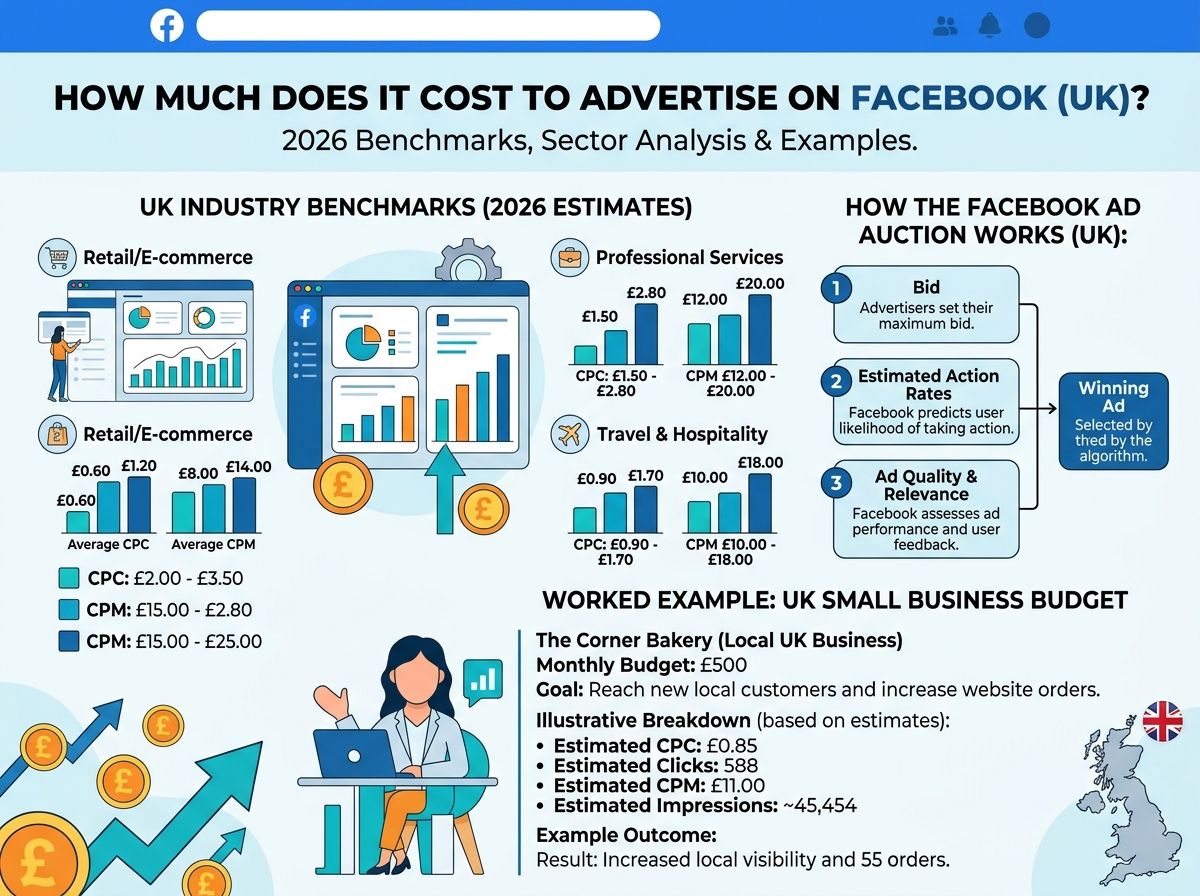
If you’re wondering how much does it cost to advertise on FB, the honest UK answer is: expect to pay somewhere between £5 and £18 per 1,000 impressions (CPM), and £0.50 to £2.00 per click, though your actual figure depends heavily on your industry, audience, and how much competition you’re bidding against. There’s no fixed price list because Facebook, run through Meta, sells ad space via a live auction rather than a set rate card. This guide gives you real UK benchmarks by sector, explains how the auction actually sets your price, and walks through a worked example so you can see what a realistic monthly budget buys you.
How Much Does It Cost to Advertise on Facebook in the UK, Really
Most of the “average cost” figures you’ll find online are global blends, which is a problem because the UK sits above the worldwide average on almost every metric. UK Meta CPMs typically run around £8 to £18 in 2026, compared with a global average closer to £8.50, and that gap widens further in the run-up to Christmas.
For clicks, UK Facebook CPC averages sit between roughly £0.92 and £1.50 for most conversion-focused campaigns, with a median around £1.10 to £1.20 according to recent UK-specific benchmark data. Pure traffic campaigns (where you’re optimising for link clicks rather than a purchase or lead) can come in well under £0.50 a click, since Meta’s system finds it far easier to deliver a click than a completed sale.
Two things drive the UK premium: a smaller addressable audience than the US or India, and a competitive advertiser base bidding for the same eyeballs across a relatively compact population. If you’re comparing your own results to a blog post quoting $0.70 clicks, check whether that figure is US-only before you assume something’s wrong with your account.
Facebook Ads Cost UK: Ranges by Sector
Cost varies enormously by industry because Meta’s auction rewards advertisers whose ads are relevant and engaging, but it also reflects how much each click or lead is actually worth to that business. A finance company can profitably pay far more per click than a low-margin retailer, so it bids accordingly and pushes the price up for everyone in that space.
| Sector | Typical UK CPM | Typical UK CPC | Typical UK CPA (per lead/sale) |
| Ecommerce and retail | £6 to £12 | £0.40 to £1.00 | £10 to £30 |
| Food and beverage | £5 to £10 | £0.35 to £0.90 | £8 to £25 |
| Fashion and beauty | £8 to £16 | £0.50 to £1.20 | £12 to £35 |
| Home services and trades | £7 to £14 | £0.60 to £1.50 | £15 to £45 |
| Finance and insurance | £12 to £22 | £1.50 to £4.00 | £40 to £80+ |
| Legal services | £12 to £20 | £1.80 to £3.50 | £45 to £90+ |
| B2B SaaS and services | £10 to £18 | £1.20 to £2.50 | £25 to £45 |
These are directional ranges pulled from several 2026 UK-focused benchmark reports, not a guarantee of what you’ll pay. Prices shift with the season, so treat the table as a starting point rather than a fixed quote, and check it against your own account data once you’ve got a few weeks of spend behind you.
Reels placements typically run 20% to 35% cheaper on CPC than Facebook Feed, since fewer advertisers compete for that inventory right now. Retargeting your existing website visitors, on the other hand, usually costs 30% to 50% more per impression than cold prospecting, because you’re bidding against your own remarketing pool of a much smaller, warmer audience.
Meta Ads Pricing UK: How the Auction Actually Sets Your Price
Meta doesn’t have a price list because every ad slot is decided by an auction that runs in milliseconds, every time someone opens Facebook or Instagram. Understanding this is the difference between guessing at a budget and setting one that actually works.
When you set up a campaign, you’re not bidding purely on price. Meta combines three things into what it calls Total Value: your bid, your ad’s estimated action rate (how likely that specific person is to convert, based on your creative and their behaviour), and Meta’s own estimate of ad quality. A well-designed ad with a modest bid can beat a poorly targeted ad with a much higher one, which is why two businesses spending the same £2,000 can get very different results.
This means the fastest way to lower your meta ads pricing uk isn’t always to raise your bid. Improving creative relevance, tightening your audience, and giving Meta a clean, working pixel or Conversions API setup often does more for your cost per result than simply spending more.
Minimum Viable Test Budgets
A common mistake is setting a test budget too low to learn anything, then concluding Facebook ads “don’t work” for the business.
As a rough floor, £1,000 to £1,500 a month gives most UK small businesses enough volume to generate meaningful conversion data within a few weeks. Below that, especially for a purchase-optimised campaign, you risk never collecting enough signal for Meta’s system to find your best audience reliably. A realistic test budget for most UK SMBs sits closer to £1,500 to £3,000 a month, run for at least four to six weeks before making a firm call.
There’s a useful formula here: target cost per result × 50 ÷ 7 (the reason for the number 50 is explained next). If your target cost per sale is £20, that’s £20 × 50 ÷ 7, or roughly £143 a day, to have a realistic shot at enough weekly conversions. If that daily figure is beyond your budget, either raise it, set a more realistic cost target, or optimise for an earlier, more frequent event like Add to Cart rather than Purchase.
How Should I Spend on Facebook Ads: The Learning Phase Problem
Every new ad set on Meta goes through what’s called the learning phase, and it consumes a meaningful chunk of your early spend whether you notice it or not.
Meta’s system needs roughly 50 optimisation events (purchases, leads, whatever you’ve chosen to optimise for) within a rolling seven day window before it has enough data to deliver consistently. Until that threshold is reached, your ad set is officially “learning,” and results tend to be volatile: costs might spike one day and dip the next, and none of it is a reliable signal of long-term performance.
If your ad set is only generating 10 to 20 conversions a week, expect it to take two to four weeks to properly exit learning, and don’t judge the campaign harshly during that window. The most common cause of a stuck “Learning Limited” status is simply not enough budget or audience size to hit 50 events a week; the most common fix is consolidating several narrow ad sets into one or two broader ones, since five ad sets each generating 8 events a week will never individually reach the threshold, but combined they might.
It’s also worth knowing that certain changes reset the learning phase back to day one: a budget change over roughly 20%, a change to targeting, or switching your optimisation event. Small creative tweaks and minor budget nudges usually don’t trigger a reset, but if you’re constantly tinkering with a new campaign, you may be the reason it never stabilises.
Facebook Advertising Budget for Small Business: A Worked Example
Numbers are easier to trust with a real scenario, so here’s a plausible example for a small UK ecommerce business selling a £35 product with a 40% margin.
Budget: £1,800 a month (£60 a day), spent on a single consolidated conversion campaign optimising for Purchase.
Expected reach and impressions: at a blended CPM of around £9, £1,800 buys roughly 200,000 impressions across a month. With reasonable frequency capping, that translates to somewhere between 60,000 and 90,000 unique people reached, depending on audience size and overlap between placements.
Expected clicks: at a typical ecommerce CPC of around £0.70, that same £1,800 generates roughly 2,570 clicks to the website over the month.
Expected conversions: assuming a modest 2% landing page conversion rate, a common benchmark for a reasonably optimised ecommerce checkout, that’s roughly 51 sales across the month, or about 12 to 13 a week.
That weekly figure matters because it sits right around Meta’s 50-events-per-week guideline, meaning this budget is close to the minimum needed to properly exit the learning phase within a reasonable timeframe. At £35 a sale and a 40% margin, that’s roughly £1,785 in gross profit against £1,800 spent, which is close to break-even on ad cost alone before accounting for product cost, so a business in this position would want to push for a better conversion rate or a higher average order value rather than assuming the channel isn’t working.
Why Cost Varies So Widely Between Accounts
Two UK businesses in the same industry, spending identical budgets, can get wildly different results, and it’s rarely down to luck.
Audience size and overlap matter more than most advertisers expect. A tightly defined audience of 50,000 people gets exhausted quickly, driving up frequency and cost, while a broader audience of a few million gives Meta’s algorithm more room to find efficient matches. Creative quality is the other major lever: Meta’s delivery system rewards ads that hold attention with cheaper impressions, so a genuinely strong video or image can outperform a mediocre one at the same bid by a wide margin.
Tracking setup quietly shapes cost too. Since Apple’s iOS privacy changes reduced the data Meta receives directly from browsers and apps, accounts with a properly configured Conversions API (sending conversion data server-side rather than relying purely on browser signals) tend to see better event match quality and more efficient delivery. And simple timing plays a real role: the same campaign can cost 35% to 60% more to run in the final quarter, when every retailer bids for the same Christmas shopper.
FAQs
How much does it cost to advertise on Facebook per day in the UK?
There’s technically no minimum beyond a few pounds, but a meaningful test needs at least £30 to £50 a day to generate useful data within a few weeks. For most small UK businesses, £50 to £100 a day is a more realistic starting point for a conversion campaign.
What’s a good Facebook ads budget for a small business in the UK?
A realistic monthly test budget is £1,500 to £3,000, run for at least four to six weeks before judging results. Below roughly £1,000 a month, most conversion campaigns struggle to generate enough weekly events to exit Meta’s learning phase reliably.
Why is my Facebook ads cost per click so high?
The most common causes are a narrow or overlapping audience, weak creative that isn’t holding attention, a highly competitive industry like finance or legal, or running during a high-demand period like Q4. Check your ad relevance diagnostics in Ads Manager first, since a low quality ranking usually points to the fix.
How long does the Facebook ads learning phase last?
It typically lasts about a week if your ad set reaches roughly 50 optimisation events within that window, but it can stretch to two to four weeks if your conversion volume is lower. Frequent changes to budget, targeting, or optimization events will reset the counter, so it’s worth leaving a new campaign alone during this period.
Is Facebook advertising cheaper than Google Ads in the UK?
Generally yes on a cost-per-click basis. UK Facebook CPCs average roughly £0.90 to £1.50, compared with UK Google Search CPCs that often run £2 to £5 or more depending on the keyword, though the two platforms serve different buying intent so a direct comparison isn’t always fair.
Do Facebook ads cost more at Christmas?
Yes, noticeably. UK CPMs can rise 35% to 60% above baseline from October through December as retailers compete for the same holiday shoppers, with some verticals seeing CPMs spike above £25 in December.
What’s the difference between CPM and CPC when budgeting?
CPM is what you pay per 1,000 impressions regardless of clicks, and suits awareness-focused campaigns. CPC is what you pay per click, and is more relevant when you’re optimising for traffic or conversions, since it ties spend more directly to an action rather than just visibility.