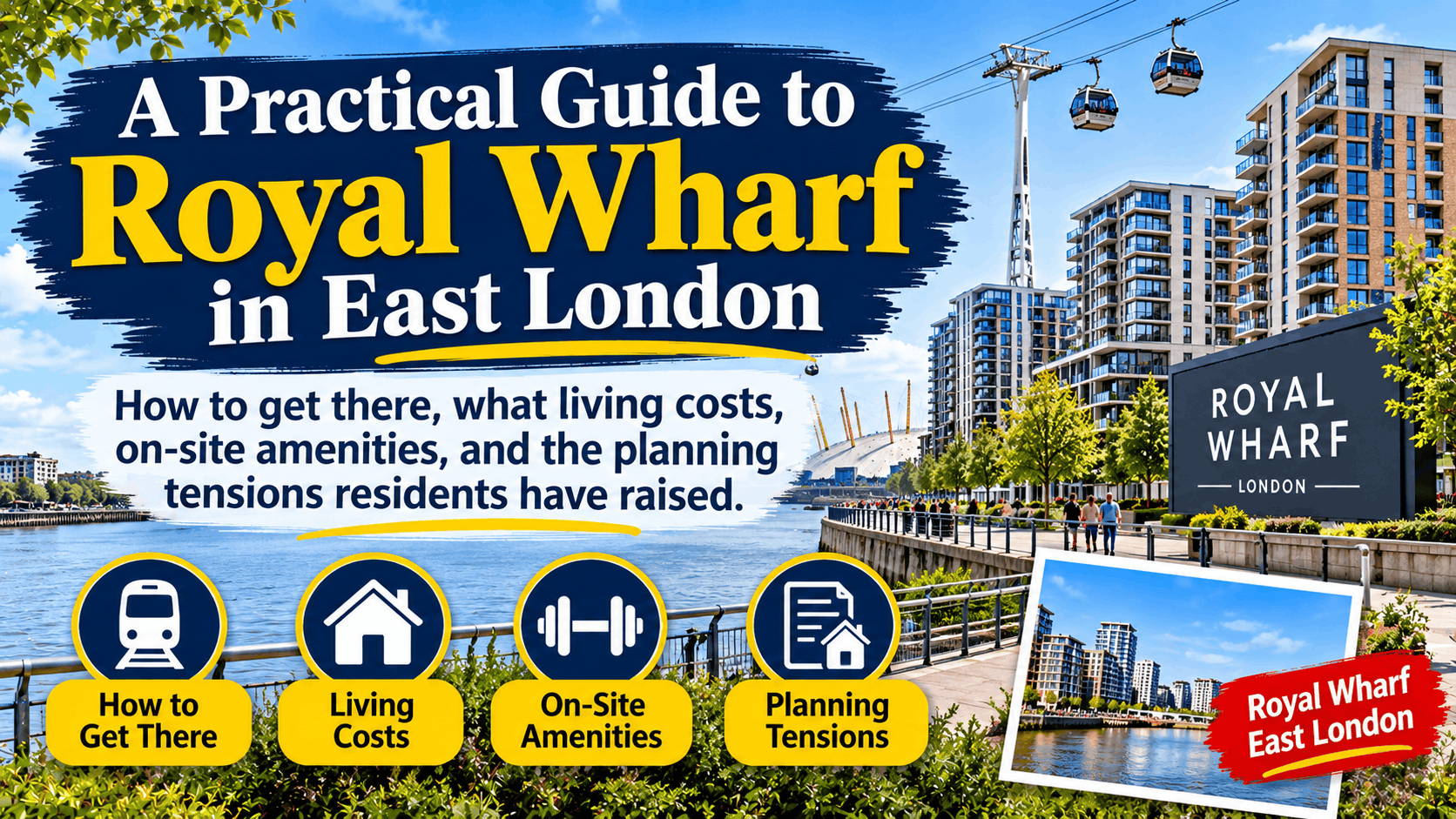
Royal Wharf is a large purpose-built riverside district in Silvertown, East London, within the London Borough of Newham. It is not a tourist attraction or a historic wharf in the traditional sense, but a residential development of around 4,000 homes built on former dockland, now home to roughly 10,000 people. If you are considering living there, visiting someone who does, or simply trying to understand what the place actually is, the useful information is practical: how to reach it, what is on site, what it costs, and the tensions that have emerged as the development has matured.
What Royal Wharf Actually Is
The site covers about 15.2 hectares (37.5 acres) on the north bank of the Thames, between Pontoon Dock and West Silvertown. It was masterplanned by Howells for developers Ballymore and Oxley Holdings, and built out over roughly six years before completion around 2020. The design deliberately borrows from 19th-century London estates: a grid of streets, a high street running through the middle, townhouses alongside taller mansion blocks and riverside towers.
The headline numbers are useful for scale. Around 4,000 homes house approximately 10,000 residents. The development includes a primary school, a nursery, a community centre, a GP surgery, a dentist, a pharmacy, a Sainsbury’s Local, cafés, and a residents’ clubhouse with a 25-metre pool and gym. Royal Wharf Pier, on the Thames, is London’s longest riverboat terminal and is served by Uber Boat by Thames Clippers.
Getting to Royal Wharf: Transport Options Compared
Royal Wharf’s location is one of its strongest selling points, but the transport picture is more nuanced than estate agent listings sometimes suggest.
DLR: The two closest stations are Pontoon Dock and West Silvertown, both on the Docklands Light Railway. Pontoon Dock is roughly an eight-minute walk from the centre of the development . From there, Canning Town is one stop away for the Jubilee line.
Elizabeth line: Custom House station, on the Elizabeth line, is within walking distance, though the walk is longer than to the DLR. Listings routinely cite it as an option, and it materially improves access to central London and Heathrow.
River bus: Royal Wharf Pier puts the development on the Thames Clippers network, which is a genuinely different way to commute or travel into central London.
Bus: Local routes including the 241, 129 and 330 serve the area.
Cycling and walking: The riverside path connects the site towards the Thames Barrier and beyond. The development is car-light by design, with parking primarily for blue badge holders in newer plots.
| Destination | Typical route | Rough journey time |
| Canning Town (Jubilee) | DLR from Pontoon Dock | 1 stop |
| Canary Wharf | DLR via Canning Town or direct DLR | Around 12-15 minutes |
| Bank | DLR and Jubilee | Around 15-20 minutes |
| London City Airport | DLR | Under 10 minutes |
| Heathrow | Elizabeth line from Custom House | Longer but direct |
Journey times are indicative and should be checked against TfL’s live planner before travel.
Living at Royal Wharf: Costs and Practicalities
Because Royal Wharf is a residential development, the most searched questions tend to be about property costs. The figures below are drawn from current listings and should be treated as examples rather than market averages.
A one-bedroom flat at Mercier Court was listed at £340,000, with ground rent of approximately £3,314 per year and a service charge listed at £480 per year, which looks unusually low and may reflect a different charging basis or a listing error. A two-bedroom flat at Liner House was listed at £575,000 with a service charge of £4,925 per year and ground rent of £600. A three-bedroom penthouse at Liner House was listed at £1,150,000 with a service charge of £7,994 per year . Rental listings show a furnished studio at £1,700 per month and a two-bedroom flat at £2,525 per month.
These figures illustrate two things. First, service charges vary significantly between buildings and unit sizes. Second, ground rents on some older leases are substantial. Anyone buying should check the lease terms carefully, including ground rent review clauses, rather than relying on a listing summary.
The residents’ clubhouse is a core part of the offer. It includes a 25-metre swimming pool, a hydro pool, sauna, steam room, and gym, accessible to residents. A 24-hour concierge operates on site.
The Tensions: What Residents Have Complained About
Royal Wharf has not been without controversy, and a useful guide should say so plainly.
In 2026, residents objected to a planning application for a final plot within the masterplan. The objections, recorded in Newham Council’s planning committee minutes, included claims that buyers had been told a plot would remain green open space and that the development was complete. Residents also raised concerns about daylight loss to the primary school and nursery, overcrowding, infrastructure strain on GP services and schools, and antisocial behaviour . The committee approved the application, with councillors noting that mis-selling is not a material planning consideration and expressing sympathy for residents’ distress .
Separate local reporting described residents’ anger over a brochure that depicted a plot as public green space which was later proposed for a 12-storey residential building, with a petition attracting over 500 signatures . Ballymore’s position, as reported, was that the green space vision evolved. These accounts come from residents and local journalism rather than from an independent adjudication, and they should be read as claims and reported concerns rather than established findings of wrongdoing.
The practical takeaway for anyone considering Royal Wharf is not to assume that any remaining open land will stay undeveloped. Check the current planning status of nearby plots with Newham Council’s planning portal if that matters to you.
Is Royal Wharf Worth Visiting or Living In?
For a renter or buyer who values riverside walks, a purpose-built high street, on-site amenities, and quick access to Canary Wharf and the City, Royal Wharf offers a coherent package that many London developments struggle to match. The school and community infrastructure are real, not marketing promises. The river bus stop is a genuine differentiator.
The caveats are equally real. Service charges are significant and variable. The development is dense, and residents have raised legitimate concerns about infrastructure capacity and the gap between marketing and delivery. It is not a historic London neighbourhood and does not pretend to be; it is a new piece of city that is still being finished.
If you are visiting, the riverside path and the pier are the main draws, and the café and shop cluster gives you a reason to linger. If you are considering living there, treat the estate agents’ claims about transport and amenities as a starting point, check service charges and lease terms in detail, and look at the planning applications for any empty plots nearby.
Frequently Asked Questions
How do you get to Royal Wharf?
The nearest DLR station is Pontoon Dock, about an eight-minute walk away . Custom House, on the Elizabeth line, is also within walking distance. Royal Wharf Pier is served by Uber Boat by Thames Clippers, and local bus routes include the 241, 129 and 330.
What are service charges like at Royal Wharf?
They vary widely by building. Current listings show a two-bedroom flat at around £4,853 per year and a three-bedroom penthouse at £7,994 per year . Always check the service charge history and what it covers before buying or renting.
What was the Royal Wharf green space row about?
Residents objected to a 2026 planning application for a final plot, saying a marketing brochure showed it as public green space . The developer said an historic brochure was inaccurate and did not reflect the 2012 consented masterplan . Newham councillors approved the application in March 2026 .
Is Royal Wharf a good place to live?
It depends on what you value. The transport links, riverside location and on-site amenities are genuine strengths. The trade-offs are high service charges, density, and resident concerns about infrastructure and management. Read the planning status of nearby plots and the lease terms carefully before committing.
Is there parking at Royal Wharf?
The development is car-light by design, with parking primarily for blue badge holders in newer plots. If you need a car, check the specific building’s parking provision before proceeding, as it is not guaranteed.