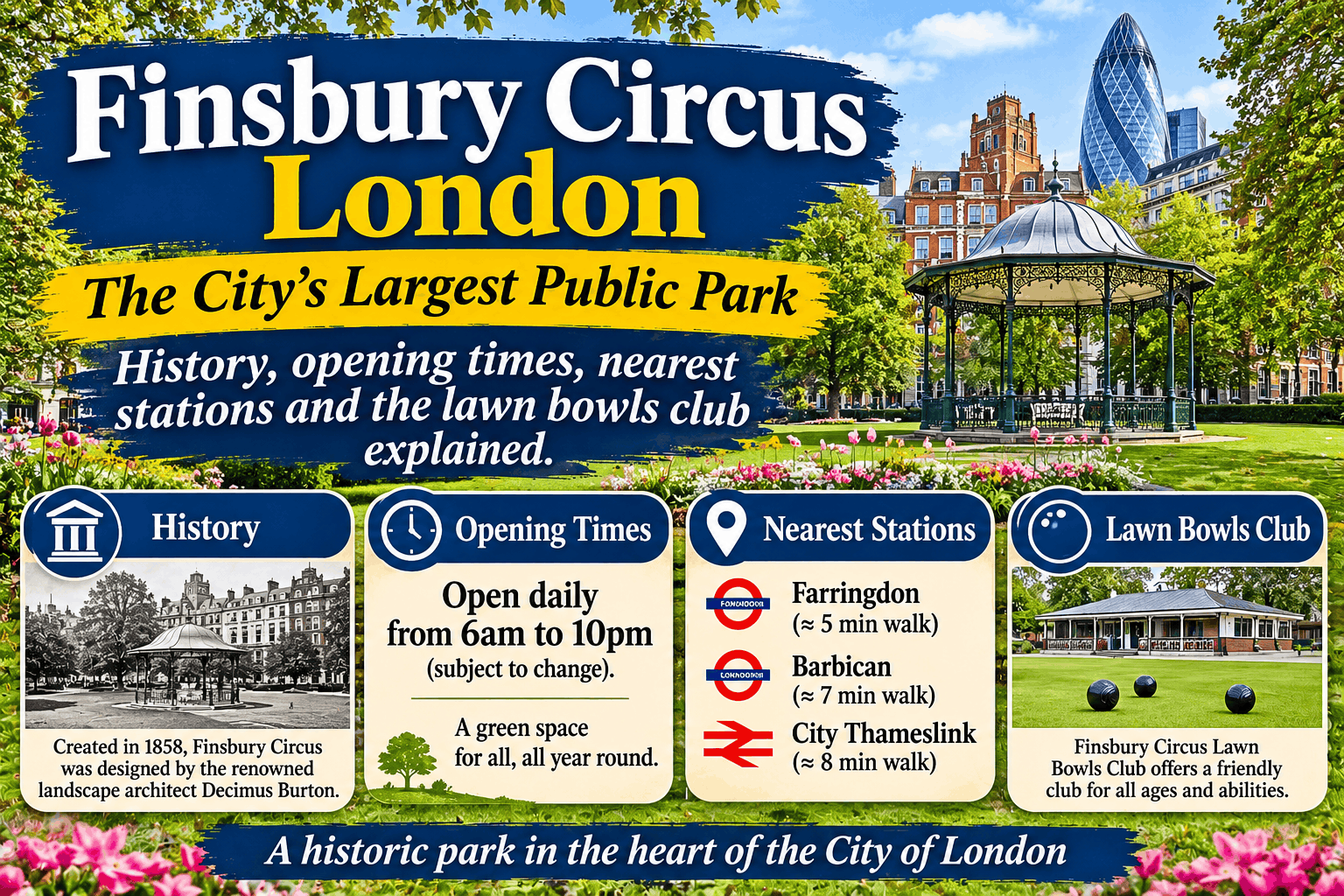
Finsbury Circus is a 2.2-hectare elliptical park in the City of London, and it holds a specific distinction: it is the largest public open space within the City’s boundaries . It is not a circus in the performance sense. The name reflects the oval shape of the space, echoing the circuses of ancient Rome . The gardens are free to enter, open daily from roughly 8am until dusk, and they sit within a few minutes’ walk of both Moorgate and Liverpool Street stations . This guide explains what the park is, its history, and the practical details for visiting.
What You Will Find Inside
The park is a working green space in the middle of the financial district. Its features are modest but distinctive.
The Lawn Bowls club. A bowling green has existed in the gardens since 1925, and it is still in use . On a weekday lunchtime, you may see members playing, which gives the park a surprisingly traditional atmosphere for its location.
The bandstand. Built in 1955, the bandstand sits near the bowling green . In summer, it hosts regular concerts that draw office workers and students looking for a sunny lunch break .
The gardens. The layout, with its circuit of lime trees, was designed by William Montague to the specifications of architect George Dance the Younger in 1815 . The park is immaculately maintained, with lawns and paths that make it suitable for a short walk or a quiet sit.
The History: From Private Garden to Public Park
The site has a layered past. It was created in 1812 on land that had been part of Finsbury Manor, and the second Bethlem Royal Hospital (Bedlam) had stood there since 1675 .
For much of the 19th century, the gardens were a private space for the freeholders and leaseholders of the surrounding buildings. They objected when the City of London Corporation sought to buy the land and open it to the public, fearing that public use would lower property values . The campaign to make it public was led by Alpheus Morton, a deputy Alderman, and the park became known within the Corporation as “Morton’s Park” .
The park was finally opened to the public in the early 20th century under powers granted by the City of London (Various Powers) Act 1900 .
One notable building fronts the northwest quadrant: Britannic House, designed by Edwin Lutyens between 1921 and 1925 for the Anglo-Persian Oil Company (later BP). It is Grade II listed, and its sculptures are by Francis Derwent Wood .
The Crossrail Chapter and Restoration
Finsbury Circus was one of the main worksites for the construction of the Elizabeth Line (Crossrail) at Liverpool Street. From around 2010, the central section of the gardens was taken up to allow the excavation of a shaft for the platform tunnels beneath .
The park has since been restored. A 2026 property report describes the area as “the newly landscaped Finsbury Circus,” and a new office development at 23 Finsbury Circus is being positioned at its entrance, near the Elizabeth Line entrance to Liverpool Street station . The restoration has returned the gardens to public use, and the park is once again a functioning green space rather than a construction site.
Getting There and Opening Times
The park is exceptionally well connected. Moorgate station is the closest Tube stop, about a 3-minute walk away. Liverpool Street Underground is about a 4-minute walk, and Liverpool Street mainline station is about a 6-minute walk .
The gardens are open from 8am to 7pm or dusk, whichever is earlier, and they are closed on Christmas Day, Boxing Day and New Year’s Day . A Trip.com listing gives similar hours (08:00–19:00) . There is no admission charge.
Events: The Midsummer Fayre
The park is used for occasional public events. In July 2026, it hosted the final evening of the Culture Mile Midsummer Fayre on Thursday 9 July, from 5pm to 9pm. The event included live music, a sausage dog walk and dog show, creative workshops, a hog roast and summer refreshments .
This is not a regular weekly market. It is a programmed event, so check the Culture Mile BID website if you are planning a visit around a specific date.
Common Misunderstandings
“It is the same as Finsbury Square or Finsbury Park.” It is not. Finsbury Circus is a distinct park in the City of London. Finsbury Square is just north of the City, and Finsbury Park is several miles away .
“It is a circus venue.” The name refers to the shape, not to performances. There is no big top or circus ring. The “circus” is the elliptical layout of the space .
“It is a tourist attraction with facilities.” It is a public garden. There are no toilets, cafes or visitor centres within the park itself. The surrounding area has plenty of options, but the park is simply a green space.
Frequently Asked Questions
What is Finsbury Circus?
It is a 2.2-hectare public park in the City of London, the largest public open space within the City’s boundaries. It has a lawn bowls club, a bandstand and gardens laid out in the 19th century .
Is Finsbury Circus open to the public?
Yes. The gardens are open daily from 8am to 7pm or dusk, whichever is earlier, except on Christmas Day, Boxing Day and New Year’s Day .
How do I get to Finsbury Circus?
The nearest Tube station is Moorgate, about a 3-minute walk away. Liverpool Street station is about a 6-minute walk for mainline trains and the Elizabeth Line .
What is there to do at Finsbury Circus?
It is primarily a green space for sitting, walking or eating lunch. You can watch the lawn bowls club in season, and in summer there are occasional bandstand concerts. It also hosts programmed events such as the Midsummer Fayre .
Was Finsbury Circus affected by Crossrail?
Yes. The central gardens were used as a worksite for the Elizabeth Line construction at Liverpool Street. The park has since been restored and landscaped .