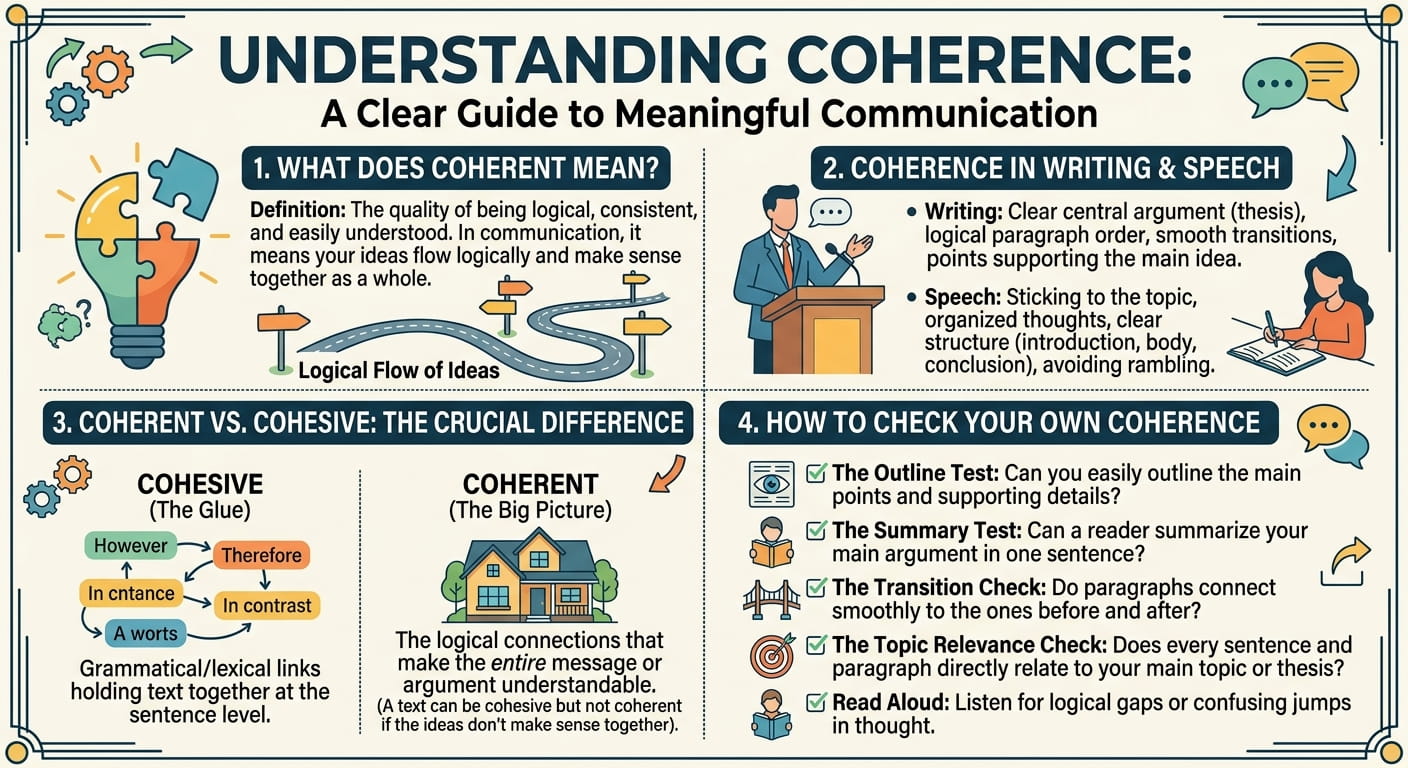
Coherent meaning refers to the quality of being logical, well-organised and easy to understand. When something is coherent, its parts fit together in a way that makes sense as a whole . The word applies to arguments, plans, explanations and even the way a person speaks. This article unpacks the different senses of coherent, explains how it differs from a related term that often causes confusion, and offers practical ways to check whether your own writing or speech meets the standard.
The Core Meaning: Logical and Well Organised
The most common use of coherent describes something that holds together logically. The Cambridge Dictionary defines it as being clear and carefully considered, with each part naturally connected or following from the others . A coherent argument is one where the evidence supports the conclusion without gaps or contradictions. A coherent plan is one where the steps make sense in sequence and serve a clear purpose.
Merriam-Webster offers a simple test: if something is coherent, it is easy to understand . That ease of understanding is not accidental. It comes from the internal structure being sound.
When People Are Coherent
The word also describes a person’s ability to express themselves clearly. If someone is coherent, you can follow what they are saying . The opposite, incoherent, is often used in medical or emergency contexts to describe someone whose speech is confused or difficult to follow, perhaps due to injury, illness or intoxication.
This sense is worth noting because it shows how the word moves between describing things (arguments, plans) and describing people (speakers, writers). In both cases, the underlying idea is the same: there is a clear thread that the reader or listener can follow.
Coherent Versus Cohesive: A Distinction That Matters
These two words are often confused, and the confusion is understandable because they overlap. Both suggest connection. But they point to different qualities.
Coherence is about whether something makes sense as a whole. Cohesion is about whether the parts are well connected on the surface . A text can be cohesive but incoherent. The classic example from linguistics is a sentence that is grammatically well-formed and whose words link together properly, but which describes something nonsensical, such as an octopus being an air-filled curtain with seven heads . The grammar holds. The meaning does not.
A useful shortcut: ask whether the main question is “Does it make sense?” If so, you are judging coherence. If the question is “Do the parts hold together smoothly?”, you are judging cohesion . Strong writing usually needs both, but coherence is the more fundamental requirement. Without it, smooth transitions and elegant linking words are decoration on an empty frame.
Where the Word Comes From
Coherent entered English in the sixteenth century from the Latin cohaerere, meaning to stick together. The prefix *co-* means together, and haerere means to adhere or cling . The original physical sense, of things literally sticking together, is preserved in specialist uses. In physics, coherent waves are waves with a constant phase relationship, which allows them to interfere in predictable ways .
But the figurative sense, of thoughts or arguments holding together, appeared almost as early as the physical one . That longevity suggests the metaphor is natural to how English speakers think about reasoning: a good argument is one whose parts cling together rather than falling apart.
How to Check Your Own Coherence
If you want to test whether a piece of writing is coherent, try these steps.
Summarise the main point in one sentence. If you cannot, the piece may lack a clear through-line. A coherent text has a centre of gravity.
Check whether each paragraph earns its place. Every section should either advance the main point, provide necessary context, or address a genuine objection. Material that does neither is a coherence problem, not just a length problem.
Look for contradictions. A coherent argument does not assert one thing in paragraph two and the opposite in paragraph seven without acknowledging the tension.
Read it aloud. Coherence problems often reveal themselves when spoken. If you find yourself losing the thread, a reader will too.
Coherence Is Not the Same as Correctness
A coherent argument can be wrong. Someone can build a perfectly logical case on a false premise. Coherence is about internal consistency and clarity, not about correspondence to reality. This is why the word is useful in debate and analysis: it allows you to say that an argument holds together without endorsing its conclusion.
Frequently Asked Questions
What does coherent mean in simple words?
Coherent means logical, clear and well-organised. If something is coherent, its parts fit together in a way that makes sense, so you can follow it easily. It can describe an argument, a plan, a piece of writing or a person’s speech. The opposite is incoherent, meaning confused or difficult to understand .
What is the difference between coherent and cohesive?
Coherent is about whether something makes sense as a whole. Cohesive is about whether the parts are well connected on the surface, through smooth transitions and clear links . A text can be cohesive without being coherent, but strong writing usually aims for both. Coherence is the more fundamental quality because it concerns meaning.
What does it mean when a person is coherent?
When a person is coherent, they can express themselves in a clear, understandable way . You can follow their train of thought. The word is often used in medical contexts to describe whether someone’s speech is lucid or confused, but it also applies to everyday situations, such as whether a speaker or writer communicates effectively.
What is the origin of the word coherent?
Coherent comes from the Latin cohaerere, meaning to stick together, from *co-* (together) and haerere (to adhere) . It entered English in the sixteenth century and was used from early on for both physical things that cling together and abstract things, like thoughts or arguments, that hold together logically .
A Practical Habit
The next time you finish a draft, ask yourself the one-sentence question: what is this piece actually saying? If the answer comes quickly and matches what is on the page, you are probably coherent. If you hesitate, the problem is likely structural, not stylistic. Fixing the structure first will do more for your reader than polishing the sentences.