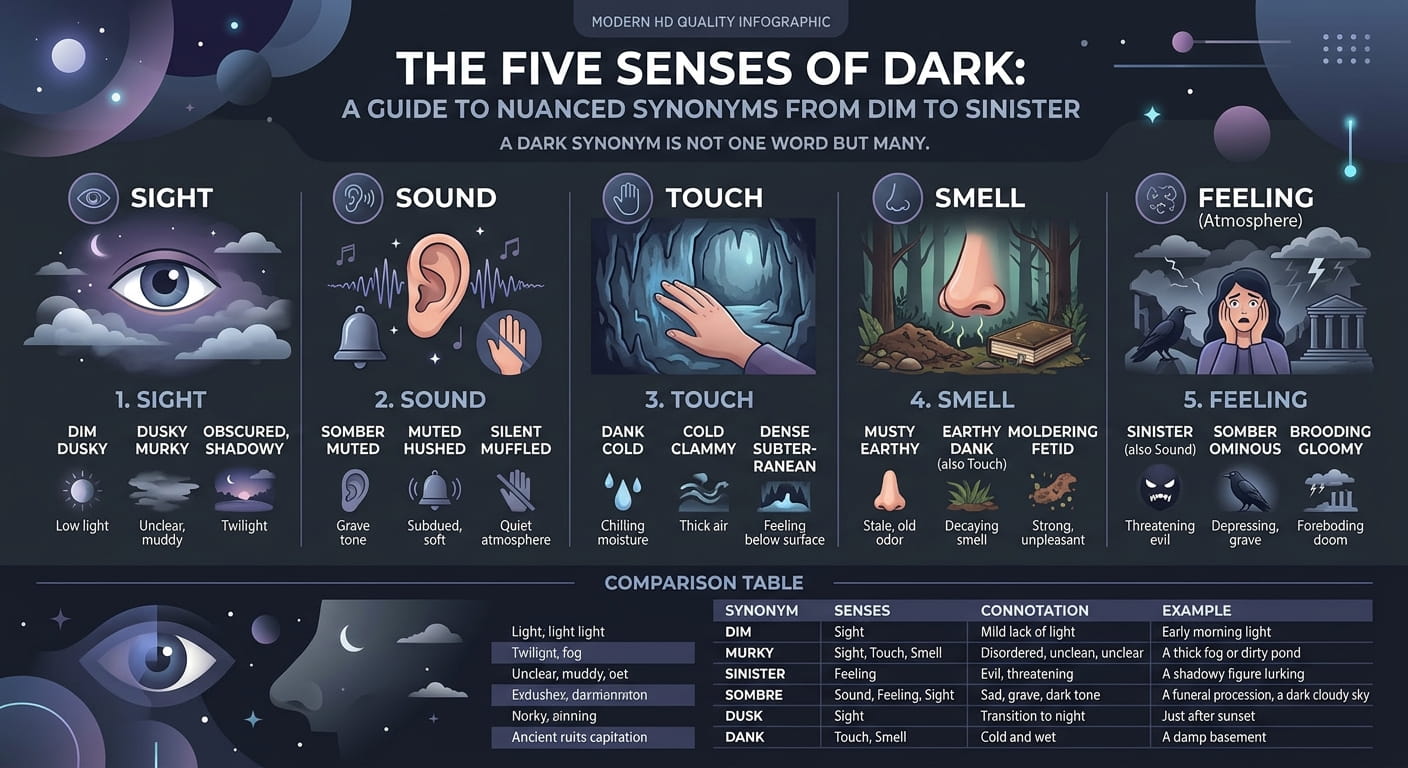
A dark synonym is any word that can replace “dark” in a sentence without losing the intended meaning. The problem is that “dark” does more work than most adjectives. It describes the absence of light, a colour shade, a mood, a moral quality, and a secret. No single synonym covers all of those. Collins Dictionary lists more than forty alternatives for the adjective alone, split across five distinct senses . This article groups the most useful synonyms by meaning, explains which ones suit which contexts, and flags the ones that sound wrong outside a specific register.
The Five Senses of Dark
Before choosing a synonym, decide which sense of “dark” you mean. The Collins Thesaurus organises the adjective into five categories: having little or no light, sinister or evil, secret or mysterious, gloomy or sad, and sullen or angry . A word from one category will usually sound absurd in another.
Sense One: Little or No Light
This is the most literal use. The best synonyms here are the ones that specify a type of darkness rather than just repeating it.
Dim is the mildest. A dim room has light, just not much of it. It carries no emotional weight .
Murky suggests darkness thickened by something else, often water or fog. It implies obscurity as well as low light .
Dusky is a softer, more atmospheric choice, associated with twilight or fading evening light .
Pitch-black is the extreme. It means total darkness, with no qualification .
Tenebrous is the literary option. Dictionary.com defines it as “dark; gloomy; obscure”, and it is the kind of word that appears in descriptions of shadowed corridors and gloomy caves rather than in everyday speech .
Crepuscular is a specialist term meaning relating to twilight. It is accurate but will sound pretentious in most contexts unless you are writing about animals that are active at dusk .
Sense Two: Sinister or Evil
When “dark” describes something morally bad, the synonyms become much stronger. Sinister itself is on the list, along with evil, foul, vile, wicked, and nefarious . These are not interchangeable with the literal sense. Calling a room “nefarious” would be a mistake.
Nefarious is useful for describing actions or schemes rather than atmospheres. It suggests deliberate wrongdoing rather than mere unpleasantness.
Baleful and malevolent appear in broader synonym lists, both carrying a sense of wishing harm . They suit descriptions of looks or intentions.
Sense Three: Secret or Mysterious
This is where many writers go wrong. “Dark” in the sense of hidden or unknown has its own vocabulary: obscure, cryptic, enigmatic, arcane, and recondite .
Obscure is the most flexible. It can mean physically hidden or difficult to understand.
Cryptic suggests deliberate puzzling. A cryptic remark is one designed not to be understood easily.
Arcane implies knowledge that is restricted to a few, often with a hint of the old or ritualistic .
Sense Four: Gloomy or Sad
The emotional sense of dark calls for words like gloomy, bleak, dismal, sombre, melancholy, and cheerless .
Sombre is particularly useful in British English. It describes a mood that is serious and subdued rather than actively sad. A sombre occasion is one marked by gravity, not despair.
Bleak suggests hopelessness as well as darkness. A bleak outlook offers no comfort.
Sense Five: Sullen or Angry
A “dark look” is not just gloomy. It is threatening. Collins offers threatening, forbidding, ominous, and dour .
Dour is a good British choice. It describes a person or expression that is stern and unyielding rather than simply angry.
Ominous implies that something bad is about to happen. It is forward-looking in a way that “dark” is not always.
A Quick Comparison Table
| Sense | Safe choices | Literary or specialist | Avoid in this sense |
| Low light | dim, murky, dusky | tenebrous, crepuscular | nefarious, dour |
| Evil | sinister, wicked, vile | baleful, malevolent | dim, dusky |
| Secret | obscure, cryptic | arcane, recondite | gloomy, bleak |
| Sad | gloomy, bleak, sombre | melancholy | sinister, evil |
| Angry | threatening, ominous | dour | murky, dim |
The Noun Form: Darkness
The noun “darkness” has its own set of synonyms, and the same rule applies: choose by sense.
For physical absence of light, Collins lists shadows, gloom, obscurity, blackness, duskiness, and shadiness . Gloom is the most versatile of these. It can describe both literal dimness and emotional low spirits.
For the time of day, night, dusk, nightfall, and twilight are the natural alternatives . “Darkness fell” becomes “night fell” or “dusk fell” without loss.
For the sense of secrecy or ignorance, secrecy, mystery, ignorance, and blindness appear in the Collins entry . “In the dark” about something becomes “in ignorance” or “unaware”, though the latter is a paraphrase rather than a direct synonym.
Common Mistakes
Using a literal synonym in a figurative sentence. “He had a dim plan” is not the same as “he had a dark plan”. Dim suggests weakness or stupidity, not moral menace.
Assuming all synonyms are equally common. Tenebrous and crepuscular are perfectly good words, but they belong in fiction, poetry, or deliberately literary prose. Using them in a business email will read as affectation.
Forgetting the British preference for certain forms. Sombre is the standard British spelling, not “somber”. Grey is British, gray American. Collins lists both grey and gray in the literal sense , but a UK publication should use grey.
Reaching for the most obscure option. The fact that a word exists does not mean it improves a sentence. Dim is often the right choice. Gloomy is often the right choice. Obscurity is not a virtue in itself.
Frequently Asked Questions
What is a synonym for dark?
It depends on the sense. For low light, use dim, murky, dusky, or pitch-black. For evil, use sinister, wicked, or vile. For secret, use obscure, cryptic, or arcane. For sad, use gloomy, bleak, or sombre. For angry, use threatening, ominous, or dour. Collins Thesaurus groups the adjective into these five distinct senses, and the synonyms are not interchangeable between them .
What is a better word for dark and gloomy?
Sombre is a strong British choice for a mood that is dark and serious. Bleak suggests hopelessness as well as gloom. Dismal and dreary are more everyday options. If you want a single word that carries both literal darkness and emotional weight, gloomy does the job without sounding forced.
What is the opposite of dark?
The direct opposite is light or bright in the literal sense. For the emotional sense, cheerful or hopeful works. For the sense of evil, good or benevolent. For the sense of secret, clear or open. The antonym depends on which sense of dark you are using, just as the synonym does.
Is tenebrous a common word?
No. Tenebrous is a literary or formal word meaning dark, gloomy, and obscure. It comes from the Latin tenebrosus, meaning darkness, and has been in English since the late Middle Ages . It is useful in fiction or atmospheric description, but it would sound out of place in ordinary conversation or most professional writing.