
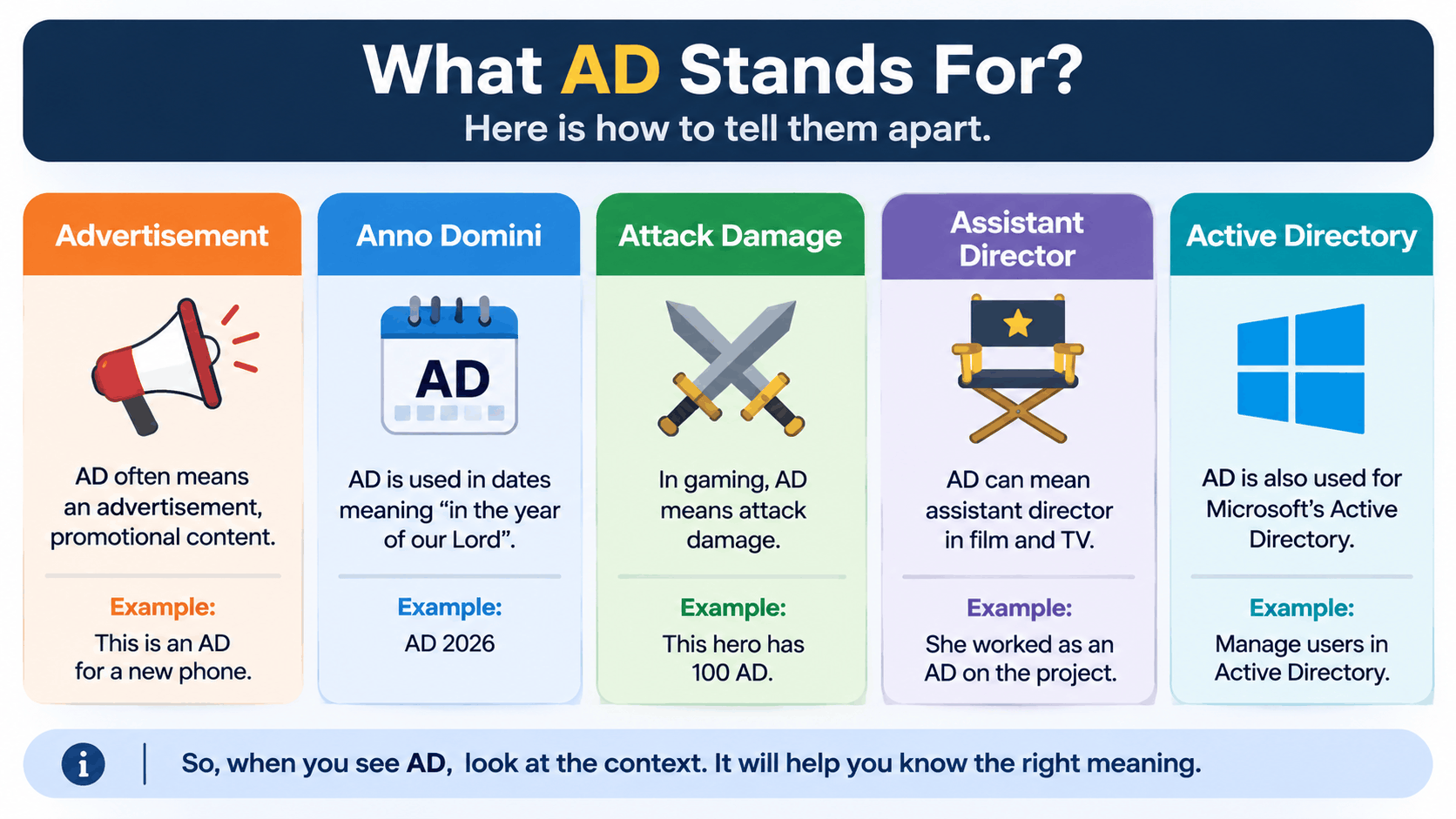
What stands for AD depends entirely on where you see it. In lowercase, ad is short for advertisement, and it is now more common in British English than the full word . In uppercase, AD is most often Anno Domini, the Latin phrase meaning “in the year of the Lord,” used to label years in the Christian calendar . Beyond those two, AD appears as Attack Damage in gaming, Assistant Director in job titles, and Active Directory in IT. This guide explains each meaning, how to tell them apart, and the one formatting rule that matters for the calendar use.
The Two Most Common Meanings: Advertisement and Anno Domini
These two account for the vast majority of uses, and the difference between them is often a matter of capitalisation.
Ad (lowercase) means advertisement. Fowler’s Dictionary of Modern English Usage notes that “ad” is a frequent abbreviation of advertisement or advertising, first recorded in 1841 and now in very widespread use. It is, by a considerable margin, the most common of the three forms: ad, advert, advertisement. Fowler’s argues that while some dictionaries still label it “informal,” it is more accurate to say that both “ad” and “advert” are the standard forms in speech, while “advertisement” is slightly formal . In the Oxford English Corpus, “ad” is more than three times as frequent as “advertisement” .
AD (uppercase) means Anno Domini. This is Latin for “in the year of the Lord,” and it is used to label years following the supposed date of the birth of Jesus . The formatting rule is specific: AD should be placed before the numeral, so you write AD 44, not 44 AD . The exception is when referring to a century: “the third century AD” is customary for convenience, to correspond with “the third century BC” . In print, AD is often set in small capitals, without full stops, with a space between it and the numeral .
The alternative to AD is CE (Common Era), which is often used as a culturally neutral equivalent, along with BCE for Before Common Era . If you are writing for an audience that prefers secular dating, CE is the safer choice.
AD in Gaming: Attack Damage
If you are reading about video games, particularly MOBAs like League of Legends or Dota 2, AD almost certainly stands for Attack Damage. Esports Wales defines it as one type of damage that can be done to enemy champions, alongside Ability Power and True Damage . It refers to the damage dealt by basic attacks and by items or abilities that scale with attack damage rather than ability power.
This is a context-specific abbreviation. It would be confusing to use it outside a gaming discussion, and it has nothing to do with the calendar or advertising.
AD in Jobs: Assistant Director and Art Director
In professional contexts, AD commonly stands for Assistant Director or Art Director. Acronym Finder lists both, along with Athletic Director . The film and television industry uses “Assistant Director” for the crew member who manages logistics on set. Publishing and design use “Art Director” for the person in charge of visual style.
Which one it means depends on the industry. A film call sheet uses the first. A magazine masthead uses the second. If you see “AD” in a job title and the context is unclear, the full title is usually spelled out elsewhere in the document.
AD in Technology: Active Directory
In IT and Microsoft environments, AD stands for Active Directory, the component of Windows that provides distributed user management and authentication . It is the system that lets organisations manage users, computers and permissions across a network.
This is a technical abbreviation that appears in job descriptions, support tickets and documentation. It is not interchangeable with the other meanings, and using “AD” to mean “advertisement” in an IT context would cause confusion.
Other Meanings Worth Knowing
The full list of AD meanings runs to dozens. The Free Dictionary’s acronym page lists well over a hundred, including Adult, Administration, Alzheimer’s Disease, Analog-to-Digital, Airworthiness Directive, Accidental Discharge and Andorra (the country code) . Acronym Finder lists 84 other meanings in its “Acronym Attic” .
In medicine, AD can mean Alzheimer’s Disease, Addison’s Disease, Atopic Dermatitis or Autosomal Dominant . In the pharmaceutical world, AD is a qualifier for “administration & dosage” . In military contexts, it can mean Active Duty or Air Defense .
The practical point is that no single answer is correct without context. The abbreviation is a container, and the meaning is supplied by the surrounding words.
How to Tell Which AD You Are Looking At
The context almost always resolves it. These are the reliable signals.
| Context | Likely meaning |
| A commercial, marketing, or media text | Advertisement |
| A historical date, especially before a year number | Anno Domini |
| A gaming discussion, especially MOBAs | Attack Damage |
| A film credits list or job posting | Assistant Director |
| A magazine masthead or design team | Art Director |
| IT documentation or Microsoft support | Active Directory |
| A medical record or clinical discussion | Alzheimer’s Disease, Addison’s Disease, or another medical term |
If the context does not resolve it, the abbreviation is being used poorly. A well-written document will spell out the full term on first use.
Frequently Asked Questions
What does AD stand for?
It depends on context. The most common meanings are Advertisement (usually lowercase “ad”) and Anno Domini (uppercase, referring to the calendar) . In gaming, it means Attack Damage . In jobs, it can mean Assistant Director or Art Director . In IT, it means Active Directory .
Is it AD or ad for advertisement?
Lowercase “ad” is the standard form for advertisement. It is now more common in British English than the full word . Uppercase “AD” is more commonly associated with Anno Domini or with job titles, so the capitalisation helps distinguish the meanings.
Where does AD go in a date?
AD goes before the year: AD 44, not 44 AD . The exception is when referring to a century, where “the third century AD” is standard. In print, AD is often set in small capitals with a space before the numeral .
What is the difference between AD and CE?
AD is Latin for “in the year of the Lord” and is explicitly Christian in origin. CE stands for Common Era and is used as a culturally neutral alternative . Both refer to the same dating system, and the choice between them is a matter of audience and convention rather than a difference in meaning.