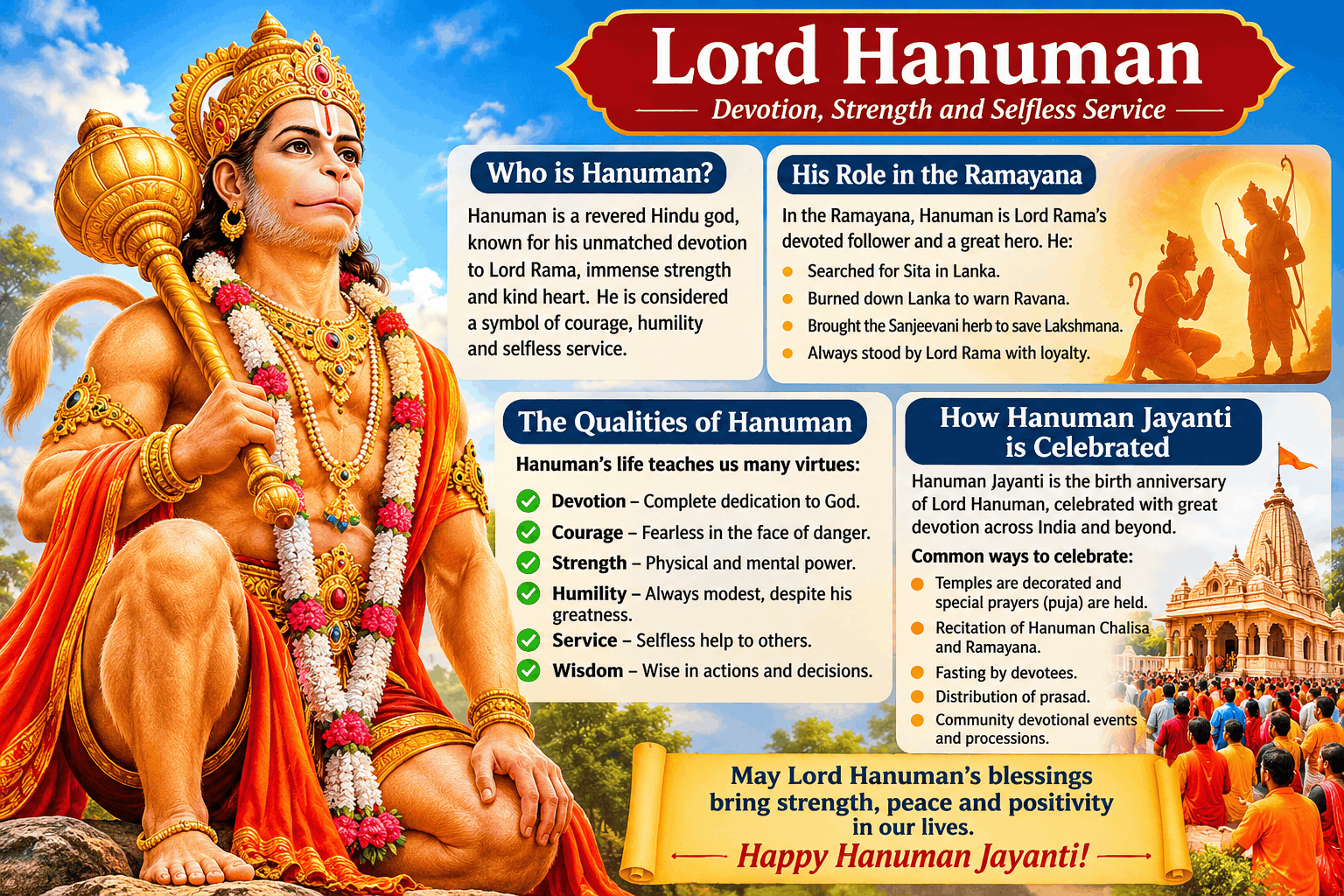
Hanuman the god is one of the most beloved figures in the Hindu pantheon, a divine monkey who embodies strength, courage and, above all, selfless devotion to Lord Rama. He is a central character in the epic Ramayana, where he serves as Rama’s most trusted ally in the rescue of Sita from the demon king Ravana . He is also one of the chiranjivis, beings believed to be immortal and present in the world across ages . This guide explains his origins, his role in the epic, the qualities that make him unique, and the practical ways he is worshipped today, including the festival of Hanuman Jayanti.
The Origins and Birth of Hanuman
Hanuman’s parentage is layered. He is described as the son of Anjana, an apsara (celestial nymph) who was cursed to live on earth as a monkey, and Kesari, the king of the Vanara tribe . He is also closely linked to Vayu, the wind god, who in several stories played a direct role in his birth, earning Hanuman the name Pavan Putra, meaning “son of the wind” .
The Vanara tribe, to which Hanuman belongs, is often translated as a clan of monkeys, but some sources describe them as upa-devatas, or demi-deities . This distinction matters: Hanuman is not merely an animal character in a story. He is a divine being with a specific role in the cosmic order.
Hanuman in the Ramayana: The Devoted Warrior
Hanuman’s defining role is in the Ramayana. When Sita, Rama’s wife, is abducted by Ravana, Hanuman becomes the crucial link between Rama and the rescue mission . His most famous acts include:
The leap to Lanka. Hanuman crosses the sea to the island of Lanka to find Sita, a feat of immense physical power that gives him the title “the Herculean leap” .
The burning of Lanka. When his tail is set alight, Hanuman uses it to set the demon city ablaze, demonstrating both his power and his resourcefulness.
Bringing the mountain. When Lakshmana is wounded and needs a specific herb, Hanuman carries an entire mountain to the battlefield because he cannot identify the correct plant.
These stories establish him as a warrior of unmatched strength. But the source of that strength is the key to understanding him.
The Qualities That Define Hanuman
The Book of Hanuman describes him as “an outstanding scholar, a fearless warrior, and the ideal lieutenant: intelligent, totally committed to his master, selfless and humble” . He represents four divine attributes: akhand brahmacharya (lifelong celibacy), immense physical prowess, command of the scriptures, and dasya bhakti, which is worship through service .
His power is inseparable from his devotion. A spiritual lecture on Hanuman makes the point that his “infinite strength was accompanied by immeasurable humility” . He is always depicted with folded hands, in an attitude of service. The same lecture argues that strength allied with dharma and devotion becomes “fruitful in immortal glory,” while strength corrupted by ego, as in Ravana, leads to downfall .
The Devotion and Power of the Monkey God adds a symbolic layer: as a monkey, Hanuman represents the “ever-restless human mind.” He teaches that anyone can attain spiritual heights through perseverance and discipline, and that the mind, perfected through devotion, can achieve its highest potential .
Hanuman Jayanti: The Festival of His Birth
Hanuman Jayanti celebrates his birth and is observed on the full moon day (Purnima) of the Hindu month of Chaitra . In 2026, it was celebrated on 2 April .
The festival is marked by devotees waking early, bathing, and applying sindoor (vermilion) to Hanuman idols, a tradition believed to please him . Red flowers, fruits, and sweets are offered. The Hanuman Chalisa, a forty-verse hymn composed by Tulsidas in the sixteenth century, is recited, along with the Sundar Kaand . Temples hold spiritual discourses from dawn, because Hanuman is believed to have been born at sunrise .
The Chalisa is central to his worship. It is described as the most popular hymn in praise of Hanuman, recited by millions of Hindus every day . It details his strength, courage, wisdom, celibacy, and devotion, and it is chanted for protection and to overcome obstacles .
Why Hanuman Remains So Accessible
One source describes Hanuman as “perhaps the most accessible deity in the Hindu pantheon” . The reasons are worth understanding.
He is easy to please. A text on his legendary story notes that “even a small prayer to him would please the Lord” . This accessibility contrasts with deities who require elaborate rituals.
He is a model of service. His relationship with Rama is one of total surrender. As the lecture puts it, “There is no Rama without Hanuman” . For devotees, Hanuman is the path to Rama, the mediator who grants access to the divine.
He protects. He is invoked as Sankat Mochan, the remover of obstacles and protector from negative energies . This practical role makes him a daily presence in the lives of his devotees.
He is a symbol of potential. The monkey mind, restless and undisciplined, becomes through devotion a vehicle for spiritual achievement . Hanuman is not a distant god but a model for what a devotee can become.
Frequently Asked Questions
Who is Hanuman the god?
Hanuman is a Hindu deity, a divine monkey who is a central character in the Ramayana and one of the chiranjivis (immortal beings). He is the son of Anjana and Kesari, and is closely associated with Vayu, the wind god. He is revered for his strength, courage and selfless devotion to Lord Rama .
What is Hanuman the god of?
He is associated with strength, courage, devotion, service and protection. He is invoked as Sankat Mochan, the remover of obstacles, and is considered a protector from negative energies. He is also a symbol of the mind perfected through discipline and devotion .
Why is Hanuman depicted as a monkey?
He is born into the Vanara tribe, a clan described as monkeys or demi-deities. Symbolically, the monkey represents the restless human mind. Hanuman teaches that this restless mind can attain spiritual heights through perseverance and devotion to a higher purpose .
What is Hanuman Jayanti?
Hanuman Jayanti is the festival celebrating Hanuman’s birth. It is observed on the full moon day of the Hindu month of Chaitra. In 2026, it was celebrated on 2 April. Devotees apply sindoor to idols, recite the Hanuman Chalisa, and offer red flowers and sweets .