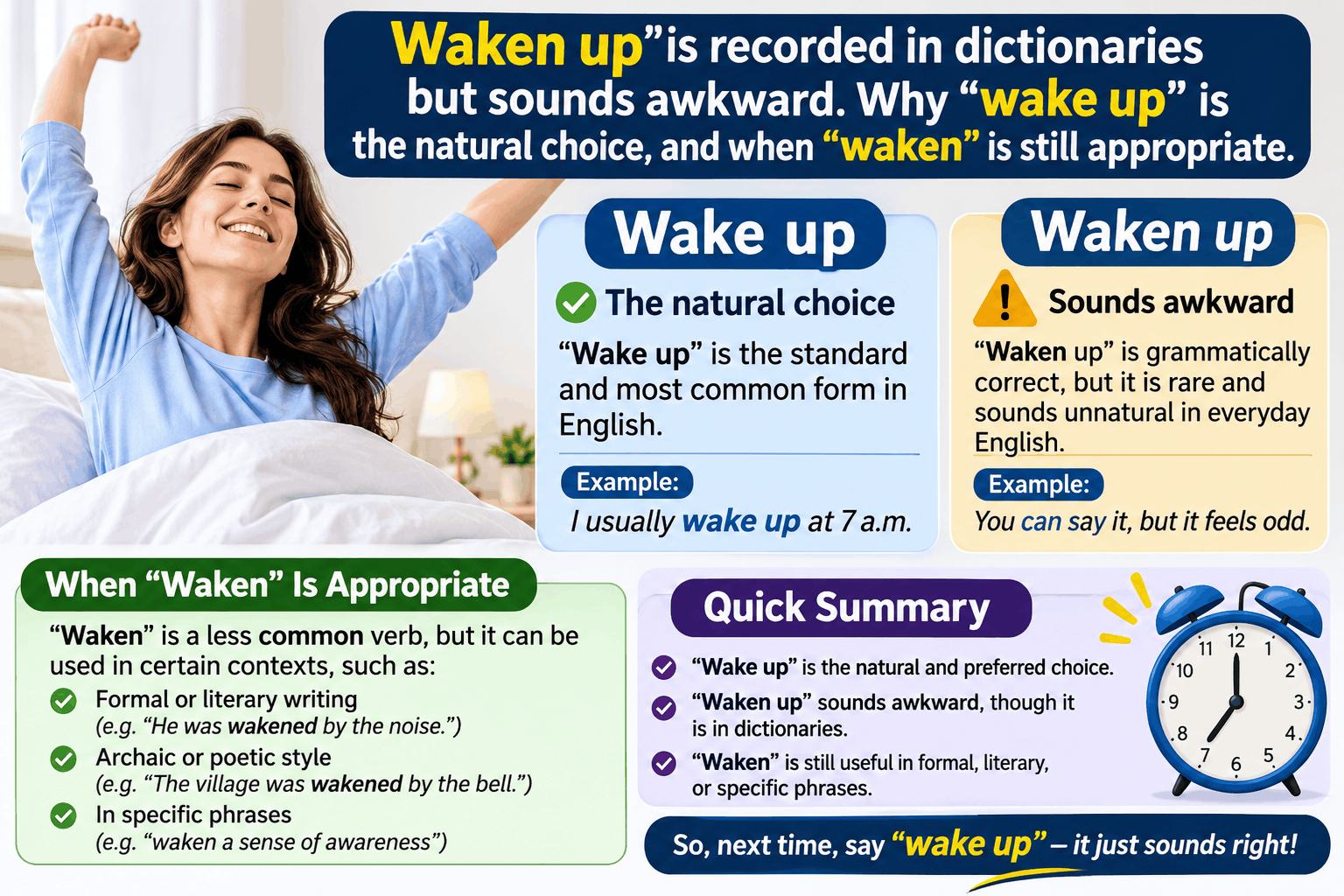
“Waken up” is a phrase that sits in an uncomfortable middle ground. It is not the standard way to say “wake up,” but it is not a simple mistake either. The verb “waken” exists, and dictionaries do record “waken up” as a valid construction meaning the same as “waken” . However, style guides and usage authorities are clear that “wake up” is the ordinary, natural form, while “waken” is formal or literary, and the addition of “up” to it is unusual . This guide explains what “waken up” means, why “wake up” is almost always the better choice, and the specific contexts where “waken” still appears.
The Meaning: Same as “Waken” and “Wake Up”
If you encounter “waken up,” it means to wake from sleep or to cause someone to wake from sleep. Collins Dictionary explicitly states that “waken up means the same as waken,” and gives the example: “Drink this coffee, it will waken you up” . Another dictionary entry confirms the same: “Waken up means the same as waken” .
So the meaning is not in doubt. The issue is usage. “Waken up” is not incorrect in the way that “I goed” is incorrect. It is a construction that exists but is rarely used, and its rarity makes it sound strange to most native ears.
Why “Wake Up” Is the Better Choice
The Oxford Reference guide to the verbs wake, awake, waken and awaken makes the hierarchy clear. It states that wake is “the only one to be followed optionally by up” . This is a significant point. The particle “up” belongs with “wake,” not with the other three verbs.
The same guide notes that wake is used “about four times as often as the others combined” . It is the ordinary working verb. Awake, awaken and waken “often have a tinge of formality or literariness not present in wake” .
The Oxford Advanced Learner’s Dictionary reinforces this: “Wake (up) is the most common of these verbs. … Waken and awaken are much more formal. Awaken is used especially in literature” .
The practical conclusion is straightforward. If you want to sound natural in British English, use “wake up.” It is the form that everyone uses, it is understood instantly, and it does not carry the literary weight of “waken.”
Where “Waken” Still Appears
“Waken” is not obsolete. It appears in specific registers where its formality or literary quality is appropriate.
In literature and formal writing. The Longman Dictionary marks “waken” as “literary” and gives examples like “She gently wakened the sleeping child” . The Australian Writers’ Centre notes that waken and awaken are more “literary” sounding than wake .
In older texts or translations. You may encounter “waken” in poetry, hymns, or older prose. It has a slightly archaic or elevated feel.
In some regional or dialect usage. The forms of these verbs have varied across time and place, and “waken” may still appear in some spoken varieties.
In the fixed phrase “waken up.” The dictionaries that record it do so as a variant of “waken,” not as a separate idiom. It is not a phrase with its own distinct meaning.
The Verb Forms
If you are writing and need the past tense or past participle, the forms are:
| Present | Past | Past Participle |
| wake | woke | woken |
| waken | wakened | wakened |
| awake | awoke | awoken |
| awaken | awakened | awakened |
Source: Australian Writers’ Centre .
“Waken” is a regular verb, so it takes “-ed” for both the past tense and the past participle. “Wake” is irregular, with “woke” and “woken.” This is another reason “wake up” is simpler: its forms are more familiar.
A Note on “Woken Up”
“Woken up” is correct and standard. It is the past participle of “wake up.” For example: “I was woken up by the phone” . This is the passive construction, and it uses “wake,” not “waken.” The Guide to Grammar and Writing confirms that the passive forms are “woken/awoken/woken up” .
So the correct forms are:
- Present: I wake up / I waken (formal) / I am wakened (passive)
- Past: I woke up / I wakened (formal)
- Perfect: I have woken up / I have wakened (formal)
- Passive: I was woken up / I was wakened (formal)
Frequently Asked Questions
Is “waken up” correct?
It is recorded in dictionaries as meaning the same as “waken,” so it is not strictly incorrect . However, it is not the standard or natural form. The ordinary phrase is “wake up.” “Waken” is formal or literary, and adding “up” to it is unusual.
What is the difference between “wake up” and “waken up”?
The meaning is the same: to stop sleeping or to cause someone to stop sleeping. The difference is register. “Wake up” is the everyday form used by most people. “Waken up” is formal, literary, and rare. For any normal conversation or piece of writing, use “wake up.”
Which is correct: “wake up” or “waken up”?
Both can be defended, but “wake up” is the clear recommendation. Oxford Reference states that wake is the only one of the four verbs to be followed by up, and that it is used four times as often as the others combined . “Waken up” sounds awkward to most native speakers because it combines a formal verb with a particle that belongs to the informal one.
What does “waken” mean?
“Waken” means to wake from sleep or to rouse someone from sleep. It is a formal or literary synonym for “wake.” The Longman Dictionary labels it “literary” . It is more common in writing than in speech, and it is rarely used with “up” in modern British English.