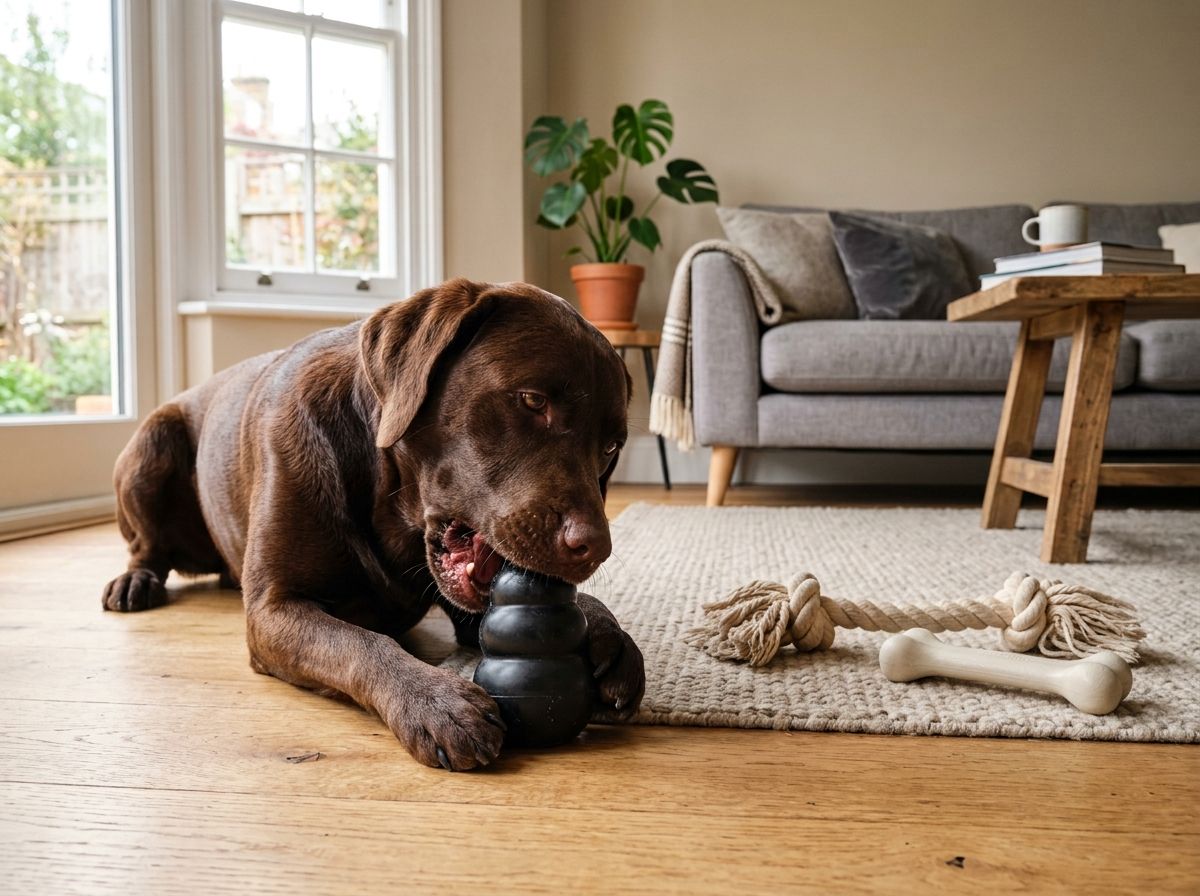
If your dog can destroy a toy in under ten minutes, you’re not imagining it: some dogs chew far harder than others, and most toys on the shelf simply aren’t built for it. The best dog toys for chewers are made from solid natural rubber, reinforced nylon, or thick rope, with no stuffing, squeakers, or loose parts that come apart under pressure. Brands like KONG Extreme and Nylabone Extreme Chew consistently outlast standard toys for power chewers, though no toy is truly indestructible.
This guide covers what “chew-proof” actually means, typical UK prices, the mistakes that lead to wasted money (or worse, a vet bill), and how to match a toy to your dog’s chewing strength.
What Counts as a “Chewer” Dog
Not every dog that chews needs a heavy-duty toy. Vets and trainers generally sort chewing into three levels:
- Light chewers mouth toys gently, mostly for comfort or play, and rarely cause damage.
- Moderate chewers apply steady pressure and will wear down softer toys over weeks or months.
- Power chewers, often larger breeds or working dogs like Staffordshire Bull Terriers, Labradors, and German Shepherds, can tear through plush toys and even standard rubber in minutes.
If you’re not sure which category your dog falls into, watch how quickly they get through a basic rope toy. Gone in a single sitting usually means power chewer.
What Makes a Toy Genuinely Durable
Three things separate a toy that survives from one that doesn’t: material, construction, and size relative to your dog’s jaw.
Material
Solid natural rubber (used in KONG’s Extreme and Classic ranges) flexes under bite pressure rather than shattering, which is why it holds up better than hollow plastic. Nylon chews, such as Nylabone’s Extreme range, resist punctures well but can be harder on teeth if your dog bites down aggressively rather than gnawing. Rope toys wear down through fraying rather than snapping, which makes them easier to monitor for safe replacement timing.
Construction
Look for single-piece moulded designs over glued or stitched components. Anything with a squeaker, stuffing, or plastic eyes is a choking risk for a determined chewer, regardless of how tough the outer material feels.
Size
A toy that’s too small for your dog’s mouth is both a choking hazard and easier to destroy, since a smaller surface area concentrates bite force. As a rule of thumb, if your dog can fit the entire toy in their mouth at once, size up.
What Chew Toys for Power Chewers Actually Cost in the UK
Prices vary a fair bit by size and brand, so treat these as a general guide rather than fixed figures, since prices change often and are worth checking on the retailer’s site before you buy.
KONG Extreme toys start from around £7.59 for the smallest size and rise with dog size, according to <cite index=”32-1″>KONG’s own UK product listing</cite>. Larger sizes such as XX-Large typically run higher, and stockists including Pets at Home and PetPlanet carry the full size range.
Nylabone Extreme Chew toys sit in a broadly similar bracket to KONG, with bacon and cheese-flavoured dental versions among the most popular according to <cite index=”22-1″>a UK roundup of chew toys, which also noted a customer report of the toy surviving a strong-chewing Labrador</cite>.
Rope and tug toys from specialist retailers such as Lords & Labradors tend to sit in the £8 to £20 range depending on size, and many UK pet shops offer free delivery over a spending threshold, commonly around £40 to £75.
Premium indestructible ranges, such as newer nylon-based products from smaller specialist brands, often cost more, sometimes £20 or above per toy, reflecting denser materials engineered specifically for aggressive chewers.
None of this is genuinely indestructible. Even KONG states plainly on its own product safety notice that the Extreme range is <cite index=”39-1″>strong but not indestructible, and will eventually show chew damage</cite>, so budget for eventual replacement rather than a one-off purchase.
Common Mistakes When Buying for a Strong Chewer
Buying by price instead of material. A £3 toy from a supermarket shelf almost never survives a genuine power chewer, and you’ll end up spending more replacing it repeatedly than if you’d bought one durable toy upfront.
Ignoring size guides. Manufacturers list weight or breed guidance for a reason. Sizing down to save money usually backfires, since an undersized toy breaks faster and poses a bigger choking risk.
Assuming rubber always beats nylon, or vice versa. Some dogs are gnawers and do better with nylon’s texture; others clamp down hard and do better with rubber’s give. If one material keeps failing, it’s worth switching type rather than just buying a tougher version of the same one.
Skipping supervision. Even the toughest branded toys carry an advisory to supervise play and check for wear, and that’s worth taking seriously rather than treating as boilerplate small print.
Not replacing worn toys promptly. A toy with visible cracks, chunks missing, or fraying beyond the surface should be swapped out. Continuing to offer a damaged toy is one of the more common causes of avoidable vet visits for swallowed fragments.
How to Match a Toy to Your Dog
Start with your dog’s current chewing habits rather than their breed alone, since individual dogs vary a lot even within the same breed. A few starting points:
- Light to moderate chewers: standard KONG Classic or a mid-weight rope toy usually holds up fine.
- Power chewers under 25kg: KONG Extreme (Medium or Large) or Nylabone Extreme Chew tend to be the most consistently recommended by UK retailers and rescue reviewers.
- Power chewers over 25kg, or dogs that have destroyed Extreme-range toys before: step up to XL or XXL sizes, or specialist heavy-duty nylon ranges built specifically for high bite force.
If your dog goes through even the toughest branded toys within days, that’s worth mentioning to your vet, since it can sometimes point to anxiety-driven or compulsive chewing rather than simple play.
FAQs
What is the toughest material for a dog chew toy?
Solid natural rubber and reinforced nylon are generally considered the toughest widely available materials, with KONG Extreme (rubber) and Nylabone Extreme Chew (nylon) among the most commonly recommended for power chewers by UK pet retailers.
Are indestructible dog toys actually indestructible?
No. Manufacturers including KONG explicitly state their toughest ranges are strong but not indestructible, and will eventually wear down with use. Treat “indestructible” marketing claims as a durability rating, not a guarantee.
How much should I spend on a chew toy for a strong chewer?
Expect to pay roughly £7 to £20 for a durable rubber or nylon toy from an established brand, with larger sizes and specialist heavy-duty ranges sometimes exceeding £20. Cheaper toys are rarely cost-effective for determined chewers once you factor in replacement frequency.
Is rubber or nylon better for aggressive chewers?
It depends on how your dog chews. Rubber flexes and suits dogs that clamp down hard, while nylon resists punctures and suits dogs that gnaw steadily, so it’s worth trying both if one type keeps failing quickly.
How often should I replace a dog’s chew toy?
Replace it as soon as you see cracks, missing chunks, or fraying that exposes the inner material, rather than waiting for the toy to fully fall apart. Regular inspection matters more than a fixed time schedule.
Can chew toys damage a dog’s teeth?
Very hard materials, including bones, antlers, and some dense nylon toys, can occasionally cause tooth fractures in determined chewers. If your dog bites down hard rather than gnawing, a slightly softer rubber option is usually the safer choice.
What size chew toy should I buy?
Choose a size your dog cannot fit entirely inside their mouth, since undersized toys are both easier to destroy and a greater choking risk. Most brands list size guidance by weight or breed on the packaging.
Do squeaky toys work for power chewers?
Generally no. Squeakers and stuffing are common choking hazards once a strong chewer breaks through the outer material, so solid, single-piece toys are the safer choice for this group of dogs.