If you want to sell foreign currency you brought back from holiday, the quickest route is any UK supermarket travel money bureau, Tesco, Asda or the Post Office, where you can hand over leftover banknotes and walk out with sterling the same day. The catch is the buy-back rate: it’s always worse than the rate you’d get buying currency, typically 1.5 to 4 percentage points lower, and most places won’t touch your coins at all.
This guide covers exactly how buy-back rates work against the spread, what a buy-back guarantee actually promises (and its conditions), why coins get refused almost everywhere, and where leftover currency and coins actually go if you’re carrying a small amount. It finishes with a straight comparison of the main UK bureaux and supermarket services on their buy-back terms.
Where to sell leftover currency UK: the main options
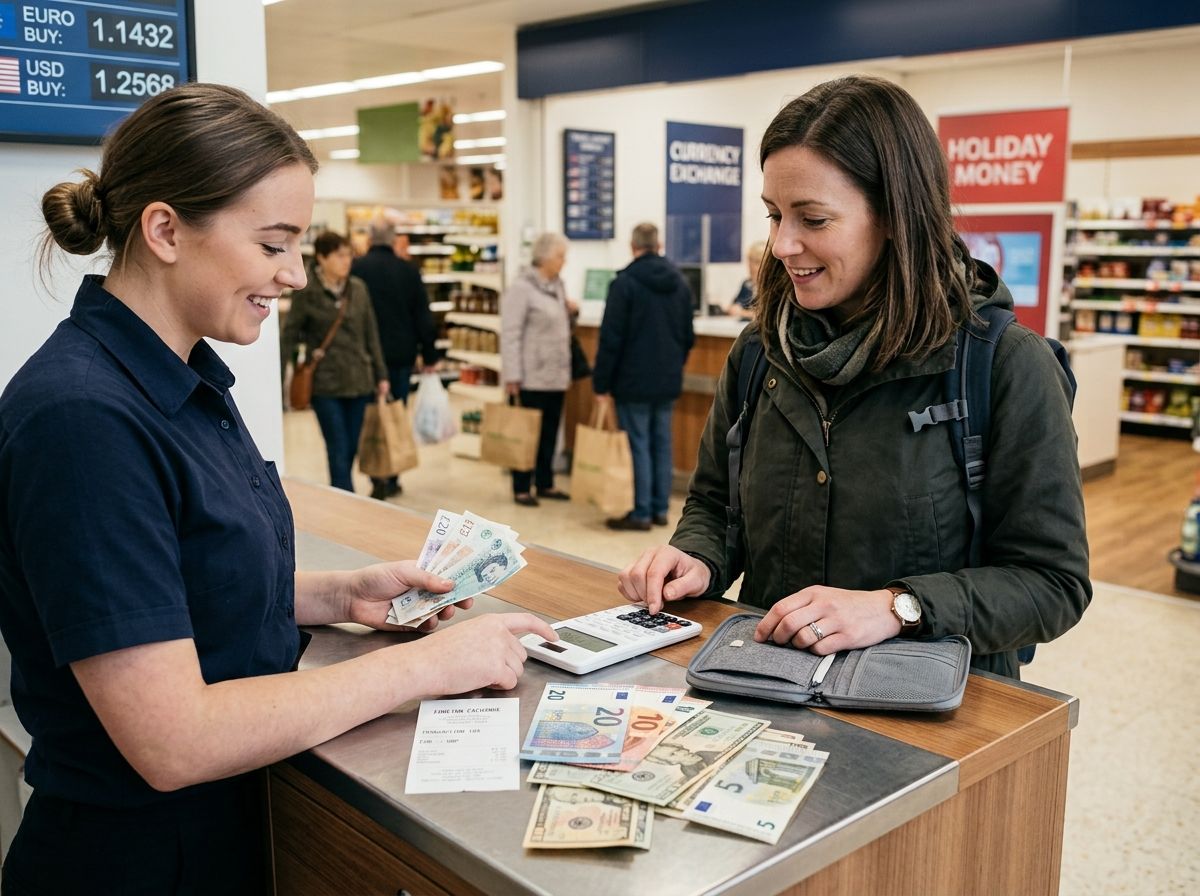
Supermarket bureaux (Tesco, Asda) are the most convenient option for most people, since you can combine the trip with your weekly shop and get paid in cash on the spot. Both accept banknotes from any provider, not just their own, and neither typically charges commission on the buy-back itself.
Post Office branches offer the widest network, with over 2,500 branches able to buy back travel money, though smaller branches may ask to see the original purchase receipt while larger ones won’t. Post Office pays the sterling straight into your bank account at the counter rather than handing over cash, which is worth knowing if you were expecting notes in hand.
High street bureaux like Marks & Spencer, John Lewis and independents such as Eurochange or Ramsdens also buy back most major currencies, and it’s worth comparing two or three if you’re converting a larger amount, since rates genuinely vary day to day and branch to branch.
Online specialists, including Currency Online Group and similar providers, will post you a tamper-proof envelope to send your notes by Royal Mail Special Delivery, and pay the sterling into your bank account once they’ve received and verified it. This suits larger amounts where the slightly better online rate outweighs the wait, but it’s not the option for a same-day need.
How the buy-back rate compares to the buy rate
Every currency exchange transaction has two prices: the rate you pay when buying foreign currency, and the rate you receive when selling it back. The gap between them is called the spread, and it’s how bureaux and supermarkets make their money on a transaction that otherwise carries no separate commission.
For mainstream currencies like euros and US dollars, that spread commonly runs to 1.5 to 4 percentage points between the buy and sell rates, according to travel money comparison data. In practical terms, if you bought €100 for £85 before your trip, don’t expect to get exactly £85 back for an unspent €100 note, the buy-back rate will be a little worse, and how much worse depends entirely on which provider you use and the specific currency involved. Less common or more volatile currencies tend to carry a wider spread than euros or dollars.
Currency buy-back guarantee: what it actually promises
A buy-back guarantee, sometimes marketed as a “Buy Back Promise,” locks in the exchange rate you originally paid, so you can sell unspent notes back at the same rate rather than whatever the daily buy-back rate happens to be when you return. It sounds simple, but it comes with real conditions worth reading before you rely on it.
Tesco’s version, for example, costs an extra £2.99 (£2.75 with a Clubcard) per currency at the point of purchase, applies to a maximum of £250 of currency at your original rate, with anything above that exchanged at the day’s standard buy-back rate, and must be redeemed within 45 days of your original purchase with the receipt in hand. Asda’s equivalent Buy Back Promise similarly requires a minimum of £35 and caps the guaranteed-rate amount at £250, with anything above exchanged at the daily rate instead.
Crucially, a buy-back guarantee only covers banknotes you bought from that specific provider under that scheme, it doesn’t extend to currency picked up elsewhere or brought back from a previous trip. If you didn’t take out the guarantee when you bought your money, you’ll simply get that day’s standard buy-back rate instead, which is still worth having, just not locked in at your original price.
Why coins are usually refused
Every major UK provider, supermarkets, the Post Office, high street bureaux, refuses foreign coins for buy-back, accepting banknotes only. The reason is purely practical: coins are heavy relative to their value, expensive to sort, transport and ship back to the country of origin, and the processing cost for a bureau often exceeds what the coins are actually worth.
This applies uniformly across the market, so it’s not worth hunting for an exception among mainstream UK providers. If you’re specifically trying to sell foreign coins UK-wide, your realistic options sit outside the standard travel money network entirely, covered next.
Options for small amounts and leftover coins
If you’re holding a small amount of leftover notes or a jar of foreign coins, a few practical routes exist beyond the standard buy-back counter.
Charity donation is the simplest option for coins specifically. Major charities including Oxfam accept foreign coin and note donations at their shops, or via a postal collection scheme, commonly run through a specialist partner such as Cash4Coins, which sorts, counts and converts bulk donations into cash for the charity. You won’t get anything back yourself, but it stops the coins sitting in a drawer indefinitely and turns them into something useful.
Specialist coin and currency exchange services, such as Cash4Coins, will buy back both coins and notes directly, including currencies and denominations most high street bureaux won’t touch, though the rate reflects the extra handling involved and processing can take one to several weeks depending on volume.
Airport charity collection points are worth using on your way home if you’ve only got a handful of coins left, since many UK airports run collection boxes for exactly this purpose on arrival.
For genuinely small amounts, weigh the time and postage cost of a specialist service against simply donating the coins to charity, since below a certain value the effort of selling rather than donating rarely pays off.
Comparing the main UK bureaux on buy-back terms
Tesco buys back notes from any provider, not just its own, with no set minimum and its optional Buy Back Promise capped at £250 at the guaranteed rate. Asda operates almost identically, buying back any provider’s banknotes commission-free with no minimum for standard buy-back, and the same £250 cap on its own guarantee scheme. Neither accepts coins.
The Post Office’s reach is its main advantage, useful if you’re not near a supermarket bureau, though you’ll be paid into your bank account rather than handed cash at smaller branches. High street names like Marks & Spencer and John Lewis also buy back currency, generally on broadly similar terms to the supermarkets, so it’s genuinely worth comparing the live rate across two or three options if you’re converting a larger sum, since the difference on, say, £300 of leftover euros can be a few pounds either way.
FAQs
Where can I sell leftover currency in the UK?
The most convenient options are supermarket travel money bureaux such as Tesco and Asda, Post Office branches, and high street bureaux like Marks & Spencer or John Lewis. Most accept banknotes bought from any provider, not just their own, and pay out the same day in cash or directly to your bank account.
What is the Tesco buy back rate?
Tesco’s buy-back rate changes daily and applies to foreign banknotes bought from any provider, with no commission charged. If you took out Tesco’s Buy Back Promise at purchase, you can lock in your original exchange rate on up to £250 of currency, redeemable within 45 days of purchase with your receipt.
Can I sell foreign coins in the UK?
No mainstream UK provider, including supermarkets, the Post Office and high street bureaux, buys back foreign coins, only banknotes. To convert coins into cash, you’ll need a specialist service such as Cash4Coins, or you can donate them to charity, where many shops accept foreign coin donations directly.
How does a currency buy-back guarantee work?
A buy-back guarantee lets you sell unspent currency back at the same rate you originally paid, rather than the standard daily buy-back rate, usually for a small fee added at the time of purchase. It typically only covers a set maximum amount, commonly around £250, and must be redeemed within a set window, often 45 days, with your original receipt.
Do I need a receipt to sell foreign currency back?
It depends on the provider and branch. Larger Post Office branches and most supermarket bureaus don’t require proof of purchase for a standard buy-back, but smaller branches, and any buy-back guarantee scheme specifically, will usually ask for the original receipt.
Is it worth exchanging small amounts of leftover currency?
Often not, once you account for your time and any minimum thresholds some providers apply to guaranteed-rate schemes. For genuinely small sums, it’s usually more sensible to donate the notes or coins to charity or keep them for your next trip to the same country, rather than travelling somewhere specifically to exchange a few pounds’ worth.
Why is the buy-back rate always worse than the rate I paid?
The gap, known as the spread, is how currency exchange providers make money on a transaction, since most charge no separate commission on the buy-back itself. It typically runs 1.5 to 4 percentage points between the buy and sell rates, and it’s how the bureau covers the cost and risk of holding foreign currency.
Can I sell currency back to a different provider than I bought it from?
Yes, in almost all cases. Tesco, Asda and most other UK providers will buy back banknotes regardless of where you originally purchased them, though any provider-specific buy-back guarantee only applies to currency bought through that same scheme.