If you’re trying to find the best US dollar rate on the high street, here’s the short answer: check the rate against today’s mid-market price (around $1.34 to $1.35 to the pound at the time of writing), then add up any commission and delivery charges before you compare providers. Supermarkets and the Post Office usually beat high street banks, and both beat the airport by a wide margin. The rest of this guide shows you exactly how to run that comparison so you don’t overpay.
Dollar rates move every few minutes, so any figure quoted here is a snapshot, not a promise. What doesn’t change is the method: work out the true cost of a deal, not just the headline number on the sign.
What “best rate” actually means
Every dollar rate you see starts from the same place: the mid-market rate. This is the rate banks use to trade with each other, and it’s the number you’ll find on Google, XE or Wise. As of early August 2026, it sits at roughly £1 to $1.34 to $1.35, though it shifts constantly with the markets.
No high street provider gives you that exact rate. They all build in a margin, which is how they make money on the transaction. The gap between the mid-market rate and the rate you’re quoted is often called the spread. A narrower spread means a better deal, even if the headline dollar figure looks less exciting than a rival’s.
How to compare currency deals properly
This is the part most people skip, and it’s why they end up overpaying. A rate on its own tells you almost nothing. You need three numbers before you can judge a deal.
1. The rate against the mid-market rate
Take the dollar rate you’ve been quoted and compare it with today’s mid-market rate. If the mid-market rate is 1.35 and a provider offers 1.28, you’re losing roughly 5% before any fees are added. Sites such as XE or Wise show the live mid-market figure for free, so check it on your phone before you commit to anything.
2. Commission
Some bureaux still charge commission on top of a worse rate, which is the worst of both worlds. Others advertise “0% commission” but simply widen the spread instead, so the commission is hidden inside the rate rather than shown separately. Always ask what you’d get in dollars for a fixed amount, say £500, and compare that number across providers rather than trusting the word “commission-free” on its own.
3. Delivery, collection and minimum order charges
Home delivery typically costs £3.99 to £6.95 for smaller orders, though most providers waive it once you spend £400 to £1,000, and the threshold varies by brand. Branch collection is usually free once you’ve ordered online, but walking in and asking for cash over the counter, with no online order first, tends to get you the weakest rate a branch offers. Many online providers also set a minimum order of around £100, so check that before you commit to a small amount.
Put together, the maths looks like this: (rate quoted, versus mid-market rate) minus commission, minus any delivery fee, equals the real cost of the deal. Run every provider through that formula and the winner is often not the one with the flashiest headline rate.
Best place to buy dollars in the UK: high street options compared
Here’s how the main high street routes actually stack up, based on how they’re typically priced rather than any single day’s numbers.
Supermarkets. Tesco, Sainsbury’s, Asda and M&S Bank travel money regularly post some of the sharpest headline dollar rates on the UK high street, especially when you order online for branch collection rather than walking in. Asda has recently been near the top of dollar rate comparisons, though the leader board shifts from week to week, so it’s worth a quick check on a comparison site before you order.
The Post Office. It stocks dollars in around 11,500 branches and offers a Click and Collect Express service: order by 2pm Monday to Friday (1pm on Saturday) and your dollars are ready to collect in as little as two hours. Its rates sit mid-table against other UK travel money providers on most comparison sites, so it’s rarely the cheapest, but the branch network and speed make it a solid fallback if you’re short on time.
Specialist bureaux. Firms such as ChangeGroup, eurochange and Travelex often run 0% commission online, with the best rates reserved for online orders collected in branch rather than walk-in purchases. ChangeGroup, for example, has around 19 London branches and offers next-day home delivery from £6.95, waived on larger orders.
High street banks. Banks are consistently the weakest option for cash currency, typically loading a bigger margin onto the rate than supermarkets or specialists. If your own bank is quoting the best rate you’ve seen, it’s worth double-checking a comparison site before you buy.
Where to get the best exchange rate in the UK
As a general rule, the order runs like this, from cheapest to most expensive: online order with branch collection, then online order with home delivery, then walking into a high street branch unannounced, then the airport. Online rates are almost always sharper than in-branch, walk-up rates, because providers use the online price to win your business before you’ve committed to a branch.
A comparison site such as Compare Holiday Money or Money.co.uk will show you same-day rates from a dozen or more UK providers at once, filtered by the amount you want to spend. That’s usually a faster way to find the best rate than checking each provider’s site individually, though always click through to confirm the figure on the provider’s own checkout page, since comparison sites can lag by a few minutes.
Should I buy currency at the airport?
In almost every case, no. UK airport kiosks are consistently the most expensive place to buy dollars, and industry comparisons have found travellers can lose upwards of £150 to £180 on a £1,000 exchange compared with high street branches of the same provider. Some studies put airport dollar rates at 10% to 15% worse than the mid-market rate, against a typical high street margin of 2% to 5%.
The exception is a genuine emergency: you’ve landed with no local cash and need a taxi or a coffee. For that, take out a small amount and treat it as the cost of convenience, not a shopping trip. If you know you’ll want cash on arrival, order it online before you fly and collect it from a high street branch, or from an airport branch of the same chain, since some providers let you order online at the high street rate and simply collect at the airport before your flight.
Best travel money rates: cash, or a travel card instead?
Cash isn’t always the answer, and for many UK travellers a fee-free debit card now beats carrying dollars altogether.
Fee-free debit and travel cards compared
A handful of UK current accounts now offer genuinely fee-free spending abroad, using the card network’s own exchange rate rather than a bank’s marked-up version.
- Chase UK charges no foreign transaction fee and uses the mid-market rate, with free cash withdrawals abroad up to £1,500 a month.
- Starling Bank offers fee-free card spending and unlimited fee-free ATM withdrawals worldwide, with no monthly cap, which makes it one of the simplest options for a longer US trip.
- Monzo is fee-free on card payments, but cash withdrawals outside the EEA are only fee-free up to £200 every 30 days, after which a 3% charge applies.
- Revolut matches the market rate on weekdays, but adds a 1% weekend markup on its free plan, so a Saturday spend can cost slightly more than a Tuesday one.
- Wise gives you the mid-market rate on card spending, with free ATM withdrawals up to £250 a month from May 2026, then 2.69% on anything above that.
None of these cards charge you for the pleasure of paying in dollars, which puts them ahead of most high street bank debit cards, where a foreign transaction fee of 2.75% to 3% is still standard on top of a marked-up rate.
When cash still makes sense
A card won’t help at a market stall, a small diner that’s cash-only, or when you want a fixed holiday budget in your hand rather than watching an app balance. If you’re travelling somewhere with patchy card acceptance outside big US cities, carrying $100 to $200 in cash as a backup is still sensible, even if your main spending runs through a fee-free card.
Click and collect: how it works and whether it’s worth it
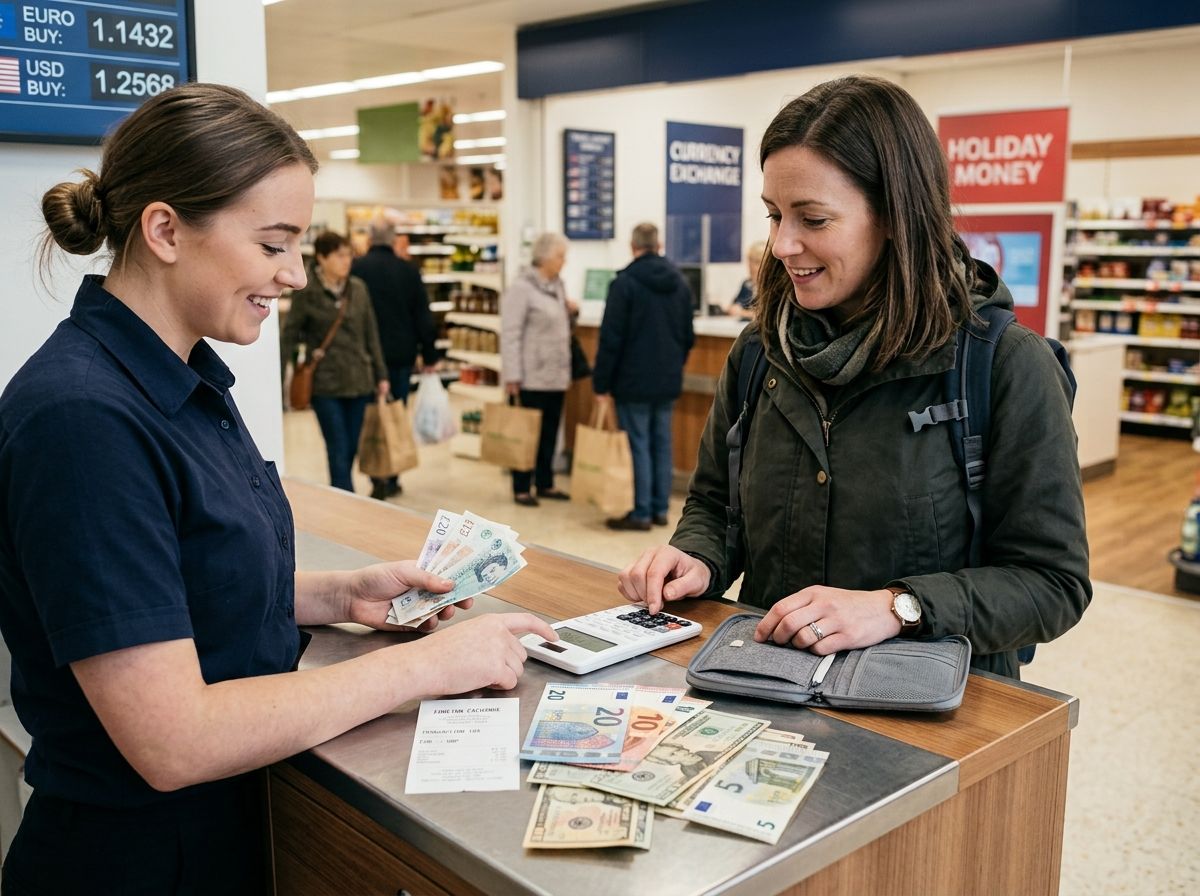
Click and collect is close to the sweet spot for most UK travellers: you get the online rate, which is nearly always better than a walk-in branch rate, but you avoid a delivery charge and don’t need to be home to sign for a parcel.
The process is simple with most providers. Order online and pay by card, choose a branch near you, then collect within the stated window, which ranges from two hours with the Post Office’s Click and Collect Express or ChangeGroup, up to next-day with slower providers. Bring the payment card you ordered with and photo ID, since most bureaux ask for both at collection.
The only downside is availability. Not every branch stocks every currency in cash, and popular routes like dollars and euros sell out at busy times such as the summer holidays or half-term, so book a day or two ahead if you can rather than leaving it to the morning you travel.
Step-by-step: getting the best US dollar rate before you go
- Check today’s mid-market GBP/USD rate on XE or Wise so you have a baseline to judge every quote against.
- Run your amount through a comparison site to see which providers are currently sharpest for dollars.
- Cross-check the top two or three directly on their own websites, since aggregator rates can be a few minutes out of date.
- Add up commission and any delivery or collection fee, not just the headline rate.
- Order online and choose a branch collection where it’s free, rather than home delivery, unless you’re ordering a large amount that qualifies for free delivery anyway.
- Set up a fee-free card such as Chase or Starling as backup, so you’re not relying on cash alone for the whole trip.
- Avoid the airport unless it’s a genuine top-up for the first hour after landing.
FAQs
What is the best place to buy dollars in the UK right now?
There isn’t one fixed answer, because rates move daily and the leader board changes with them. Supermarkets such as Asda and Tesco, plus specialist bureaux like ChangeGroup, regularly top comparison tables for dollars, so check a live comparison site on the day you buy rather than relying on last month’s winner.
Is it cheaper to buy dollars online or in person?
Online is almost always cheaper. Providers use their online price to compete for your order, while walk-in branch rates, quoted to someone who hasn’t pre-ordered, tend to be weaker. Order online even if you plan to collect the cash from a branch a few streets away.
Should I buy currency at the airport?
No, not unless it’s an emergency top-up. Airport kiosks are consistently the most expensive way to buy dollars in the UK, with some comparisons showing a loss of £150 or more on a £1,000 exchange versus high street branches of the same company.
What is the mid-market rate and why does it matter?
It’s the rate banks use to trade currency with each other, shown for free on sites like XE and Wise. Comparing any quote against it tells you the real size of the margin you’re being charged, rather than judging a rate in isolation.
Is a travel card better than cash for a US trip?
For most people, yes. Fee-free cards like Chase and Starling use the card network’s rate with no loading, so your everyday spending in the US costs less than paying with a standard high street bank debit card, which usually adds a 2.75% to 3% fee.
How much does home delivery of dollars usually cost?
Typically £3.99 to £6.95 for smaller orders, waived once you spend enough, often between £400 and £1,000 depending on the provider. Branch collection is usually free regardless of order size, provided you order online first.
Can I get dollars the same day I order them?
Often yes. The Post Office’s Click and Collect Express and some specialist bureaux can have dollars ready in around two hours if you order by early afternoon, though cut-off times and stock vary by branch, so check before you travel across town.
Is it safe to buy currency from an online bureau I haven’t heard of?
Check whether the firm is FCA-authorised as a payment institution, not just registered, since authorisation carries stronger requirements to keep customer money in segregated accounts. The FCA’s register is free to search, and it’s worth the two minutes before you hand over a large sum.