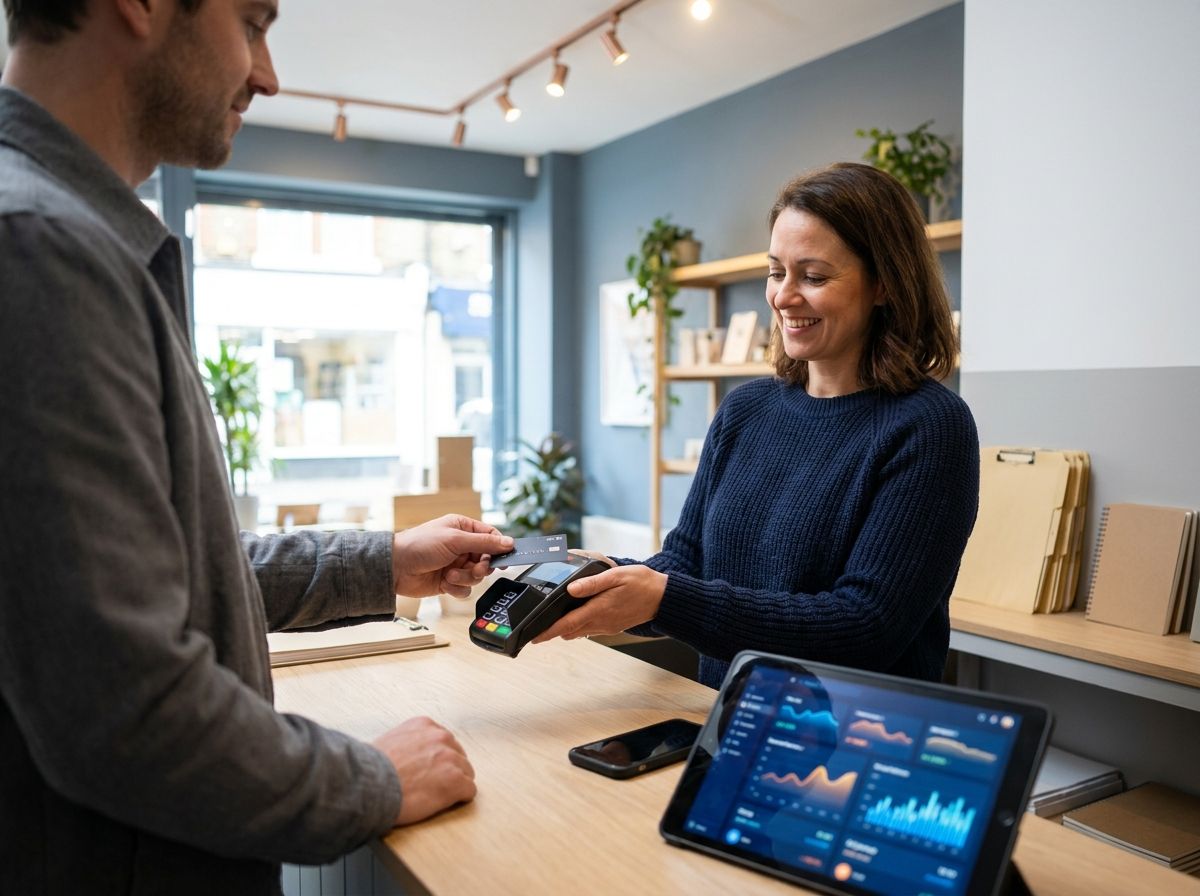
If you’re setting up to accept card payments for the first time, here’s the short version. You need a way to capture the card details (a machine, a reader, a gateway or a link), a provider to move the money (a merchant account or a payment facilitator), and a small transaction fee on every sale, usually somewhere between 1% and 2.75% depending on the route you choose. This guide covers the four practical ways to accept card payments as a UK business, when you actually need a merchant account, and how the fee stack breaks down so nothing catches you out later. We’ll also cover settlement timing and what happens if a customer disputes a payment.
The four ways to accept card payments
There are four routes into accepting card payments, and most UK businesses end up using more than one.
1. Card machine (countertop or fixed terminal)
A traditional card machine sits at your till, usually wired or connected over Wi-Fi, and is built for high transaction volumes. It’s the standard choice for shops, cafés and salons with a fixed till point. Machines from providers like Worldpay, Barclaycard and Dojo typically cost £15 to £40 a month to rent, on top of the per-transaction fee.
2. Mobile card reader
A mobile reader pairs with an app on your phone or tablet over Bluetooth. It’s the go-to for market stalls, mobile hairdressers, tradespeople and pop-up events, since there’s no fixed line or monthly rental in most cases. SumUp, Zettle and Square all sell readers in this category, usually for a one-off hardware cost of £29 to £59.
3. Online payment gateway
A gateway (Stripe, Worldpay, Opayo, Braintree) sits behind your website’s checkout and processes card details when a customer buys online. Setting one up means integrating an API or a plugin into your site, which usually needs some technical help unless you’re on a platform like Shopify or WooCommerce with a built-in connection.
4. Payment link
A payment link is the simplest online option: you generate a link or QR code for a specific amount and send it by email, text or invoice. No website is needed. It suits invoice-based businesses, tradespeople taking deposits, and anyone accepting card payments over the phone without a full gateway setup.
How to take card payments UK: merchant account vs payment facilitator
To actually take a card payment, the money has to move somewhere, and that’s where a merchant account or a payment facilitator comes in.
A merchant account is a dedicated business bank account that sits between the card networks and your normal business bank account. You apply to an acquiring bank (Worldpay, Elavon, Barclaycard and similar), and once approved you get your own Merchant ID. It suits established businesses with predictable turnover, since approval can take a few days to a couple of weeks and often involves a credit check and, in some cases, a rolling contract.
A payment facilitator (often shortened to PayFac) removes the need for your own merchant account entirely. Providers such as SumUp, Zettle by PayPal, Square and Stripe hold one master merchant account and onboard individual businesses as sub-merchants underneath it. You can typically be approved and take payments the same day, with no contract and no credit check, which is why most sole traders and new businesses start here.
The trade-off is pricing and control. A PayFac’s rates are fixed and non-negotiable, and if your account gets flagged for unusual activity (a sudden spike in transaction value is a common trigger) funds can be held while they review it. A merchant account, once set up, usually gives you a lower negotiated rate at higher volumes and fewer surprise holds.
Card payment fees explained: interchange, scheme fees and acquirer margin
Every card payment fee you pay is really three separate charges stacked together, and only one of them is up for negotiation.
Interchange fees UK
Interchange is the fee paid to the customer’s card-issuing bank on every transaction. In the UK it’s capped by law under the retained Interchange Fee Regulation, at 0.2% of the transaction value for consumer debit cards and 0.3% for consumer credit cards, according to the Payment Systems Regulator (PSR). On a £50 debit card sale, that’s 10p in interchange. Commercial and corporate cards fall outside these caps and typically run at 1.0% to 2.5%, while American Express, which is exempt from the cap altogether, sets its own rates of roughly 1.5% to 3.5%.
One quirk worth knowing about: since Brexit, interchange on UK-to-EEA online transactions has been uncapped and sits far higher, at around 1.15% for debit and 1.5% for credit. The PSR has proposed an interim cap on these cross-border rates and the situation is still under review, so if you sell online to European customers, it’s worth checking the PSR’s site for the current position before you price anything.
Scheme fees
Scheme fees go to Visa and Mastercard for running the card network itself. They’re not capped, and the PSR has found they’ve risen noticeably faster than inflation since interchange was capped in 2015. These fees are usually bundled into your headline rate rather than itemised, so you won’t see them as a separate line on most invoices.
Acquirer margin
This is your processor’s own cut, covering the terminal, gateway, customer support and their profit. It’s the only part of the fee stack you can actually negotiate, and it’s where the real difference between providers shows up. A small business on a flat 1.75% rate might be paying 0.2% interchange, roughly 0.3% to 0.4% scheme fees, and the rest as acquirer margin.
Blended vs interchange-plus pricing
Most small businesses are quoted a blended rate: one flat percentage covering every card type, which is simple but hides the mix underneath. Larger or higher-volume businesses can often move to interchange-plus pricing, where you pay the actual interchange cost plus a fixed processor margin on top. It’s more transparent, and it’s usually cheaper if a lot of your customers pay with debit cards, since you’re not subsidising the higher commercial-card rate baked into a blended fee.
When you’ll get paid: settlement timing
Settlement is the gap between a customer tapping their card and the money landing in your business bank account. Most modern providers settle funds the next working day, though some (SumUp and Zettle among them) offer instant or same-day payout for a small extra fee. Traditional merchant accounts can take two to three working days, particularly around bank holidays, so it’s worth checking this before you commit if cash flow timing matters to your business.
Chargebacks: the basics
A chargeback happens when a customer disputes a payment directly with their card issuer rather than asking you for a refund. Under Visa and Mastercard rules, a cardholder generally has up to 120 days from the transaction (or expected delivery date) to raise one, and in some fraud cases that window can stretch much further.
As the merchant, you get far less time to respond, typically 30 days under Visa’s rules and 45 days under Mastercard’s, though in practice many processors set a shorter internal deadline, sometimes as little as a week. If you don’t respond with evidence (proof of delivery, a signed receipt, correspondence with the customer) in time, you lose the dispute automatically and the money is taken back, along with a chargeback fee that’s usually £15 to £25.
The best defence is basic paperwork: keep delivery confirmations, take card-present transactions with chip and PIN or contactless rather than manually keyed entry where possible, and respond to any dispute notice the moment it lands rather than waiting.
Card acceptance for sole traders
If you’re a sole trader, card acceptance for sole traders works the same way as for any other business structure, but a few things simplify the process. You don’t need a limited company or a separate business bank account to get approved by most PayFac providers, though having one makes bookkeeping considerably easier. You’ll usually need your name, address, UTR (Unique Taxpayer Reference) if you’re registered as self-employed, and proof of ID to pass verification checks under UK anti-money laundering rules.
A mobile reader or a payment link is normally the cheapest way in for a sole trader, since there’s no monthly rental and no long-term contract. Once your turnover grows and becomes more predictable, it’s worth reviewing whether a merchant account with interchange-plus pricing would now work out cheaper than the flat PayFac rate you started on.
Whatever setup you choose, you’ll also need to meet the Payment Card Industry Data Security Standard (PCI DSS), a set of 12 security requirements covering how card data is handled. Most small providers handle the technical side of this for you, but you’ll still need to complete a short annual self-assessment questionnaire confirming your setup is compliant.
FAQs
Do I need a merchant account to accept card payments?
No. A payment facilitator such as SumUp, Zettle or Stripe lets you accept card payments as a sub-merchant under their existing merchant account, with approval often granted the same day. You’d only need your own dedicated merchant account if you want lower negotiated rates at higher transaction volumes or more control over holds and settlement.
How much does it cost to accept card payments in the UK?
Typical transaction fees run from around 1% to 2.75% depending on the provider and card type, on top of any monthly rental or hardware cost. Interchange itself is capped at 0.2% for debit and 0.3% for credit under UK law, so most of what you pay above that is scheme fees and processor margin.
Can I charge customers extra for paying by card?
Not for consumer debit or credit cards. The Payment Services Regulations 2017 ban surcharging on consumer cards, and this is enforced by Trading Standards. You can pass on a genuine cost for a business or corporate card, and offering a cash discount is legal, provided the base price isn’t inflated to disguise it.
How long does it take to start accepting card payments?
With a mobile reader or online payment link from a payment facilitator, you can often be approved and taking payments the same day. A traditional merchant account application with an acquiring bank usually takes anywhere from a few days to two weeks, depending on credit checks and documentation.
When does the money from a card payment reach my bank account?
Most providers settle within one working day, and some offer instant payout for an extra fee. Traditional merchant accounts can take two to three working days, so check this detail before choosing a provider if your cash flow is tight.
What’s the difference between a card machine and a mobile card reader?
A card machine is typically fixed or wired at a till point and suits high-volume, in-person businesses like shops and cafés. A mobile card reader connects to a phone or tablet over Bluetooth and suits mobile or occasional sellers, such as market traders or tradespeople, since it usually has no monthly rental.
Do sole traders need a business bank account to accept card payments?
No, most payment facilitators will approve a sole trader without one, using your personal details and UTR instead. A separate business account isn’t a legal requirement for accepting cards, though it does make it easier to track income and expenses at tax time.
What happens if a customer disputes a card payment?
The card issuer raises a chargeback and pulls the disputed amount back from you while the case is investigated. You’ll usually have between one and six weeks, depending on the card network and your processor, to respond with evidence such as proof of delivery or a signed receipt before the dispute is settled automatically against you.
Are interchange fees the same as the total card processing fee?
No. Interchange is only the capped portion paid to the card issuer, 0.2% for debit and 0.3% for credit on UK consumer cards. Your total processing fee also includes scheme fees charged by Visa or Mastercard and your provider’s own margin, which together usually make up the larger share of what you actually pay.