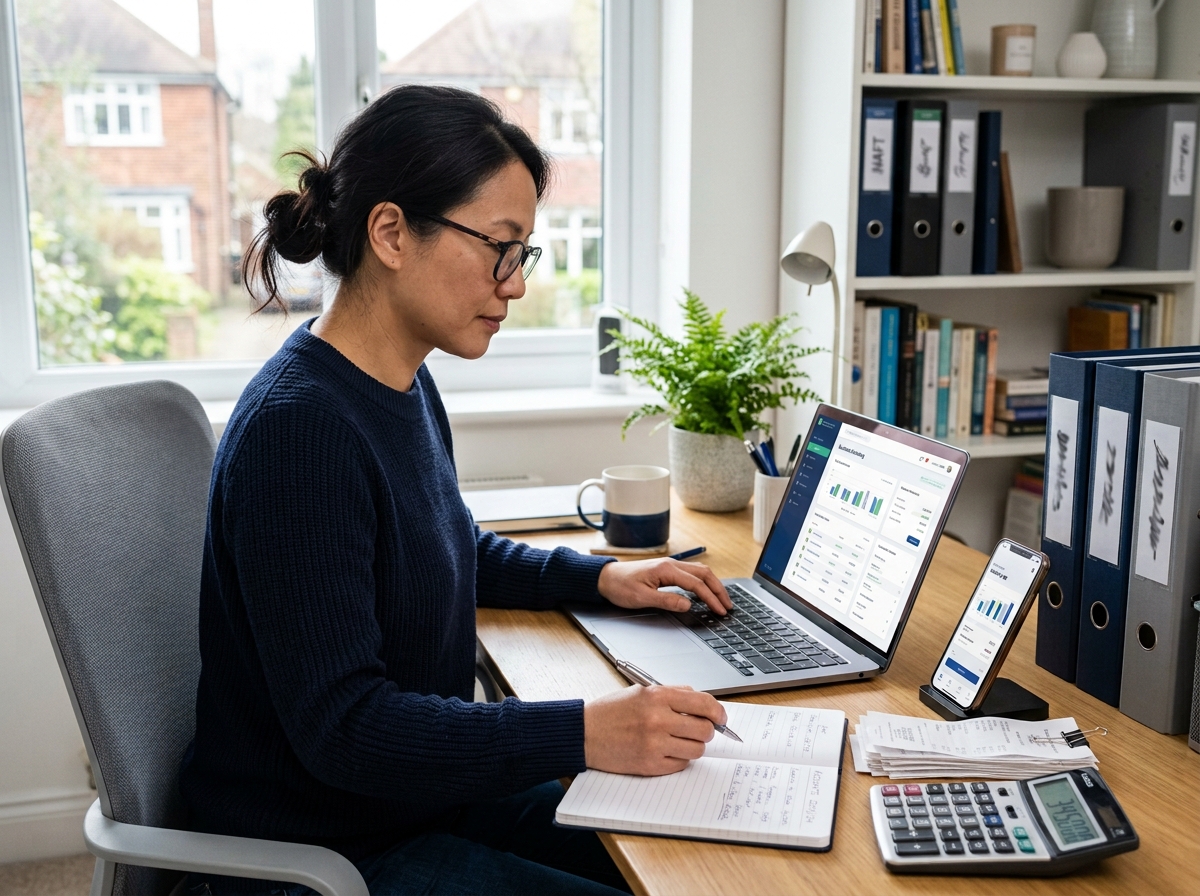
You don’t legally need a separate sole trader bank account in the UK. There’s no law requiring it, and HMRC will happily accept your Self Assessment return whether your income lands in a personal account or a dedicated business one. The catch is that most personal current account terms explicitly forbid business use, so using one anyway carries a real risk of your bank freezing or closing it once it spots regular invoice payments coming in. This guide covers the rules, the best current options, and why keeping finances separate is about to matter more than it used to.
Do sole traders need a business bank account?
No, not legally. Sole traders and business partnerships aren’t separate legal entities from the person running them, unlike limited companies, so there’s no requirement to hold a distinct account for business income. You can, in theory, run everything through the same current account you use for rent, groceries and everything else.
Limited companies are different. Because a company is its own legal entity, its money has to be kept apart from the director’s personal finances, and in practice that means a dedicated business account. Sole traders don’t face that legal separation, which is exactly why so much confusion exists around whether one is “needed.”
Sole trader banking rules: what your personal account terms actually say
Here’s where the theory and the practical reality pull apart. Even though HMRC doesn’t require a separate account, most personal current account terms and conditions explicitly state the account is for personal use only, and using it for regular business transactions can breach those terms.
If your bank notices a pattern of invoice payments, client transfers or supplier payments going through a personal account, it can act. That might mean a warning, a request to switch to a business account, or in some cases a frozen or closed account with little notice, according to guidance from several UK banking comparison sites. This is a real operational risk, not just a technicality, and it tends to catch people out just as their income is starting to grow and the disruption would hurt most.
There’s some tolerance in practice. If you’re doing the occasional freelance job or selling a handful of items to test an idea, a handful of transactions a month is unlikely to trigger anything. Once you’re invoicing regularly or trading under a business name (for example, “Jordan Clarke trading as JC Electrical”), you’re firmly in territory where a personal account is the wrong tool and possibly a breach of your bank’s terms.
Best business bank account for sole traders: how the main options compare
There isn’t a single best answer, since it depends on how much cash you handle, whether you want built-in invoicing, and how tightly you need it to work with your accounting software. Here’s how the main UK options stack up as of mid-2026.
| Provider | Monthly fee | Free banking period | Cash deposits | Accounting integration |
| Starling Bank | £0 | Ongoing, no time limit | Via Post Office, small fee applies | Xero, FreeAgent, QuickBooks |
| Tide | £0 on the free plan | Ongoing on free plan | Via PayPoint, roughly £1 per deposit | Xero, QuickBooks, built-in invoicing |
| Mettle (NatWest) | £0 | Ongoing, no time limit | Via Post Office, fee applies | Bundled FreeAgent included free |
| Monzo Business Lite | £0 | Ongoing on Lite plan | Limited, fees apply | Xero, basic invoicing on paid tier |
| Zempler Bank | £0 on Go plan | Ongoing on Go plan | Via PayPoint | Xero, QuickBooks, Sage |
| Barclays Business | From roughly £8.50/month | Around 12 months free for new businesses | Branch and Post Office, fees vary | FreshBooks and others |
| TSB Business Plus | From roughly £8.50/month | Up to around 30 months free | Branch and Post Office, fees vary | Various via Open Banking |
A few honest caveats. Fees, free periods and included features change often, sometimes with little notice, so treat this table as a starting point and check each provider’s current pricing page before you commit. Tide is an e-money institution rather than a licensed bank, which matters for deposit protection (more on that below), whereas Starling, Mettle, Monzo and the high street names are full banks.
If you handle very little cash and want the cheapest possible setup, Starling, Mettle or Tide’s free tier are the obvious starting points. If you take a lot of cash payments, factor in deposit fees carefully, since most digital-first providers charge a flat fee per deposit through the Post Office or PayPoint network rather than offering free cash handling.
Free business bank account UK: what “free” actually means
“Free” gets used loosely in this space, so it’s worth being precise. Some accounts, like Starling, Mettle and the free tiers of Tide and Monzo, have no monthly fee at all for as long as you use them, provided you stay within their standard terms. Others, mostly the high street banks, offer a free introductory period, often 12 to 30 months, after which a monthly fee kicks in automatically unless you switch or negotiate.
Genuinely free accounts almost always charge somewhere else, usually on cash deposits, international payments, or premium features like invoicing and multiple user access. Read the fee schedule for the specific things you’ll actually use rather than just the headline “free” claim.
On deposit protection: if the safety of your money matters to you, and it should, check whether your provider is a fully licensed bank covered by the Financial Services Compensation Scheme (FSCS), which protects eligible deposits up to £85,000 per person per institution. Starling, Mettle and the high street banks qualify. Tide, as an e-money institution, safeguards customer funds differently and isn’t covered by the same FSCS deposit guarantee, which is worth knowing even though it doesn’t necessarily mean your money is at risk.
Making Tax Digital compatibility: why this matters more than it used to
This is the part most older guides to sole trader banking skip entirely, and it’s becoming genuinely important. Making Tax Digital (MTD) for Income Tax is being phased in based on your gross income from self-employment and property, according to GOV.UK’s current guidance:
- From 6 April 2026, it applies if your qualifying income is over £50,000
- From 6 April 2027, the threshold drops to over £30,000
- From 6 April 2028, the threshold drops to over £20,000
Once MTD applies to you, the annual Self Assessment return is replaced by quarterly digital updates sent through MTD-compatible software, plus a year-end final declaration. That software needs a steady, accurate feed of your business income and expenses, and this is exactly where a mixed personal and business account starts to cause real friction.
Open Banking feeds from personal accounts can be unreliable for this purpose, partly because personal accounts weren’t designed for it and partly because your software has to sift business transactions out from personal ones automatically, which it doesn’t always do cleanly. A dedicated business account that connects directly to Xero, QuickBooks or FreeAgent gives your quarterly updates a much cleaner, more reliable data source, and it’s one less thing to worry about four times a year instead of once.
If your profits are anywhere near the coming thresholds, even £20,000 to £30,000 a year, it’s worth opening a separate account well before MTD applies to you rather than scrambling to untangle a year of mixed transactions once quarterly reporting starts.
Separating finances for record-keeping: the case beyond MTD
Even setting Making Tax Digital aside, keeping business and personal money apart makes ordinary record-keeping considerably easier, and this becomes harder to justify skipping the more your business grows.
A few practical reasons this matters day to day:
- Cleaner expense claims: it’s far easier to spot and claim legitimate business expenses when they’re not buried among grocery shops and takeaway orders
- Faster Self Assessment: reconciling a business-only account against your accounting software takes a fraction of the time a mixed account does
- Better financial visibility: you can see at a glance what the business is actually earning and spending, rather than estimating from memory
- Stronger paper trail if HMRC asks questions: a dedicated account gives HMRC a clean, easily reviewable record if your return is ever queried or checked
- A more credible impression with clients: paying an invoice to “J. Clarke Electrical” rather than a personal name can look more established, particularly for larger or repeat clients
None of this is legally required. But once you’re filing quarterly rather than annually, whether that’s this year or a couple of years from now depending on your income, the cost of a messy account stops being an annual headache and starts being a recurring one.
FAQs
Do sole traders need a business bank account by law?
No. There’s no legal requirement in the UK for a sole trader to hold a separate business bank account, since sole traders and their businesses aren’t treated as separate legal entities. You can use a personal account, though many personal account terms and conditions prohibit regular business use.
What is the best free business bank account for sole traders?
Starling Bank, Mettle and Tide’s free tier are among the most commonly recommended free options, each offering no monthly fee and accounting software integration. The right choice depends on how you handle cash, whether you want built-in invoicing, and whether FSCS deposit protection matters to you, since Tide is an e-money institution rather than a bank.
Can I use my personal bank account for my sole trader business?
Yes, it’s legal, but check your account’s terms and conditions first, since many personal accounts explicitly forbid regular business transactions. Banks that spot a pattern of invoice payments or client transfers can freeze or close the account, so this carries real risk once your business income becomes regular rather than occasional.
How much does a business bank account cost for a sole trader?
Several UK providers, including Starling, Mettle and Tide’s free plan, charge no monthly fee at all. High street banks like Barclays and TSB typically offer a free introductory period of around 12 to 30 months before charging roughly £8.50 a month, so check the ongoing cost, not just the introductory offer.
Do I need a business bank account for Making Tax Digital?
Not strictly, but it makes quarterly digital reporting considerably easier once Making Tax Digital for Income Tax applies to you. A dedicated account gives your MTD-compatible software a cleaner, more reliable feed of business transactions than a mixed personal account typically can.
Is my money protected in a business bank account?
It depends on the provider. Fully licensed banks, including Starling, Mettle and the high street names, are covered by the Financial Services Compensation Scheme up to £85,000 per person per institution. E-money institutions like Tide safeguard customer funds under different rules and aren’t covered by the same FSCS guarantee.
What documents do I need to open a sole trader bank account?
Most providers ask for proof of identity, such as a passport or driving licence, proof of address, and basic details about your business, including what you do and your expected turnover. Digital-first providers like Starling and Tide typically process this entirely through their app within a few minutes.
Can I have more than one bank account as a sole trader?
Yes, there’s no restriction on holding multiple accounts, and some sole traders keep a separate account purely for setting aside tax alongside their main business account. Just keep track of which transactions sit where, since splitting activity across several accounts without good records can make reconciliation harder rather than easier.