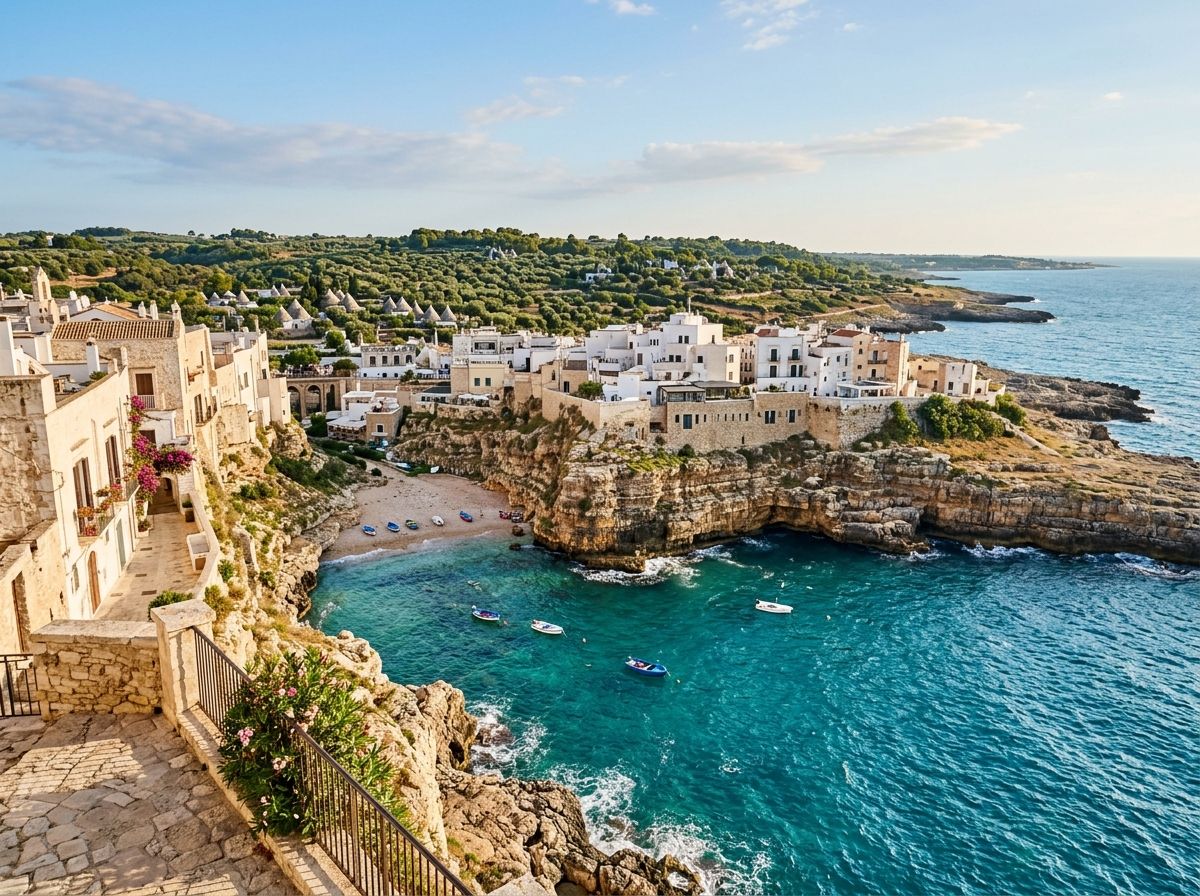
Puglia is the region running along the heel of Italy’s boot, stretching from Bari in the north down to Lecce and Otranto in the far south. If you’re wondering whether it’s worth the trip, the short answer is yes: you get whitewashed hilltop towns, cone-roofed trulli houses, warm Adriatic and Ionian coastlines, and some of the best food in Italy, usually for less than you’d pay in Tuscany or the Amalfi Coast. Ryanair and easyJet fly there directly from several UK airports, and a week is enough to see the highlights.
This guide covers how to get there, what it costs, where to base yourself, and the practical bits (passports, driving, weather) that trip up a lot of first-time visitors.
Where exactly is Puglia?
Puglia sits in the far southeast of Italy, forming the heel of the boot shape. It’s bordered by the Adriatic Sea to the east and the Ionian Sea to the south, with over 800km of coastline in total. The main cities and towns visitors head for are Bari (the regional capital), Alberobello, Ostuni, Polignano a Mare, Monopoli, Lecce and Otranto, with the Salento peninsula forming the southern tip.
It’s roughly a two-hour drive from the top of the region to the bottom, so most people base themselves in one or two spots rather than trying to cover everything.
Best time to visit Puglia
May, June and September are the sweet spot. You get warm, reliable weather (typically 24 to 29°C) without the crowds or the heat of peak summer, and accommodation prices are noticeably lower than in July and August.
July and August bring temperatures that regularly hit 32 to 35°C, packed beaches, and busier restaurants, especially around Ferragosto (15 August), when much of Italy takes its own summer holiday. Book well ahead if you’re travelling then.
October to April is quieter and cheaper still, with mild days (12 to 18°C) but a real chance of rain and some coastal restaurants closing for the season. It suits city breaks in Lecce or Bari more than a beach holiday.
How to get to Puglia from the UK
There’s no need to route through Rome or Milan. Puglia has two useful airports:
- Bari Karol Wojtyła Airport (BRI), the busier of the two, well placed for Alberobello, Polignano a Mare, Ostuni and Monopoli
- Brindisi Salento Airport (BDS), better suited to the Salento peninsula, Lecce and Otranto
Ryanair and easyJet both run direct routes from UK airports including London (Stansted, Gatwick and Luton), Manchester, Edinburgh and Bristol, with flight time around 2 hours 50 minutes. British Airways also flies Gatwick to Bari, seasonally between March and October.
Fares vary hugely by season. Budget carriers advertise one-way fares from around £20 to £30 in the shoulder season, but expect to pay £80 to £180 return if you’re booking for July or August, especially at short notice. As with any low-cost airline, the advertised price rarely includes checked luggage or seat selection, so check the full basket before comparing deals.
There are no direct trains from the UK, and while it’s technically possible to reach Puglia by rail via Paris and Milan, it takes the best part of a day and doesn’t save money over flying.
Do UK travellers need a visa for Puglia?
No, not for a normal holiday. Since Brexit, UK passport holders are treated as third-country nationals in the Schengen area, which Italy is part of, but you can still visit visa-free for up to 90 days in any rolling 180-day period, according to GOV.UK’s Italy travel advice.
A few practical points worth knowing before you go:
- Your passport needs to have been issued within the last 10 years, and needs at least 3 months left on it after the date you plan to leave the Schengen area
- ETIAS, a €7 online travel authorisation, is expected to become mandatory from the last quarter of 2026. It isn’t live yet, so check GOV.UK closer to your travel date
- The EU’s Entry/Exit System (EES), which records fingerprints and a facial photo for non-EU arrivals, is now in operation at Schengen borders, so build in extra time at passport control
- Every day in Italy counts towards your 90-day Schengen allowance across the whole Schengen area, not just Italy, so keep track if you’re combining trips
Always check the official GOV.UK Italy page before you travel, since these rules do shift.
Getting around Puglia
Hiring a car is genuinely the best way to see Puglia. Distances between towns are short, roads are generally good, and it lets you reach beaches and countryside masserie (converted farmhouses) that aren’t served by public transport. Expect to pay from around £25 to £40 a day for a small car in low season, rising sharply in August.
If you’re watching your budget or sticking to the main towns, the Ferrovie del Sud Est (FSE) regional train and bus network connects Bari, Alberobello, Lecce, Ostuni and Otranto reasonably well, though services can be infrequent, especially on Sundays.
One thing to watch for if you do drive: Italian towns often have ZTL zones (Zona a Traffico Limitato), restricted traffic areas in historic centres. Drive into one without a permit and you’ll likely get an automatic fine, even in a hire car, so park outside and walk in.
Where to stay: the best bases in Puglia
Alberobello. Home to the trulli, the cone-roofed limestone houses that are unique to this part of Italy and a UNESCO World Heritage Site. It’s small and very touristy by day, so an overnight stay lets you enjoy it once the coach parties leave.
Ostuni, known as the “White City” for its whitewashed hilltop old town, makes a good central base with easy access to nearby beaches like Rosa Marina.
Polignano a Mare. Famous for its cliffside setting and turquoise cove beaches, plus the Red Bull Cliff Diving World Series held here most summers. It gets very busy in July and August.
Lecce. Sometimes called the “Florence of the South” for its Baroque architecture, and a good pick if you want city energy with easy day trips into the Salento peninsula.
Otranto, at Italy’s most easterly point, is a whitewashed port town with some of the clearest water in the region, roughly 90 minutes south of Ostuni.
For a genuinely local stay, a masseria (a converted farmhouse, often with its own olive grove and pool) is a distinctly Puglian experience, ranging from simple agriturismo rooms to five-star properties.
What Puglia costs: a realistic budget
Puglia is one of the more affordable regions of Italy, though prices climb fast in peak season.
- Budget travellers: around £50 to £70 a day, covering a guesthouse or hostel, self-catering or simple trattoria meals, and public transport
- Mid-range: around £100 to £160 a day, covering a comfortable three-star hotel or B&B, restaurant meals and a hire car
- A meal out typically runs £20 to £35 per person with wine at a mid-range trattoria; a coffee at the bar is usually under £1.50
- A pizza or panzerotti from a local spot costs as little as £4 to £7
Prices are noticeably higher in Alberobello, Ostuni’s old town and along the Polignano coast in July and August, so factor that in if you’re travelling then.
Food and drink to try in Puglia
Puglia’s cooking is built around simple, seasonal ingredients, often summed up as cucina povera (peasant cooking). Look out for orecchiette (little ear-shaped pasta, usually with turnip tops or a rich tomato sauce), burrata (a creamy, fresh cheese the region is famous for), focaccia barese (topped with tomatoes and olives), and taralli, the crunchy ring-shaped snacks sold everywhere.
The region also produces a large share of Italy’s olive oil, and Salento is known for bold, affordable reds made from Primitivo and Negroamaro grapes.
Day trips from Puglia
Matera, just over the regional border in Basilicata, is roughly an hour’s drive from Alberobello and well worth the detour. Its Sassi district, a cluster of cave dwellings carved into limestone cliffs, is another UNESCO site and unlike anywhere else in Italy.
Closer to home, the Itria Valley around Locorotondo and Cisternino makes for an easy half-day of trullo-spotting and countryside driving, and the Torre Guaceto nature reserve near Ostuni is worth it for unspoiled beaches and birdwatching, including flamingos at the nearby Le Cesine reserve.
FAQs
Is Puglia worth visiting?
Yes. It offers a mix of hilltop towns, coastline and food that rivals better-known parts of Italy, usually at a lower cost than Tuscany or the Amalfi Coast. It suits couples, families and groups equally well, and a week gives you enough time to see several towns without rushing.
How do I get to Puglia from the UK?
Fly direct to Bari or Brindisi with Ryanair, easyJet or British Airways from airports including London, Manchester, Edinburgh and Bristol. Flight time is around 2 hours 50 minutes, with one-way fares from roughly £20 in low season.
Do I need a visa to visit Puglia?
No, UK passport holders can visit visa-free for up to 90 days in any 180-day period, under Schengen rules that apply to all of Italy. You will need a valid passport with at least 3 months left after your departure date, and from late 2026, a €7 ETIAS authorisation is expected to become mandatory.
What is the best time of year to visit Puglia?
May, June and September give warm weather without peak-season crowds or prices. July and August are hottest and busiest, while October to April is quiet, cheap, and suited more to city breaks than beach time.
How many days do you need in Puglia?
A week is enough to cover two or three bases, such as Alberobello or Ostuni plus Lecce, along with a day trip to Matera. Ten days to two weeks lets you slow down and explore the Salento peninsula properly.
Is it better to hire a car in Puglia?
For most visitors, yes. Distances between towns are short, roads are generally in good condition, and a car gives you access to beaches, masserie and countryside that trains and buses don’t reach. Just avoid driving into ZTL restricted zones in historic centres.
What is Puglia known for?
Trulli houses in Alberobello, whitewashed hill towns like Ostuni, cliffside coastal towns such as Polignano a Mare, Baroque architecture in Lecce, and food built around olive oil, burrata and orecchiette pasta.
Is Puglia expensive?
It’s one of the more affordable Italian regions, with budget travellers managing on around £50 to £70 a day and mid-range travellers around £100 to £160 a day. Prices rise sharply in Alberobello, Ostuni and along the coast during July and August.
Which airport is better for Puglia, Bari or Brindisi?
Bari suits the northern half of the region, including Alberobello, Ostuni, Monopoli and Polignano a Mare. Brindisi is more convenient if you’re heading straight to Lecce, Otranto or the Salento peninsula.