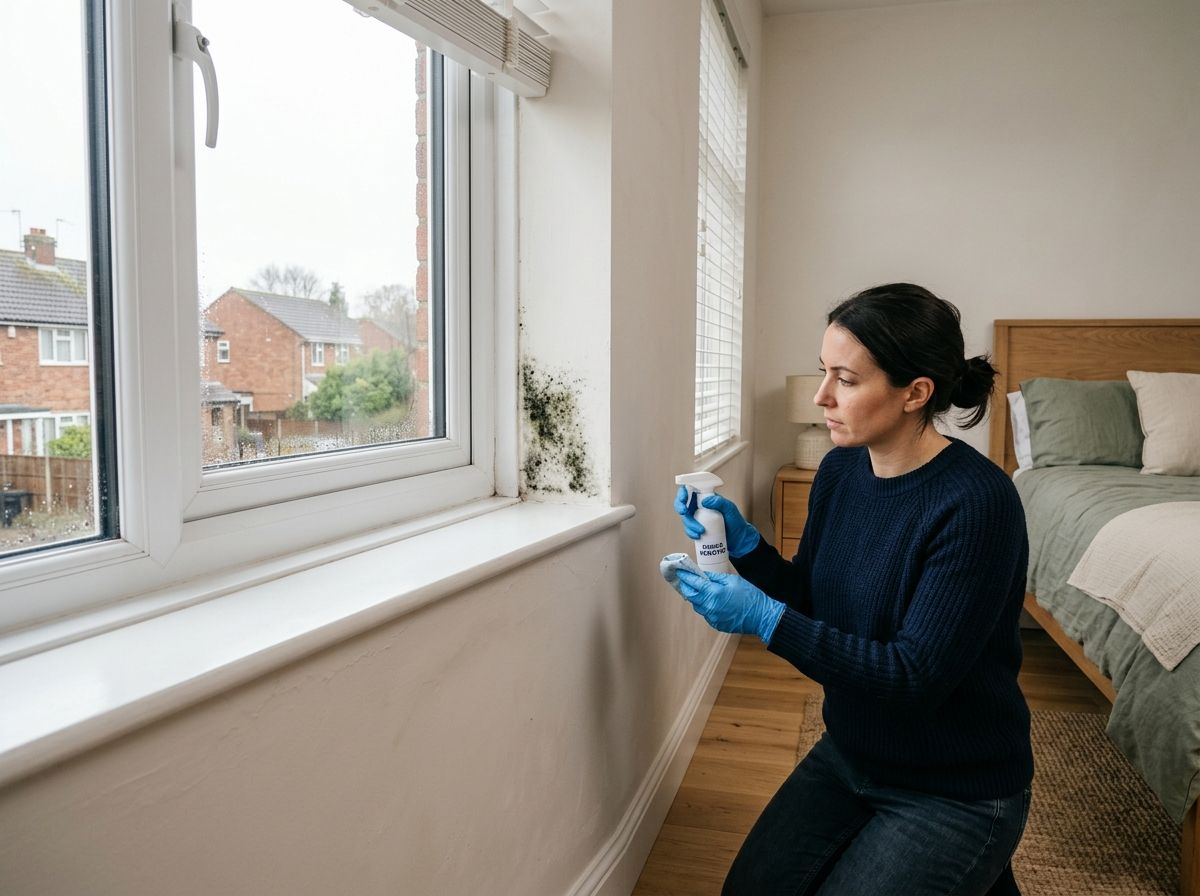
If you’ve spotted black or green spots creeping across a wall, windowsill or bit of grout, you’re dealing with mould, and you’re not alone. Almost one in three homes in England have some degree of damp and mould, according to Manchester University NHS Foundation Trust, and it’s more common in rented properties. The good news: small patches are usually easy to sort yourself, and there are now clear rules on what your landlord has to do if they can’t.
This guide walks through what causes mould, how to remove it safely, what it costs to get a professional in, and what the law says about your rights, whether you own your home or rent it.
What Causes Mould in UK Homes
Mould needs moisture to grow, and in the UK’s damp, mild climate, there’s usually plenty of it about. The most common trigger by far is condensation. This happens when warm, moist air from cooking, showering or drying washing hits a cold surface, like a window or an outside wall, and turns to water droplets.
Other common causes include:
- Poor ventilation, such as blocked air bricks or extractor fans that don’t work
- Drying clothes on radiators indoors without a window open
- Leaking pipes or a damaged roof
- Blocked or damaged guttering letting water into the walls
- Rising damp, where groundwater is drawn up through a wall that’s lost its damp-proof course
- Penetrating damp through cracked brickwork or failed window seals
Bathrooms, kitchens, bedrooms and rooms with limited airflow, like a boxroom pushed up against a cold external wall, tend to be worst affected. Bedrooms are a particular problem because they’re kept warm overnight while breathing adds extra moisture to the air, giving mould exactly what it needs.
Is Mould Dangerous to Your Health?
Yes, mould can affect your health, and for some people the risk is serious. NHS Inform lists babies, young children, older people, and anyone with asthma, eczema or a weakened immune system as more sensitive to mould exposure and advises these groups to avoid it where possible.
Breathing in mould spores can trigger coughing, wheezing, sore eyes, skin irritation and worsening asthma symptoms. Manchester University NHS Foundation Trust notes that children living in a damp home are up to three times more likely to have breathing problems than those in a dry one. Living with ongoing mould can also weigh on your mental health, given the stress of unresolved repairs and the state of your belongings.
If you’re getting persistent breathing symptoms and there’s mould in your home, it’s worth mentioning it to your GP so it’s on your medical record. This matters if you later need to prove the damp affected your health, particularly if you’re renting.
How to Get Rid of Mould Yourself (Small Areas)
If the patch is smaller than around one square metre, a DIY clean-up is usually fine, as long as you deal with the damp that’s causing it too. Cleaning mould without fixing the moisture problem just means it comes back within weeks.
Before you start:
- Open a window and ventilate the room
- Wear gloves, goggles and an FFP2 or N95 mask, since cleaning releases spores into the air
- Avoid bleach on porous surfaces like plaster or bare wood; a fungicidal wash or a diluted white vinegar solution works better and won’t just bleach the stain white while leaving spores behind
To remove it:
- Wipe down the affected wall, tile grout or window frame with your chosen mould treatment
- Leave it to work for around 24 hours before rinsing or wiping clean, following the product’s instructions
- Dry the area thoroughly with a cloth or a fan
- Throw away any sponges or cloths you used, and wash any clothing that was affected, air-drying rather than tumble drying until you’re sure the mould is gone
When to Call a Professional
Some jobs are too big, too deep, or too risky to tackle yourself. Get a professional in if:
- The affected area is larger than one square metre
- Mould keeps coming back even after you’ve cleaned it and fixed the ventilation
- You suspect rising or penetrating damp rather than simple condensation
- Someone in the household has a serious respiratory condition
- You can smell mould but can’t see it, which often means it’s growing behind wallpaper, under carpet, or inside a ventilation unit
Costs vary quite a bit depending on the scale of the job. Based on current UK mould remediation pricing, treating mould in a single medium-sized room typically costs £800 to £1,500, covering containment, removing affected plaster and drying the space out. A whole-property job runs from around £2,000 up to £6,000 or more, and severe, long-neglected cases have run past £10,000 once structural repairs are needed. Properties in London and the South East tend to cost 20% to 30% more than the same job elsewhere in the UK, largely down to labour rates.
Prices change fairly often and depend heavily on the specific property, so always get two or three written quotes before you commit to anything.
How to Stop Mould Coming Back
Prevention is far cheaper than repeated treatment. A few habits make a real difference:
- Keep your home at a steady 18°C to 21°C, since consistent warmth reduces condensation on cold surfaces
- Use extractor fans in the kitchen and bathroom, and leave them running for 20 minutes after cooking or showering
- Open trickle vents or windows regularly, even in winter, for a short burst of fresh air
- Dry washing outdoors where you can; if you must dry it inside, keep a window open and the door shut
- Check that air bricks and vents aren’t blocked by furniture or draught excluders
- Get gutters, downpipes and roof tiles checked at least once a year
A dehumidifier can help in a room that’s consistently damp, particularly a bedroom or a ground-floor flat.
Mould in Rented Homes: Landlord and Tenant Responsibilities
Responsibility usually splits along fairly predictable lines. Landlords are generally responsible for fixing the underlying cause, things like a leaking roof, faulty guttering, broken extractor fans or a failed damp-proof course. Tenants are expected to ventilate the property reasonably and clean up condensation as it appears, rather than letting it build up unchecked.
Awaab’s Law: What Social Tenants Need to Know
Awaab’s Law came into force for social landlords in England on 27 October 2025, named after two-year-old Awaab Ishak, who died from a respiratory condition linked to mould in his family’s housing association flat in Rochdale. It sets firm legal deadlines for how quickly social landlords, meaning councils and housing associations, must respond to reports of damp and mould.
Under phase one, a social landlord must investigate a reported damp or mould hazard within 10 working days and give the tenant a written summary of the findings within 3 working days of that inspection. If the hazard is judged an emergency, meaning it poses an immediate risk of harm, it must be made safe within 24 hours. If the landlord can’t meet these timescales, they have to explain why in writing and give a revised date.
Phase two, expected around October 2026 according to government guidance, will bring excess cold, excess heat, fire, electrical hazards and structural issues into scope. A further phase is expected in 2027, extending the law to almost every hazard covered by the Housing Health and Safety Rating System.
Scotland is bringing in similar but separate rules. Draft regulations laid before the Scottish Parliament would require landlords to complete an investigation within 10 working days and start any necessary repair work within 5 working days of that investigation finishing, expected to come into force on 6 October 2026, according to the Scottish Association of Landlords. Check GOV.UK and, if you’re in Scotland, the Scottish Government’s own guidance for the confirmed dates, since these timelines can shift before they’re finalised.
Private Renters and the Renters’ Rights Act
Awaab’s Law currently applies only to social housing. The Renters’ Rights Act 2025 has created the legal groundwork to extend similar duties to private landlords, and industry guidance expects this to happen during 2026, but as of this update the exact date and the private-sector rules hadn’t been confirmed. It’s worth checking GOV.UK periodically if you’re a private tenant, since this is a fast-moving area.
In the meantime, private tenants still have protection under existing housing law. If your landlord won’t act on a serious damp or mould problem, Citizens Advice and Shelter both offer free guidance on how to complain formally and, if needed, how to get your local council’s environmental health team involved.
FAQs
What’s the difference between mould removal and mould remediation?
Removal cleans the visible mould from a surface, while remediation deals with both the mould and the underlying cause of the damp, such as a leak or poor ventilation. Removal alone tends to be a short-term fix, since the mould usually returns if the moisture problem isn’t sorted.
Can I clean mould myself or do I need a professional?
You can usually clean a small patch, under about one square metre, yourself with proper PPE and a fungicidal wash or diluted white vinegar. Call a professional if the area is larger, keeps coming back, or you suspect rising or penetrating damp rather than simple condensation.
Does home insurance cover mould damage?
Sometimes, but not always. Policies may cover mould caused by a sudden event like a burst pipe or flood, but they typically exclude mould from long-term neglect or gradual damp. Always check your specific policy wording, since cover varies between insurers.
Is black mould more dangerous than other types?
Colour alone isn’t a reliable guide to risk. Some indoor moulds, such as Aspergillus, are linked to more serious respiratory illness in people with existing lung conditions or weakened immunity, but any mould can trigger allergic or asthma symptoms in a sensitive person.
What temperature stops mould from growing?
Keeping your home at a steady 18°C to 21°C helps reduce the condensation that mould feeds on, since a warmer, more even indoor temperature means fewer cold surfaces for moisture to collect on.
My landlord won’t fix damp and mould. What can I do?
Report it in writing first, keeping a dated copy for your records. Social tenants in England can now rely on Awaab’s Law timescales; everyone else can contact Citizens Advice, Shelter, or their local council’s environmental health team for help if the landlord doesn’t act.
How long does professional mould remediation take?
A small, single-room job can be finished within a day or two once drying equipment is in place. Whole-property jobs, or homes with severe rising damp, can take several days to weeks, particularly in high-moisture regions or older properties with solid, porous walls.
Does bleach kill mould for good?
Bleach can kill surface mould on non-porous surfaces like tiles, but on porous materials such as plaster or wood it often only bleaches the visible stain white while spores remain underneath. A dedicated fungicidal mould treatment tends to be more effective on these surfaces.