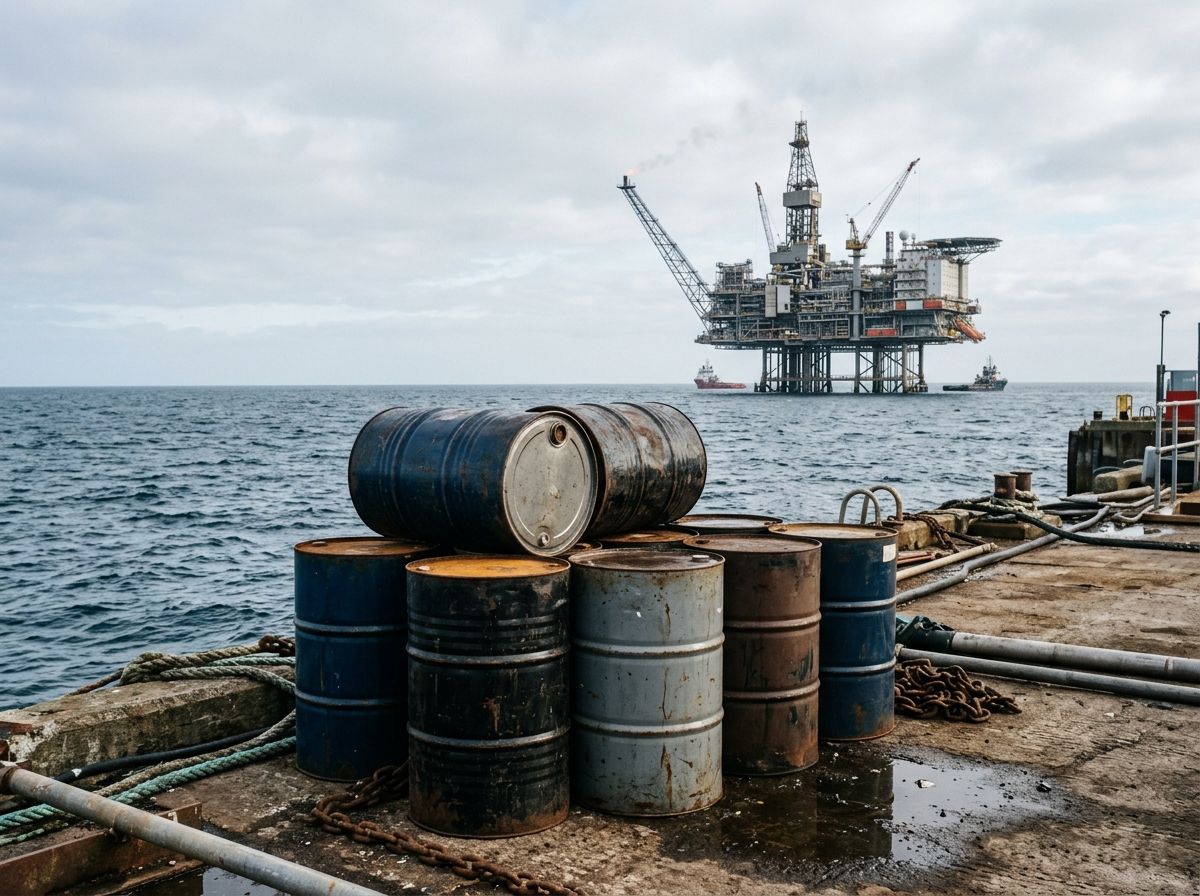
If you’ve seen “barrel per day” in the news and wondered what it actually measures, here’s the short answer: it’s how the oil industry tracks how much crude oil a well, company or country pumps out (or a refinery processes) in a 24-hour period. One barrel equals 42 US gallons, or about 159 litres. When a report says Saudi Arabia produces “9 million barrels per day”, it means that country extracts roughly 9 million times 42 gallons of oil every single day.
It sounds like a niche industry term, but barrel per day figures (often shortened to bpd, bbl/d or b/d) sit behind almost every oil price headline you’ll read this year, including why UK pump prices keep shifting.
What Does “Barrel Per Day” Mean?
Barrel per day is a flow rate, not a fixed amount. It tells you a volume of oil over a set stretch of time, much like miles per hour tells you speed rather than distance alone. A single figure on its own (say, “500,000 barrels per day”) only makes sense alongside the period it covers, which by convention is always one calendar day.
You’ll usually see it written as bpd, bbl/d, b/d or simply bd. All four abbreviations mean exactly the same thing, and you’ll spot different ones depending on which analyst or news outlet you’re reading.
The measure applies to three separate things, and mixing them up is a common source of confusion:
- Production: how much crude a well, field or country extracts each day
- Consumption: how much a country or refinery uses or processes each day
- Capacity: the maximum a facility could handle each day if run flat out
How Big Is a Barrel, Exactly?
A standard oil barrel holds 42 US gallons, which converts to 158.99 litres, according to the conversion widely used across the industry. That’s roughly 35 UK imperial gallons, since a US gallon is smaller than the imperial one most Britons grew up with.
For context, a typical UK family car has a fuel tank of around 50 to 55 litres. One barrel of crude oil, before refining, could theoretically fill that tank about three times over, though refining actually splits a barrel into several different fuels and products (petrol, diesel, jet fuel, and more), not just one.
| Unit | Equivalent |
| 1 barrel | 42 US gallons |
| 1 barrel | 158.99 litres |
| 1 barrel | 34.97 UK imperial gallons |
| 1,000 barrels per day | 158,990 litres per day |
| 1 million barrels per day | almost 159 million litres per day |
Where Did the Barrel Measurement Come From?
The 42-gallon barrel dates back to the very first US oil boom. Early producers in Pennsylvania in the 1860s shipped crude in whatever wooden barrels they could find, mostly old wine, fish or whisky casks. Sizes varied wildly, which made trading a headache, so producers settled on the 42-gallon barrel as a standard in 1872 to keep pricing fair and consistent.
That figure stuck, and it’s still the global default today even though almost nobody actually ships oil in physical wooden barrels anymore. Modern crude moves by pipeline, tanker and rail, but the industry kept the unit because so much pricing, taxation and contract law had already been built around it.
Production, Consumption and Capacity: Three Different bpd Figures
This is where a lot of readers get tripped up, because news stories often use “barrels per day” for all three concepts without explaining which one they mean.
Barrels per calendar day
This is the amount a refinery can realistically process across a 24-hour period under normal operating conditions, allowing for routine maintenance and downtime. It’s the figure regulators and energy agencies tend to quote for refinery capacity.
Barrels per stream day
This is the theoretical maximum a refinery could process if it ran continuously at full capacity with no downtime at all. It’s always higher than the calendar day figure, and it’s more of an engineering benchmark than a real-world average.
Barrels of oil equivalent per day (BOEPD)
Not every producer only pumps crude oil. Many fields also produce natural gas and natural gas liquids, so companies convert everything into a single “barrel of oil equivalent” figure to make output comparable. You’ll see BOEPD (or boe/d) used a lot in North Sea reporting, since UK fields typically produce both oil and gas together.
UK Oil Production in Barrels Per Day
The UK’s own output has fallen a long way from its peak. UK Continental Shelf production, covering both oil and gas measured as barrels of oil equivalent, hit roughly 4.5 million boepd at its high point in 1999. By comparison, current UK Continental Shelf output has dropped to around 1.09 million boepd, a fraction of what it once was.
Crude oil specifically averaged 0.56 million barrels per day in 2024, down from 0.63 million bpd the year before, and industry projections point to a further slide to roughly 0.5 million barrels per day by 2030 as North Sea fields mature and deplete.
The Buzzard field, roughly 100 miles north-east of Aberdeen, remains one of the UK’s biggest single producers at close to 80,000 barrels per day. Meanwhile, Adura, the new joint venture between Shell and Equinor launched in December 2025, is expected to produce more than 140,000 barrels of oil equivalent per day in 2026, making it the largest single North Sea producer this year according to Wood Mackenzie data reported by Shell.
Prices and output figures shift often, so treat exact numbers as a snapshot rather than gospel, and check NSTA (North Sea Transition Authority) publications for the latest official releases.
World Oil Production in Barrels Per Day
Global output runs at just over 100 million barrels per day. The United States leads the table by a wide margin, with the EIA projecting US crude output at around 13.6 million barrels per day for 2026. Saudi Arabia and Russia follow, though 2026 has been an unusually volatile year for both.
| Country | Approximate barrels per day (2026) |
| United States | 13.6 million |
| Saudi Arabia | 8 to 11 million (fluctuating with Middle East disruption) |
| Russia | 9.5 to 10.6 million |
| Canada | 5 to 5.6 million |
| Iraq | around 4.4 million |
| UAE | 3.5 to 4 million |
| Iran | around 4.6 million |
| United Kingdom | around 0.5 to 0.56 million |
Saudi Arabia’s figures moved sharply this year. The country cut daily output from around 10 million barrels per day to about 8 million in March 2026, a 20% drop, after conflict disrupted its ability to export through the Strait of Hormuz, according to reporting from Investing News Network. Given how quickly this situation has shifted through 2026, always check a live source such as the EIA Short-Term Energy Outlook or OPEC’s monthly report before quoting a specific figure.
How Barrel Per Day Figures Affect UK Petrol and Diesel Prices
When production in barrels per day falls short of demand, prices rise, and that filters through to the pump. Brent crude, the benchmark most relevant to UK fuel pricing, was trading around $89 to $93 a barrel on 31 July 2026, roughly £66 to £69 at current exchange rates, having spiked as high as $120 in mid-March 2026 during the worst of the Strait of Hormuz disruption, according to tracking from Oilprice.com and Fortune.
That volatility isn’t unusual. Brent has swung from roughly $42 a barrel during the 2020 pandemic collapse to over $120 during supply shocks, and each swing eventually reaches UK forecourts, since crude cost is the single biggest component of the price you pay for petrol and diesel. It typically takes one to two weeks for a change in the crude price to show up fully at the pump, since retailers work through existing stock first.
How to Convert Barrels Per Day to Other Units
If you need to translate barrel per day figures into something more familiar, here’s the quick maths:
- To litres per day: multiply barrels per day by 158.99
- To UK gallons per day: multiply barrels per day by 34.97
- To cubic metres per day: multiply barrels per day by 0.159
- To tonnes per day (approximate, since density varies by crude grade): divide barrels per day by roughly 7.33 for a typical light crude
These conversions are estimates rather than exact figures for every crude type, since oil density varies by field. For anything contractual or financial, use an official converter or check with a supplier directly.
FAQs
What does bpd mean in oil terms?
Bpd stands for barrels per day, a measure of how much crude oil a well, company or country produces, consumes or processes over a 24-hour period. You’ll also see it written as bbl/d, b/d or bd, all meaning the same thing.
How many litres is a barrel of oil?
One barrel of oil equals 158.99 litres, based on the standard 42 US gallon barrel used across the global oil industry. That works out to roughly 35 UK imperial gallons.
How many barrels per day does the UK produce?
UK crude oil production averaged around 0.56 million barrels per day in 2024, with total oil and gas output (measured as barrels of oil equivalent) at roughly 1.09 million boepd. Output has fallen sharply from a 1999 peak of about 4.5 million boepd and is projected to keep declining as North Sea fields mature.
What country produces the most oil per day?
The United States is the world’s largest oil producer, with output projected at around 13.6 million barrels per day in 2026 according to the EIA, ahead of Saudi Arabia and Russia.
Why do oil reports use barrels instead of litres?
The 42-gallon barrel became the industry standard in 1872 during the early Pennsylvania oil boom, when producers needed a consistent unit for fair trading. It stuck as the global benchmark even though oil no longer moves in physical wooden barrels.
What’s the difference between barrels per day and barrels of oil equivalent per day?
Barrels per day usually refers to crude oil alone, while barrels of oil equivalent per day (BOEPD) converts both oil and natural gas output into one combined figure. UK North Sea fields often produce both, so you’ll see BOEPD used more often in UK reporting than plain bpd.
How does barrel per day production affect UK fuel prices?
When global production in barrels per day can’t keep pace with demand, the price of Brent crude rises, and that cost typically reaches UK forecourts within one to two weeks. Brent is the benchmark most relevant to petrol and diesel prices in the UK.
Is a barrel of oil the same as a barrel of beer?
No. A UK beer barrel holds 36 imperial gallons (about 163.7 litres), while an oil barrel holds 42 US gallons (about 159 litres). They’re close in size by coincidence, but they’re defined completely separately and aren’t interchangeable in any legal or trading sense.