If you’ve searched for Ryanair flight RK558 emergency, here’s the short answer: on 19 March 2026, the Dublin to Manchester service landed safely just after 6pm and was met by fire crews after ground staff spotted a hydraulic fluid leak and, according to some witnesses, smoke coming from the aircraft. Nobody was hurt. Ryanair called it a “minor tech issue” and the plane was towed back to stand for inspection.
That’s the headline. But if you were on that flight, know someone who was, or you’re just trying to work out whether flying RK558 (or any Ryanair route) is safe, there’s more worth knowing: what caused it, how airports handle this kind of alert, what your rights are if a technical fault ever delays or diverts your flight, and how this incident compares with other recent Ryanair scares.
What happened on flight RK558
Ryanair flight RK558 operates the Dublin to Manchester route and is usually flown with a Boeing 737-800 or 737 MAX 8-200, depending on which aircraft Ryanair rotates onto the route that day. On Thursday 19 March 2026, the flight touched down at Manchester Airport’s Terminal 3 shortly after 6pm.
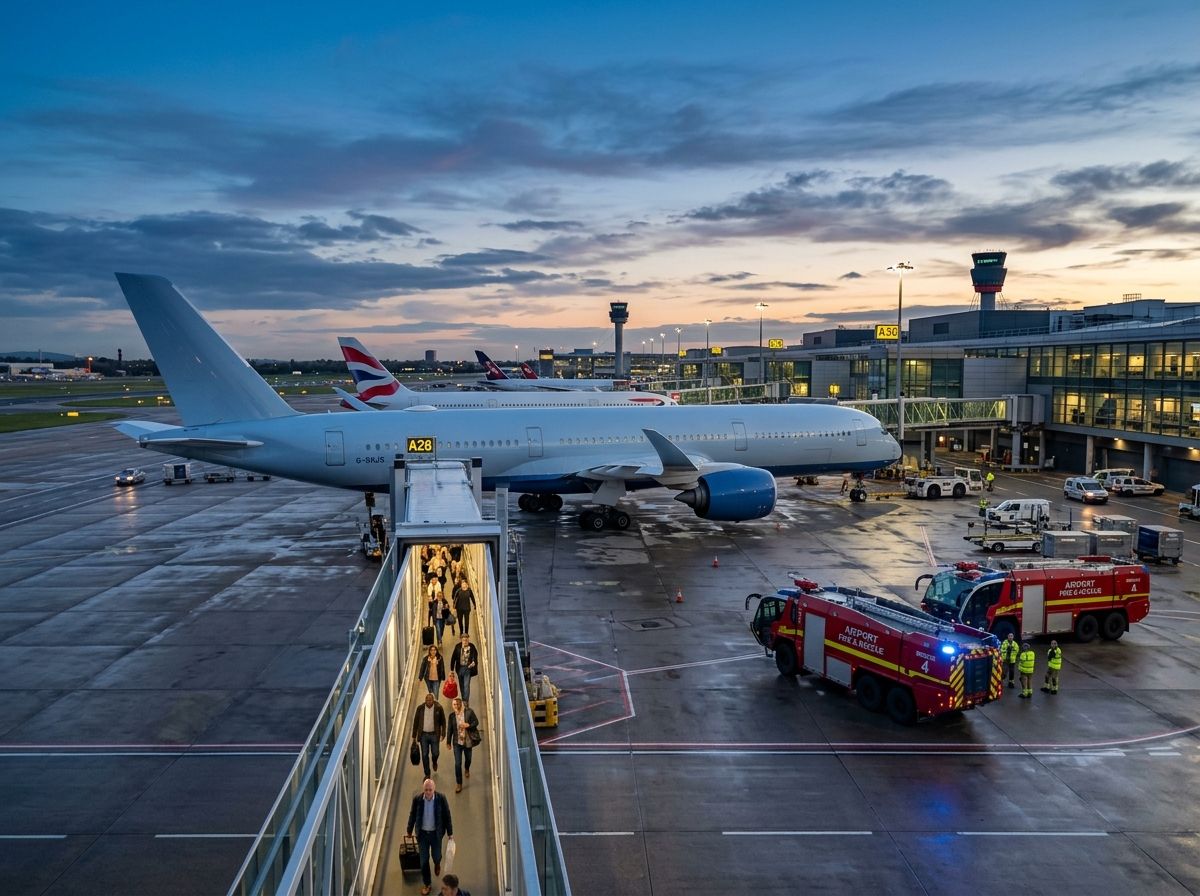
Almost immediately, ground staff noticed fluid leaking from the aircraft, later confirmed as a hydraulic leak rather than a fuel leak, and some bystanders reported seeing smoke. Manchester Airport Fire Service vehicles were sent out as a precaution, alongside an ambulance crew, standard practice whenever there’s any suggestion of leaking fluid or visible smoke near an aircraft.
Passengers disembarked normally through the terminal, not via emergency slides, which tells you this was treated as a precautionary ground response rather than an in-flight emergency. The aircraft was towed back to the stand so Ryanair engineers could inspect it properly.
Why arrivals were paused
Manchester Airport briefly suspended arrivals while the situation was assessed. Reported figures vary between roughly seven minutes and around half an hour, depending on the source, which isn’t unusual for early, fast-moving reports of the same event. Either way, this is a routine safety step: air traffic control holds other aircraft back from the runway and stands nearest the incident until fire crews confirm there’s no ongoing risk.
No other flights were cancelled because of it, and Manchester Airport returned to normal operations the same evening.
Was anyone hurt?
No. Every report so far, including Ryanair’s own statement, confirms that passengers and crew disembarked normally and that there were no injuries. The fire crew attendance was precautionary, which is standard whenever ground staff spot fluid on the tarmac or report smoke, even when there turns out to be no fire risk at all.
What Ryanair said
A Ryanair spokesperson gave this statement to reporters the day after the incident: the flight “experienced a minor tech issue upon landing,” passengers and crew “disembarked normally,” and the aircraft “was towed back to stand to be inspected by Ryanair engineers.” Ryanair hasn’t published further detail on the exact cause of the leak, and neither the airline nor the airport has confirmed publicly what triggered it.
That’s a normal level of disclosure for an incident of this size. Airlines rarely publish full technical write-ups for minor faults that don’t involve injury, diversion, or an aviation authority investigation.
Is this the same as an “emergency landing”?
Not quite, and the wording matters. RK558 had already landed when the leak was spotted. This wasn’t a mid-air emergency, a mayday call, or a diversion. It’s better described as a post-landing precautionary response: something Manchester Airport and every major UK airport handle multiple times a month for all sorts of airlines, not just Ryanair.
Genuine in-flight emergencies (a mayday declared while airborne, an emergency landing at an unplanned airport, or evacuation via slides) are a different category, and they’re rarer and much more heavily reported when they do happen.
How this compares with other recent Ryanair incidents
RK558 wasn’t the first Ryanair story to make headlines in 2026. A Ryanair flight from Tirana to Manchester (flight RK8293) diverted to London Stansted in November after a passenger suffered a medical emergency on board; despite efforts by cabin crew and fellow passengers, the man died. In October 2023, a Belfast to Edinburgh Ryanair flight turned back shortly after take-off when an emergency pressurisation warning came on in the cockpit.
Ryanair carries well over 200,000 passengers a day across Europe, so on sheer volume it will feature in aviation news more often than smaller airlines, even if its underlying safety record is in line with the rest of the industry. None of this means RK558, or Ryanair generally, is unusually risky, it just means one flight’s mechanical hiccup made the news cycle for a day.
What happens to your flight if there’s a technical fault
If you’re flying Ryanair, or any airline, and your service is delayed, cancelled, or diverted because of a technical fault, you may have rights under UK261 (the UK’s retained version of EU passenger rights law).
Compensation. UK case law, going back to Huzar v Jet2.com in the Court of Appeal, established that most technical faults do not count as “extraordinary circumstances.” That matters because it means airlines usually can’t use “it was a technical problem” alone as a reason to avoid paying compensation for a long delay or cancellation. Compensation for a UK261 claim currently ranges up to £520 depending on flight distance and delay length, according to the Civil Aviation Authority (CAA).
Care while you wait. Regardless of the cause, airlines must provide meals, refreshments, and hotel accommodation if you’re delayed overnight, plus a way to make calls or send emails, for delays over two hours (short-haul) as set out by the CAA.
When you won’t be compensated. Extraordinary circumstances genuinely outside the airline’s control, severe weather, air traffic control strikes, airport-side power failures, still don’t qualify for compensation, even though care and assistance obligations usually still apply.
What to do if you were on RK558 or a similar disrupted flight
- Keep your boarding pass and any receipts for food, drinks, or transport you paid for because of the delay.
- Note the times: when you were told about the delay, when you actually departed or disembarked, and any announcements made.
- Check Ryanair’s own compensation portal first, since claims made directly with the airline are usually free and faster than going through a third-party claims firm that takes a cut.
- Escalate to an Alternative Dispute Resolution (ADR) scheme if Ryanair rejects a valid claim; Ryanair’s ADR provider is listed on the CAA’s website.
- Use the CAA’s passenger rights checker if you’re unsure whether your specific situation qualifies.
Prices, thresholds and airline policies change fairly often, so it’s worth checking Ryanair’s own site and the CAA’s passenger rights pages before you submit a claim.
FAQS
What is Ryanair flight RK558?
RK558 is Ryanair’s scheduled service between Dublin and Manchester. On 19 March 2026, this flight landed safely at Manchester Terminal 3 before ground staff spotted a hydraulic leak, prompting a precautionary fire crew response.
Was Ryanair flight RK558 an emergency landing?
No. The aircraft had already landed normally when the leak was noticed. Fire crews attended as a precaution once smoke and fluid were reported, but this was a ground incident rather than a mid-air emergency or diversion.
Was anyone injured on Ryanair flight RK558?
No injuries have been reported. Passengers and crew disembarked through the terminal in the usual way, and Ryanair confirmed this in its statement to the press.
What caused the RK558 incident?
Reports point to a hydraulic fluid leak that developed either during or shortly after landing. Ryanair described it publicly only as a “minor tech issue” and hasn’t released further technical detail on the root cause.
Did the RK558 incident close Manchester Airport?
No, the airport didn’t close. Arrivals were paused for a short period, reported as anywhere from around seven minutes to roughly half an hour, while emergency crews assessed the aircraft, then normal operations resumed the same evening.
Am I owed compensation if my Ryanair flight is delayed by a technical fault?
Often, yes. Under UK261, most technical faults don’t count as extraordinary circumstances, so you may be entitled to compensation of up to £520 depending on distance and delay length, according to the CAA. Extreme weather or airport failures are treated differently.
Is Ryanair safe to fly with after incidents like this?
Ryanair’s overall safety record is comparable to other major European carriers, and incidents like RK558 are precautionary responses rather than signs of a wider safety problem. High passenger volumes mean Ryanair naturally appears in aviation news more often than smaller airlines.
Where can I check the current status of a Ryanair flight?
Ryanair’s own website and app show live flight status, and third-party trackers such as Flightradar24 show real-time position and delay data, though only the airline’s own channels are authoritative for rebooking and compensation purposes.