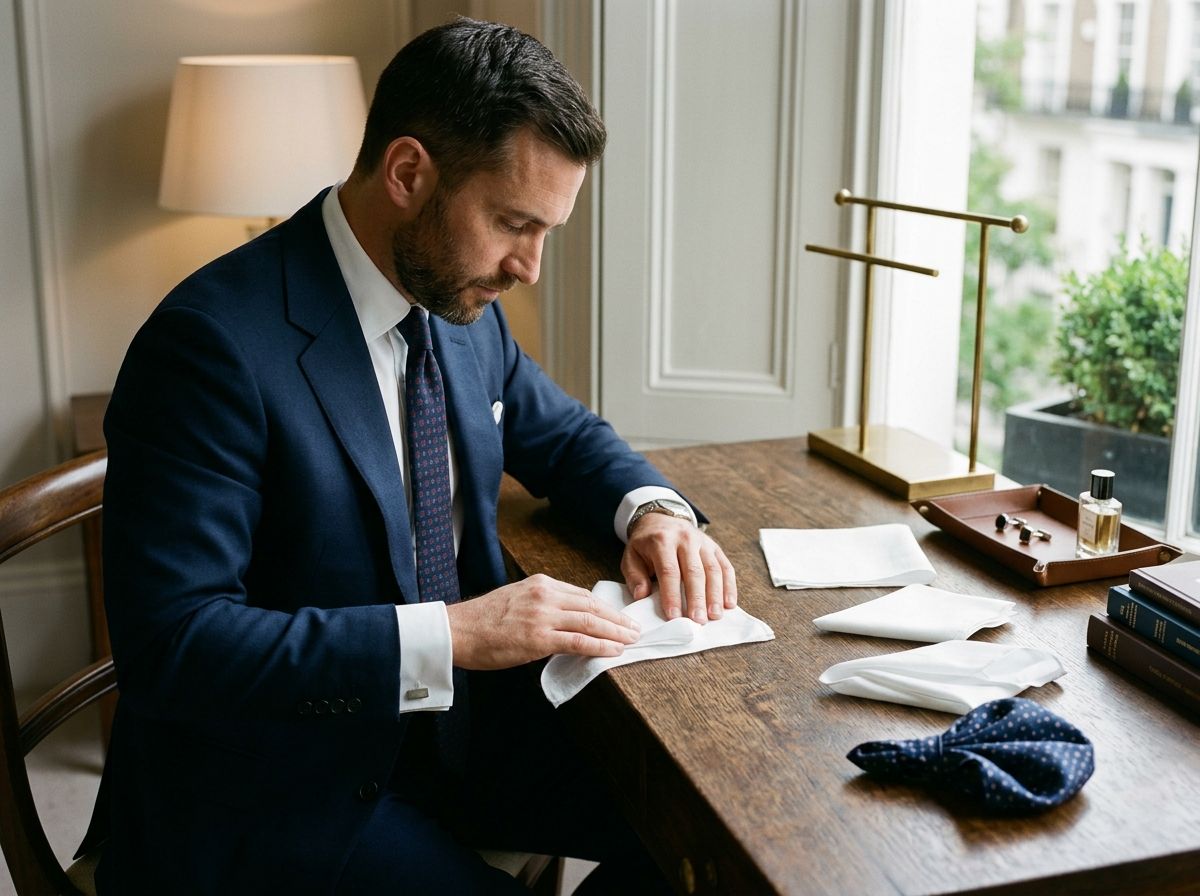
The quickest way to fold a pocket square is the Presidential fold: fold it in half twice to make a small square, then tuck it into your breast pocket with the folded edge facing up. That’s the fold most men reach for first, and it works for almost any suit or occasion. But it’s not the only option. Below, we’ll walk through five folds worth knowing, from that flat classic through to the more relaxed Puff, plus which fabric suits which fold, how much square should show, and the mistakes that give away a rushed job.
What You’ll Need Before You Start
A pocket square folds best straight from the drawer, pressed and unwrinkled. You don’t need any tools beyond a flat surface and, if the fabric is stubborn, a cool iron to set the folds. Cotton and linen squares hold a crisp fold well. Silk is slippier and suits the softer, less structured folds, since sharp creases tend to slip out of silk within an hour of wear.
The Presidential Fold (Also Called the Flat or TV Fold)
This is the fold to learn first if you’re only going to learn one. It’s clean, formal, and near-impossible to get wrong.
- Lay the pocket square flat and press out the corners so it forms a neat square.
- Fold it in half to make a rectangle.
- Fold it in half again so you’re left with a smaller square.
- Tuck it into your breast pocket with the folded edges facing up, leaving a straight line visible above the pocket.
This fold suits structured fabrics like cotton and linen, and it’s the safest choice for black tie, weddings, or any occasion where you want the pocket square to look deliberate rather than decorative.
The One Point Fold (Triangle Fold)
A step up in visual interest without much extra effort. This fold gives you a single crisp point rising out of the pocket.
- Lay the square flat in a diamond shape, with one corner pointing up.
- Fold the bottom corner up to meet the top corner, forming a triangle.
- Fold the left and right corners of the triangle in towards the centre, tapering the base.
- Fold the bottom edge up to the height you want, then tuck it into your pocket, point facing up.
It’s a versatile fold that works for business meetings and semi-formal events alike, and it reads as slightly more relaxed than the Presidential fold.
The Two Point Fold (Twin Peaks)
A natural next step from the One Point, giving you two peaks instead of one. It’s a popular choice among UK menswear brands for weddings and formal dinners.
- Start as you would for the One Point fold, forming a triangle from a diamond shape.
- Fold the right corner across to the left of centre, creating your first point.
- Fold the left corner across to the right of centre, creating your second point, slightly offset from the first.
- Fold the bottom up to fit your pocket depth and tuck it in, points facing up.
The Puff Fold
The most forgiving fold on this list, and the best starting point if precision isn’t your strong suit. It also happens to be the quickest.
- Lay the square flat and pinch the centre between your thumb and finger.
- Lift it up so the fabric falls into loose, natural folds around your pinch point.
- Gather the base with your other hand and adjust the folds so they sit evenly.
- Tuck the gathered base into your pocket, letting the puffed top sit just above the pocket line.
This fold works best with silk pocket squares, since the fabric drapes rather than holds a sharp edge, and it suits casual blazers just as well as a suit jacket.
The Reverse Puff
A variation on the Puff that’s slightly neater and less prone to unravelling through the day.
- Follow the same first two steps as the Puff fold, pinching the centre and letting the fabric fall.
- Instead of tucking the gathered base straight in, fold it under itself once before placing it in the pocket.
- Adjust the visible fabric so it fans out slightly rather than sitting in one clump.
Choosing a Fold by Fabric and Occasion
Structured fabrics like cotton and linen hold sharp creases, which is why they work well for the Presidential, One Point and Two Point folds. Silk, by contrast, is too fluid to hold a crease reliably, so it’s better suited to the Puff or Reverse Puff, where the appeal is movement rather than precision. If you’re not sure which to pick, a plain white cotton or linen square folded into a Presidential fold is the one choice that works for almost every formal occasion in the UK, from job interviews to weddings.
How Much of the Pocket Square Should Show?
As a rule of thumb, aim for around 1 to 1.5cm of fabric visible above the pocket, roughly the width of your thumb. Too little and it looks like an afterthought. Too much and it starts to compete with your tie rather than complement it. For puff folds, a slightly larger amount showing, around 2 to 3cm, tends to look intentional rather than sloppy.
Common Mistakes to Avoid
- Matching your tie and pocket square exactly. Most UK style guides, including those from Charles Tyrwhitt and Savile Row Company, recommend a pocket square that complements your tie in colour rather than mirrors it in fabric and pattern.
- Folding a silk square into a sharp-edged fold like the Presidential, which rarely holds and tends to sag within the hour.
- Overstuffing the pocket so the fold loses its shape before you’ve even left the house.
- Ironing creases in too firmly, which can leave permanent lines that show even when the square is folded a different way next time.
- Forgetting to press the square flat before you start, which throws off every fold that follows.
FAQs
What is the easiest pocket square fold?
The Puff fold is generally the easiest, since it doesn’t rely on precise measurements or sharp creases. You simply pinch the centre, let the fabric fall naturally, and tuck the base into your pocket.
How do you fold a pocket square for a wedding?
The Two Point or Presidential fold are the most popular choices for weddings in the UK, both giving a neat, deliberate look that photographs well. A crisp white or pale cotton square is the safest option if you’re unsure what the rest of the wedding party is wearing.
Should a pocket square match the tie?
No, not exactly. Most style guidance recommends choosing a pocket square that complements the tie in colour or tone rather than matching the fabric and pattern precisely, since an exact match can look overly coordinated.
What fabric is best for a pocket square?
Cotton and linen hold sharp folds well and suit formal, structured looks. Silk drapes more naturally and works better for softer folds like the Puff, though it won’t hold a crisp point for long.
How much pocket square should show above the pocket?
Around 1 to 1.5cm is the standard guide for structured folds, with slightly more, around 2 to 3cm, acceptable for puff-style folds where a looser look is the point.
Can you use a handkerchief instead of a pocket square?
Yes, a clean cotton handkerchief works as a substitute in a pinch, though handkerchiefs are usually larger than pocket squares, so watch for extra bulk in the pocket and fold in the excess fabric before tucking it in.
Do you need to iron a pocket square before folding it?
It helps, particularly for structured folds like the Presidential or One Point, since starting from a flat, wrinkle-free square makes every fold sharper and easier to control. A cool iron is usually enough; check the fabric care label first, especially with silk.