If you’ve searched “capkek” and landed here wondering what it actually means, here’s the short answer: capkek is a spelling variant of cupcake, most commonly seen in Turkish social media posts (kapkek), and it refers to exactly what you think, a small individual cake baked in a paper case, usually topped with icing. There’s no separate product or technique behind the word. It’s the same treat British bakers know as a cupcake or fairy cake.
This guide covers where the term comes from, how it differs (or doesn’t) from a UK fairy cake, and a full step-by-step method for baking capkek/cupcakes at home, plus answers to the most common questions people ask.
What Does “Capkek” Mean?
Capkek isn’t a distinct baking term with its own definition. It’s an informal or phonetic spelling that shows up mostly on Instagram, TikTok and Pinterest, largely from Turkish-language accounts posting cupcake recipes and decorating videos under tags like #capkek and #kapkek. In Turkish, “kek” means cake, and “kapkek” is simply how English “cupcake” gets adapted into Turkish spelling and pronunciation.
If you’re in the UK and searching for this term, you almost certainly mean cupcake. The rest of this guide treats capkek and cupcake as the same thing, because that’s what they are.
Capkek vs Fairy Cake: Is There a Difference?
Not really, though British bakers sometimes draw a light distinction. A fairy cake is traditionally smaller, made with a plain sponge mix, and topped with a simple glacé icing or a small swirl of buttercream. A cupcake (or capkek) tends to be a bit larger, often made with a richer batter, and topped more generously, sometimes with swirled buttercream, ganache, or fondant decoration.
In practice, most home bakers and shops in the UK use the two terms loosely. If you order a “cupcake” from a bakery, you’ll usually get the bigger, more heavily decorated version. If you see “fairy cakes” on a supermarket shelf, expect something plainer and smaller.
What You Need to Bake Capkek (Cupcakes) at Home
Equipment
- A 12-hole cupcake or muffin tin
- Paper cupcake cases
- Mixing bowls, a whisk or electric mixer, and a rubber spatula
- An ice cream scoop or two dessertspoons for portioning batter
- A wire cooling rack
- A piping bag and nozzle if you plan to decorate
Ingredients (makes 12 standard cupcakes)
- 175g unsalted butter, softened
- 175g caster sugar
- 3 large eggs
- 175g self-raising flour
- 1 tsp vanilla extract
- 2 tbsp milk (if needed, to loosen the batter)
This is the classic all-in-one sponge ratio (equal weights of butter, sugar and flour, one egg per 60g roughly), which is the most reliable base for a light, evenly risen cupcake.
Step-by-Step Method
1. Prepare Your Tin and Oven
Preheat your oven to 180°C (160°C fan/Gas Mark 4). Line a 12-hole cupcake tin with paper cases. Getting the oven properly up to temperature before the tray goes in matters more than people think, a cool oven gives flat, dense cupcakes.
2. Cream the Butter and Sugar
Beat the softened butter and caster sugar together for 3 to 4 minutes until pale and fluffy. This step adds air into the mixture, which is what gives the sponge its rise, so don’t rush it.
3. Add the Eggs
Add the eggs one at a time, beating well after each addition. If the mixture starts to look like it’s splitting, add a spoonful of the flour to bring it back together.
4. Fold in the Flour
Sift in the self-raising flour and fold it through gently with a metal spoon or spatula. Overmixing at this stage knocks the air back out, so stop as soon as you can’t see streaks of flour.
5. Add Vanilla and Loosen
Stir in the vanilla extract. If the batter looks stiff and doesn’t fall easily off a spoon, add the milk a little at a time until it reaches a soft, dropping consistency.
6. Fill the Cases
Divide the mixture evenly between the 12 cases, filling each about two-thirds full. This leaves room for the cupcakes to rise without spilling over the top.
7. Bake
Bake for 18 to 20 minutes, until well risen, golden, and springy to the touch. A skewer inserted into the centre should come out clean. Ovens vary, so start checking from 16 minutes.
8. Cool Completely
Leave the cupcakes in the tin for 5 minutes, then move them to a wire rack to cool fully before icing. Icing a warm cupcake will melt your topping and slide straight off.
Simple Buttercream Topping
- 125g unsalted butter, softened
- 250g icing sugar, sifted
- 1 to 2 tbsp milk
- ½ tsp vanilla extract
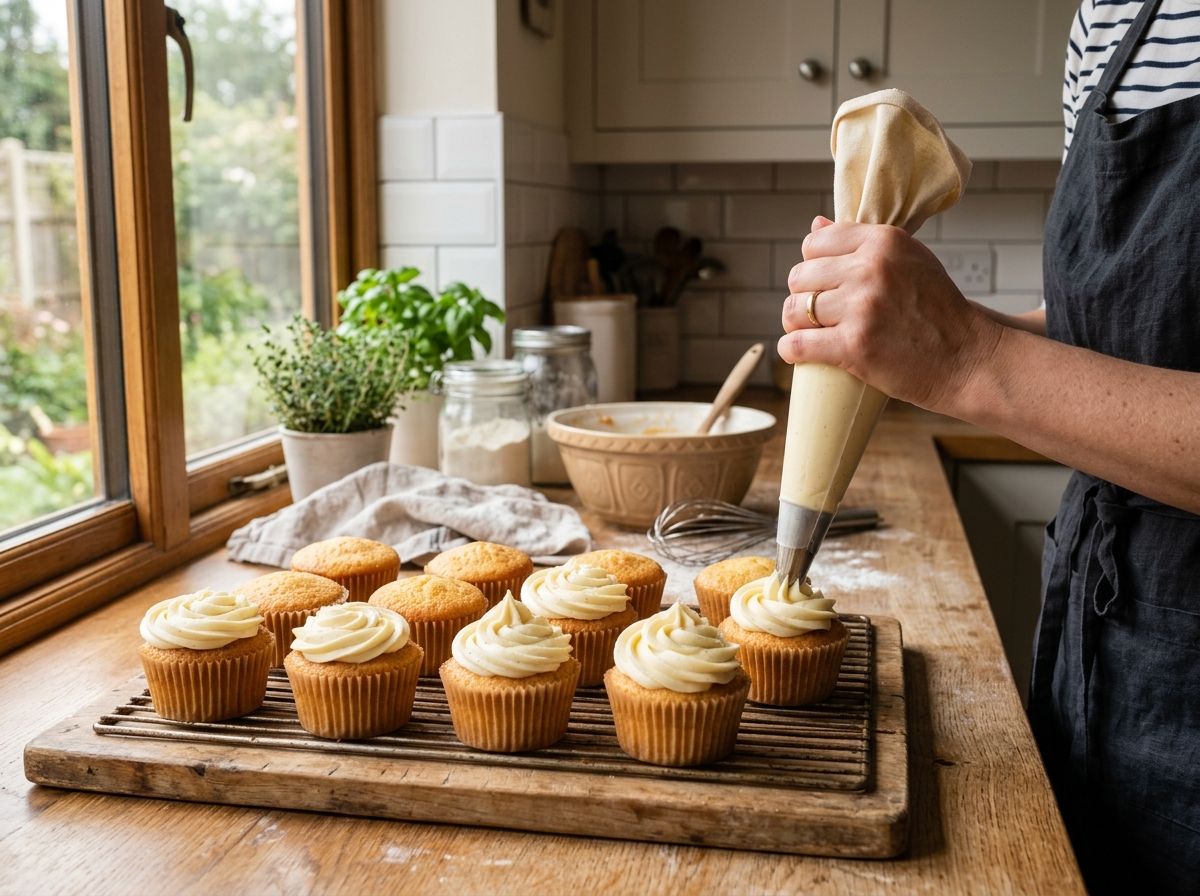
Beat the butter until smooth, then gradually add the icing sugar, beating well between additions. Add the milk a little at a time until you get a soft, pipeable consistency, then stir in the vanilla. Pipe or spread onto fully cooled cupcakes.
Common Mistakes to Avoid
- Overfilling the cases. More than two-thirds full and the batter spills over the edge as it rises, giving you a messy, uneven top.
- Opening the oven door too early. This drops the temperature suddenly and can cause the sponge to sink in the middle.
- Overmixing after adding the flour. This knocks out the air you worked to build in during creaming, leaving a denser, tougher crumb.
- Icing before they’ve cooled. Even slightly warm cupcakes will melt buttercream into a puddle rather than holding a neat swirl.
Storage and Shelf Life
Undecorated cupcakes keep in an airtight container at room temperature for about 3 days. Once topped with buttercream, they’re best eaten within 2 to 3 days and should be kept somewhere cool, though not necessarily the fridge, as chilling can dry out the sponge. Unfrosted cupcakes also freeze well for up to 3 months; wrap them individually and thaw at room temperature before icing.
FAQs
What does capkek mean?
Capkek is an informal spelling of cupcake, seen mainly in Turkish-language social media posts (also written kapkek). It refers to the same small, individually baked cake topped with icing that’s familiar in the UK as a cupcake.
Is capkek the same as a cupcake?
Yes. There’s no meaningful difference. Capkek is simply a phonetic or regional spelling variant, not a distinct type of cake or a different recipe.
What’s the difference between a cupcake and a fairy cake?
A fairy cake is usually smaller with a plainer sponge and light glacé icing, while a cupcake tends to be larger, richer, and more heavily decorated with buttercream. In everyday UK use, though, the two words are often used interchangeably.
Why did my cupcakes sink in the middle?
This usually happens because the oven door was opened too early, the oven wasn’t hot enough to begin with, or there was too much raising agent or liquid in the mix. Stick to the stated bake time before checking, and make sure your oven is fully preheated.
Why are my cupcakes dense instead of light?
Dense cupcakes are typically caused by undercreaming the butter and sugar, overmixing once the flour goes in, or measuring ingredients inaccurately. Weighing ingredients on digital scales rather than using cup measures gives more consistent results.
How long do cupcakes take to bake?
Standard-sized cupcakes take around 18 to 20 minutes at 180°C (160°C fan/Gas Mark 4). Mini cupcakes need closer to 10 to 12 minutes, and larger Texas-style muffin tins can take 22 to 25 minutes.
Can I make cupcakes without an electric mixer?
Yes. A wooden spoon and a bit of elbow grease will work fine for creaming butter and sugar, it just takes a few minutes longer to get the same pale, fluffy texture. A hand whisk speeds things up if you have one.
Can capkek/cupcakes be made ahead for a party?
Yes. Bake the sponges up to 2 days ahead and store them undecorated in an airtight container, or freeze for up to 3 months. Ice them on the day of the party for the best appearance and texture.