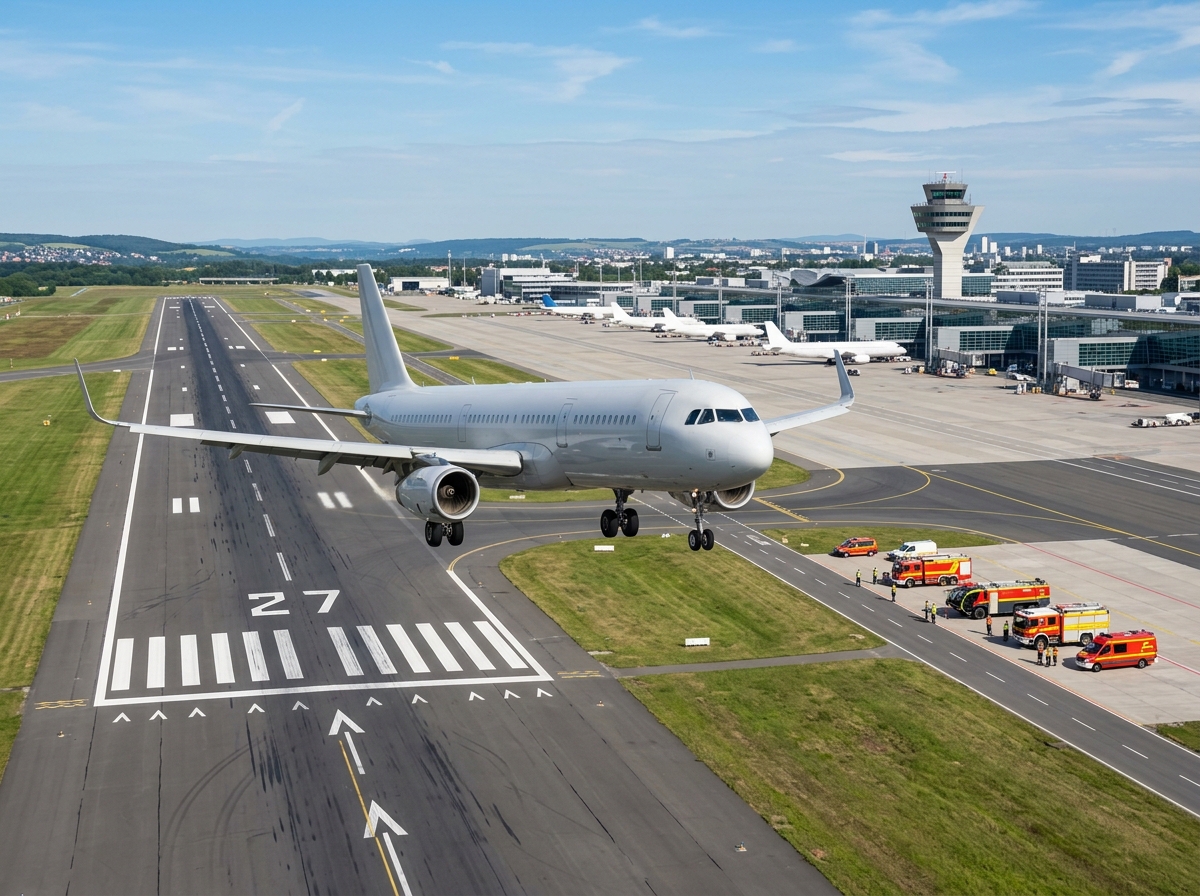
If you’re searching for easyJet U22152 emergency Germany, here’s the direct answer: on 15 August 2025, an easyJet Airbus A320 flying from Istanbul to Manchester diverted to Cologne after the first officer became incapacitated with severe stomach pain, according to Aviation Herald, the aviation industry’s leading incident-tracking source. The aircraft landed safely, no injuries to passengers were reported, and the flight eventually reached Manchester around 5 hours behind schedule after a replacement pilot was flown in. A fair amount of confused or padded-out detail has circulated online since, so this article sticks closely to what’s actually been verified.
What happened on easyJet flight U22152?
Flight U22152, operated by an Airbus A320-200 registered G-EZRX, was flying from Istanbul, Turkey, to Manchester with 185 people on board, according to Aviation Herald’s incident report, republished by AeroInside. The aircraft was cruising at 36,000 feet, roughly 150 nautical miles east-southeast of Cologne, when the captain made the decision to divert.
The reason was medical, not mechanical. The first officer had become incapacitated with severe stomach pain, and food poisoning was suspected, though this was never formally confirmed in a public statement from easyJet or a hospital. The captain declared an emergency and turned the aircraft towards Cologne Bonn Airport.
Why did the crew declare an emergency over Germany?
Declaring an emergency isn’t a sign that a flight is in immediate danger of crashing. It’s a formal procedure that gives a flight priority handling from air traffic control, which matters when time or crew capacity is limited, as it was here with one of two pilots unable to continue duties.
With the first officer unable to work, the captain judged that landing as soon as reasonably possible was the safest course of action, rather than continuing on to Manchester. That’s a standard, trained response to crew incapacitation, not an unusual overreaction.
What does declaring an emergency and squawk 7700 mean?
Aircraft in genuine difficulty, or facing a situation that needs priority attention, transmit a specific transponder code known as squawk 7700, the internationally recognised general emergency code. Flight tracking site AIRLIVE.net detected U22152 broadcasting this code shortly after the crew made their decision.
Squawking 7700 tells every air traffic controller monitoring that airspace that the aircraft needs priority handling immediately, whether that’s for a medical issue, a technical fault, or anything else the crew judges serious enough to flag. It doesn’t, by itself, tell you what the problem is, which is part of why incidents like this generate so much speculation online before the actual cause becomes clear.
Timeline of the diversion
Based on Aviation Herald’s verified reporting, here’s how the diversion unfolded.
- Cruising normally at flight level 360 (36,000 feet) on the Istanbul to Manchester route.
- First officer became incapacitated with severe stomach pain while roughly 150 nautical miles from Cologne.
- Captain declared an emergency and turned the aircraft towards Cologne Bonn Airport.
- Aircraft landed safely on Cologne’s runway 32R approximately 27 minutes after the decision to divert.
- First officer was taken to hospital, with food poisoning suspected as the cause.
- Passengers remained on board at Cologne while easyJet arranged a replacement pilot.
- Flight continued to Manchester, arriving with a delay of roughly 5 hours.
What happened to passengers after landing in Cologne?
Passengers stayed on the aircraft at Cologne Bonn Airport while easyJet organised a replacement pilot to complete the flight, according to Aviation Herald’s report. No injuries among passengers were reported at any point during the incident.
Some other articles circulating online about this event include figures, like an eight-hour delay, that don’t match Aviation Herald’s verified reporting of roughly 5 hours. It’s worth treating any specific number you see elsewhere with caution and checking it against a primary aviation incident source rather than a general news aggregator.
Is this kind of diversion common for easyJet or other airlines?
In-flight crew medical incapacitation is rare but not unheard of across the industry, which is precisely why commercial aircraft always fly with two qualified pilots rather than one. That redundancy exists specifically so a flight can be brought down safely if either pilot becomes unable to continue.
Beyond that general point, we haven’t been able to independently verify claims circulating online about a wider pattern of similar easyJet diversions on other specific routes and dates, so we’re not repeating those figures here without a primary source to confirm them.
Can passengers claim compensation for a diversion like this?
This is genuinely murky legal territory, so it’s worth understanding both sides rather than assuming a simple answer.
UK261 and extraordinary circumstances
Under UK261 (the retained EU261 rules), airlines don’t have to pay cash compensation for delays caused by “extraordinary circumstances”, situations outside their control, according to the UK Civil Aviation Authority. Airlines, including easyJet, typically classify in-flight medical emergencies as extraordinary circumstances and decline compensation claims on that basis.
However, a 2020 English court ruling in a separate case involving a different airline found that a diversion caused by a passenger’s medical emergency was not an extraordinary circumstance, since the legal test requires a genuine threat to the aircraft, passengers or crew, according to legal analysis from Bird & Bird. That ruling specifically concerned passenger illness rather than crew incapacitation, so it isn’t clear whether the same reasoning would apply to a case like U22152, where the affected person was a working crew member rather than a passenger. If you were on this flight and want to pursue a compensation claim, it’s worth getting specific advice rather than assuming either outcome, since I’m not able to give a definitive legal answer here and the case law in this area is still developing.
What airlines must still provide regardless of cause
Whatever the compensation position, airlines are still required to provide care during a long delay, regardless of the cause, according to the CAA. This includes meals and refreshments proportionate to the wait, access to communications, and overnight accommodation plus transport if the delay runs into the next day. This obligation applies even when extraordinary circumstances rule out cash compensation.
FAQS
What happened on easyJet flight U22152?
On 15 August 2025, easyJet flight U22152 from Istanbul to Manchester diverted to Cologne, Germany, after the first officer became incapacitated with severe stomach pain. The aircraft landed safely, and the flight continued to Manchester with a replacement pilot after a delay of roughly 5 hours.
Why did easyJet U22152 declare an emergency?
The crew declared an emergency because the first officer was unable to continue performing duties due to sudden, severe stomach pain, and the captain judged an immediate landing to be the safest option. Declaring an emergency gives a flight priority handling from air traffic control rather than indicating the aircraft was in imminent danger.
Where did easyJet U22152 land?
The flight landed safely at Cologne Bonn Airport in Germany, on runway 32R, approximately 27 minutes after the captain decided to divert. The first officer was taken to hospital, and passengers remained on board while a replacement pilot was arranged.
Was anyone injured on easyJet flight U22152?
No passenger injuries were reported at any point during the incident, according to Aviation Herald’s report. The first officer was taken to hospital as a precaution, with food poisoning suspected as the cause, though this was never formally confirmed publicly.
What does squawk 7700 mean?
Squawk 7700 is the internationally recognised transponder code aircraft use to signal a general emergency to air traffic control. It was detected on flight U22152 shortly after the crew decided to divert, alerting controllers to give the aircraft priority handling.
How long was the delay on easyJet U22152?
The flight reached Manchester with a delay of roughly 5 hours, according to Aviation Herald’s verified reporting. Some other sources online cite different figures, so it’s worth checking against a primary aviation incident source rather than a general news aggregator.
Can I claim compensation if I was on a diverted flight like this?
It depends on how the diversion is classified. Airlines generally treat crew medical emergencies as extraordinary circumstances, which rules out cash compensation under UK261, though the legal picture around medical diversions has been contested in court and isn’t fully settled, so specific advice is worth seeking if you were affected.
Why do two pilots matter on a commercial flight?
Commercial aircraft carry two qualified pilots specifically so a flight can continue safely if one becomes unable to perform their duties, as happened on U22152. This redundancy is a core part of why the diversion was handled safely rather than becoming a more serious situation.