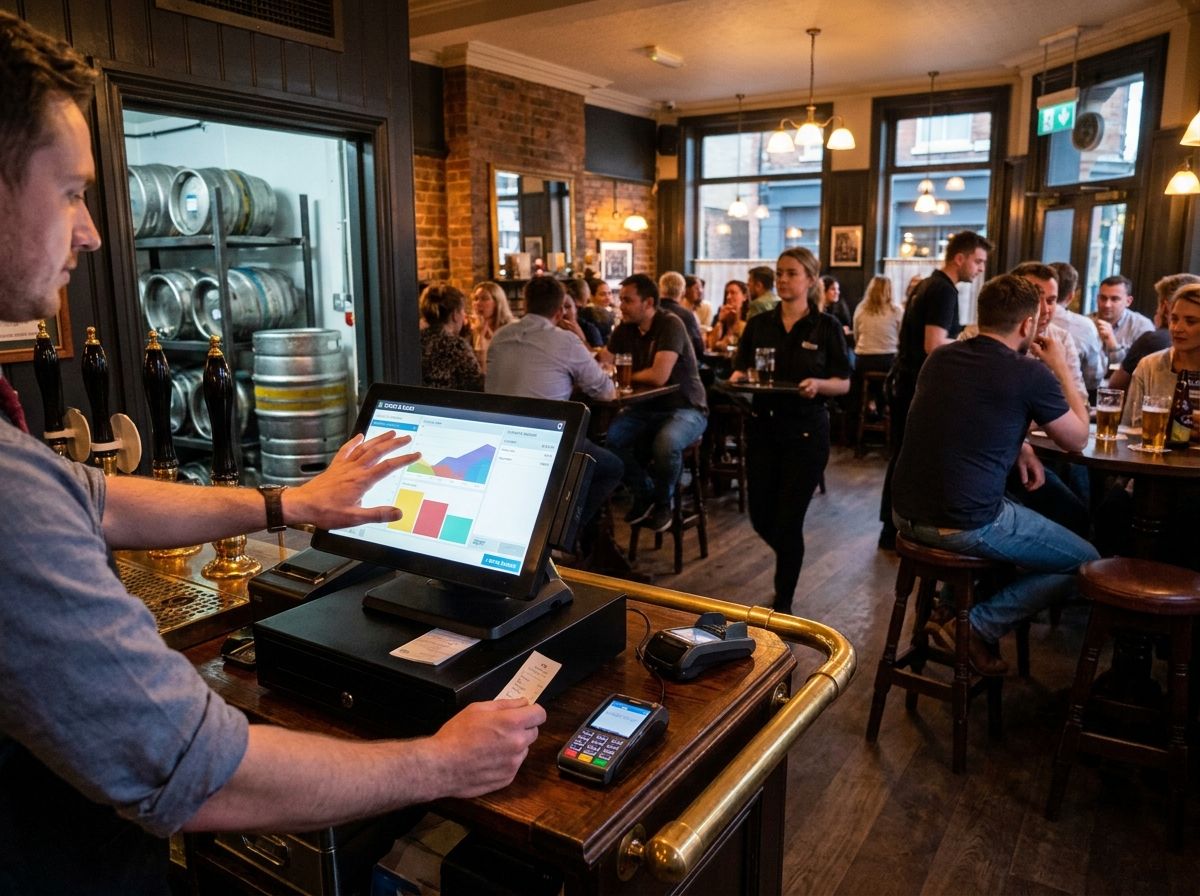
The right epos system for pubs and bars needs to handle open tabs, split rounds, cellar stock and a rushed Friday night bar queue, none of which a generic retail till is built for. Pub and bar search results overlap so heavily that separating “bar EPOS” from “pub POS” would mean writing the same article twice, so this guide covers both terms together and focuses purely on wet-led trade features rather than repeating the general pricing comparison you’ll find elsewhere on this site.
We’ll walk through tab management, round splitting, cellar and keg tracking, wet-to-dry margin reporting, age verification, tied-house reporting duties for pubco tenants, and handheld ordering, the features that actually decide whether a system holds up on a busy Saturday night rather than just looking good in a demo.
What a Bar EPOS System Needs That a Generic Till Doesn’t
A standard retail till records a sale and prints a receipt. A pub or bar environment demands considerably more, since customers run tabs across several rounds, staff serve multiple drinks at once while tracking who’s paying for what, and a busy Friday night can mean two or three staff ringing up orders simultaneously without any lag.
Most food-focused EPOS platforms, the kind built for restaurant table service, are structured around a kitchen ticket flow that doesn’t suit a wet-led bar where every transaction might be a single pint or a full round, some paid immediately and others run on a tab until closing. A bar epos system needs speed of entry above almost everything else, since a system that slows staff down during a rush costs more in lost sales than any monthly software fee ever will.
Tab Management and Round Splitting
Tab management lets staff open and hold an order against a named customer, a table, or a card left behind the bar, adding rounds throughout the evening and settling everything at the end. Good bar pos software supports customers moving between areas (upstairs, the beer garden, another bar in the same building) without needing to close and reopen their tab each time, which matters more than it sounds during a busy quiz night or match day when tabs might run for two or three hours.
Round splitting is where a lot of cheaper systems fall down in practice. A poor bar pos system forces staff to manually calculate percentages or work out who owes what by hand, which is exactly how money quietly goes missing during a rush. A properly built system lets a member of staff select specific items from an open tab and split the payment against them directly, whether that’s splitting a round evenly across a group or letting one person pay for just their own drinks.
Card pre-authorisation is worth checking for specifically if you run tabs regularly, since it lets staff hold a card against an open tab to guarantee payment without needing the customer’s card physically present for every single round.
Cellar and Keg Stock Tracking
For a wet-led pub, the cellar is where margin is genuinely won or lost, and cellar management integration is arguably the single most valuable feature a pub epos system can offer if you’re not running a food menu. A properly integrated system decrements stock automatically as drinks are poured and sold, so when a barrel goes on, the system knows how many pints it should yield, and compares that theoretical figure against what was actually poured and sold through the till.
That comparison matters because the gap between theoretical usage and actual stock reveals wastage, spillage, over-pouring or worse. Most pubs lose somewhere between 2% and 5% of draught stock to combined spillage, spoilage, line purges and unrecorded pours, and anything running noticeably above that suggests a problem worth investigating, whether that’s a line that needs cleaning, staff who need retraining on measures, or something less innocent. A single member of bar staff free-pouring just one extra drink per shift, without a metered or integrated system to catch it, can cost a pub several thousand pounds a year in lost margin.
Beyond draught beer, look for a system that also tracks bottled stock, spirits and mixers with low-stock alerts, and ideally links to your suppliers for reorder triggers before you run dry mid-service. Comparing your EPOS-recorded sales against a physical stock count on a regular basis, weekly for high-volume lines and monthly for slower-moving premium stock, is the practical routine that turns cellar tracking from a nice dashboard into an actual cost-control tool.
Wet-to-Dry Margin Reporting
If your pub serves food alongside drinks, understanding the split between your wet (drinks) and dry (food) margins matters more than a single blended profit figure, since the two typically run at very different cost percentages. Wet sales in a typical UK pub can represent 60% to 70% of turnover while accounting for only around 25% to 35% of cost of goods sold, which is why drinks usually carry a stronger margin than food even when food drives footfall.
A pub pos system with proper wet-to-dry reporting should break down sales, cost of goods and margin separately by category, drinks, food and sometimes further (draught, bottled, spirits, wine) rather than lumping everything into one number. This lets you spot a genuine problem quickly. If your draught percentage of total wet sales is falling while overall wet margin is also falling, that’s usually a pricing or promotion issue worth addressing directly, rather than a symptom you’d only notice months later in a year-end accounts review.
Integration with your accounting software (commonly Xero or Sage) is worth checking too, since manually re-entering EPOS sales figures into your accounts each week is both time-consuming and a common source of VAT reporting errors, particularly for pubs managing food and drink at different VAT treatments.
Age Verification Prompts: Challenge 25 at the Bar
Any pub or bar selling alcohol needs a till that actively supports age verification rather than relying purely on staff memory during a busy service. Challenge 25 is the UK’s standard approach: if a customer looks under 25, staff ask for proof of age before completing the sale, according to guidance from the Retailers of Alcohol Standards Group. It’s a legal requirement for alcohol sales in Scotland specifically and a common licensing condition attached to premises licences across England and Wales.
A well-built epos system for pubs should trigger an automatic prompt the moment an age-restricted product is added to an order, requiring staff to confirm ID was checked, or decline the sale, before the transaction can complete. This should be genuinely difficult to bypass without a manager override, and the system should log every verification event, which matters if Trading Standards ever ask for evidence that your due diligence policy is being followed in practice rather than just written down somewhere.
Displaying required signage around the premises remains a separate obligation alongside any till prompt. Failure to display required Challenge 25 or age-restriction signage can carry a fine of up to £1,000, according to Trading Standards guidance, so the till prompt supports your policy rather than replacing the physical signage entirely.
Tied-House Reporting Duties: What Pubco Tenants Need From Their EPOS
If you’re a tied tenant, meaning you rent your pub from a pub-owning company (pubco) and are contractually required to buy certain products, usually beer, from them or their approved suppliers, your EPOS choice may not be entirely your own decision. The Pubs Code etc. Regulations 2016 regulates the relationship between large pubcos (those owning 500 or more tied pubs, including Admiral, Greene King, Marston’s, Punch Pubs, Star Pubs and Stonegate) and their tied tenants in England and Wales, with similar rules taking effect in Scotland from October 2024.
Several major pubcos maintain a list of pre-approved EPOS vendors and may require your system to integrate directly with their central compliance and supply chain systems, since they track stock movement through their supply chain as part of managing the tied arrangement. Before purchasing any system as a tied tenant, get written confirmation from your pubco’s business manager or compliance team on which EPOS systems are pre-approved for your premises, since switching to an unapproved system without checking first has, in rare cases, created tenancy disputes.
This compatibility requirement is worth factoring into your comparison from the outset rather than treating it as an afterthought once you’ve already chosen a system you like. Some pubcos will cover or contribute towards the cost of an approved system, since better integration improves their own stock visibility and reduces disputes, so it’s worth asking directly rather than assuming you’ll bear the full cost alone.
Handheld Ordering for Pubs and Bars
Handheld ordering devices let staff take drink and food orders directly from a table, the beer garden, or a queue at the bar, sending the order straight to the till and bar or kitchen printer without walking back to a fixed terminal first. For busy pubs with outdoor space or a large footprint, this can meaningfully reduce the walking time between taking an order and it reaching the bar, which adds up across a full service.
The better bar point of sale systems pair handheld ordering with table-side or anywhere payment, letting staff take a card payment on the same device rather than asking the customer to come to the till separately. This matters for round-heavy venues in particular, since it keeps a tab moving without staff needing to interrupt service to process a single transaction at a fixed point.
When comparing handheld options, check battery life across a full shift, how the device performs on the pub’s actual Wi-Fi coverage (thick period walls in older buildings can create genuine connectivity dead spots), and whether stock levels sync in real time across handhelds and the main till, since a delay here can mean two staff members both selling the last of something that’s actually already gone.
Comparing Wet-Led EPOS Features
Rather than repeating a general pricing table, here’s what to check specifically against wet-led trade needs when you’re shortlisting a bar epos or pub epos system.
- Concurrent user handling: can two or three staff ring up orders simultaneously at peak times without noticeable lag
- Tab and round management: open, hold, transfer and split tabs, including support for customers moving between areas without closing out
- Cellar integration: automatic stock depletion against sales, with variance reporting between theoretical and actual usage
- Wet-to-dry reporting: separate margin visibility between drinks and food categories, not a single blended figure
- Age verification: an automatic, hard-to-bypass Challenge 25 prompt with audit logging
- Pubco compatibility: pre-approval status and integration requirements if you’re a tied tenant
- Handheld and offline resilience: reliable performance in areas with patchy Wi-Fi, common in older pub buildings
FAQs
What features should a pub or bar EPOS system have?
A pub or bar EPOS system needs tab management, round splitting, cellar and keg stock tracking, age verification prompts, and the ability to handle multiple staff ringing up orders simultaneously without slowing down. Food-serving venues also need wet-to-dry margin reporting and kitchen ticket routing alongside these bar-specific features.
What’s the difference between a bar EPOS system and a restaurant EPOS system?
A bar EPOS system prioritises fast single-item and round-based transactions, open tabs, and cellar stock integration, while a restaurant EPOS system is typically built around a kitchen ticket flow tied to tables and courses. Many pubs serving food need a system strong at both, since a purely bar-focused or purely restaurant-focused system will fall short on one side.
How does cellar management integration work with an EPOS system?
When integrated properly, an EPOS system decrements stock automatically as drinks are poured and sold, comparing theoretical usage against actual stock counts to reveal variance. This variance highlights wastage, spillage or potential theft that would otherwise go unnoticed until a full stocktake.
Do I need age verification prompts on my bar till?
Yes, if you sell alcohol, an automatic Challenge 25 prompt supports your legal obligations and licensing conditions. It’s a legal requirement for alcohol sales in Scotland specifically and commonly attached as a licensing condition across England and Wales.
Can I choose any EPOS system if I’m a tied pub tenant?
Not necessarily. Several major pubcos maintain a list of pre-approved EPOS vendors and may require integration with their compliance systems, so tied tenants should get written confirmation of pre-approval before purchasing any system.
What is wet-to-dry margin reporting?
Wet-to-dry margin reporting breaks down sales, costs and profit separately for drinks (wet) and food (dry) categories, rather than combining everything into one blended margin figure. This matters because drinks and food typically carry very different cost percentages, and a single combined number can hide a genuine problem in either category.
How much draught beer wastage is normal in a pub?
Most pubs lose between 2% and 5% of draught stock to combined spillage, spoilage, line purges and unrecorded pours. Anything noticeably above that range suggests a cellar management, staff training or till discipline issue worth investigating directly.
Is handheld ordering worth it for a smaller pub?
It depends on your layout and footfall. Handheld ordering delivers the most value for venues with outdoor space, multiple floors, or high footfall where walking time between a table and a fixed till adds up meaningfully across a shift.