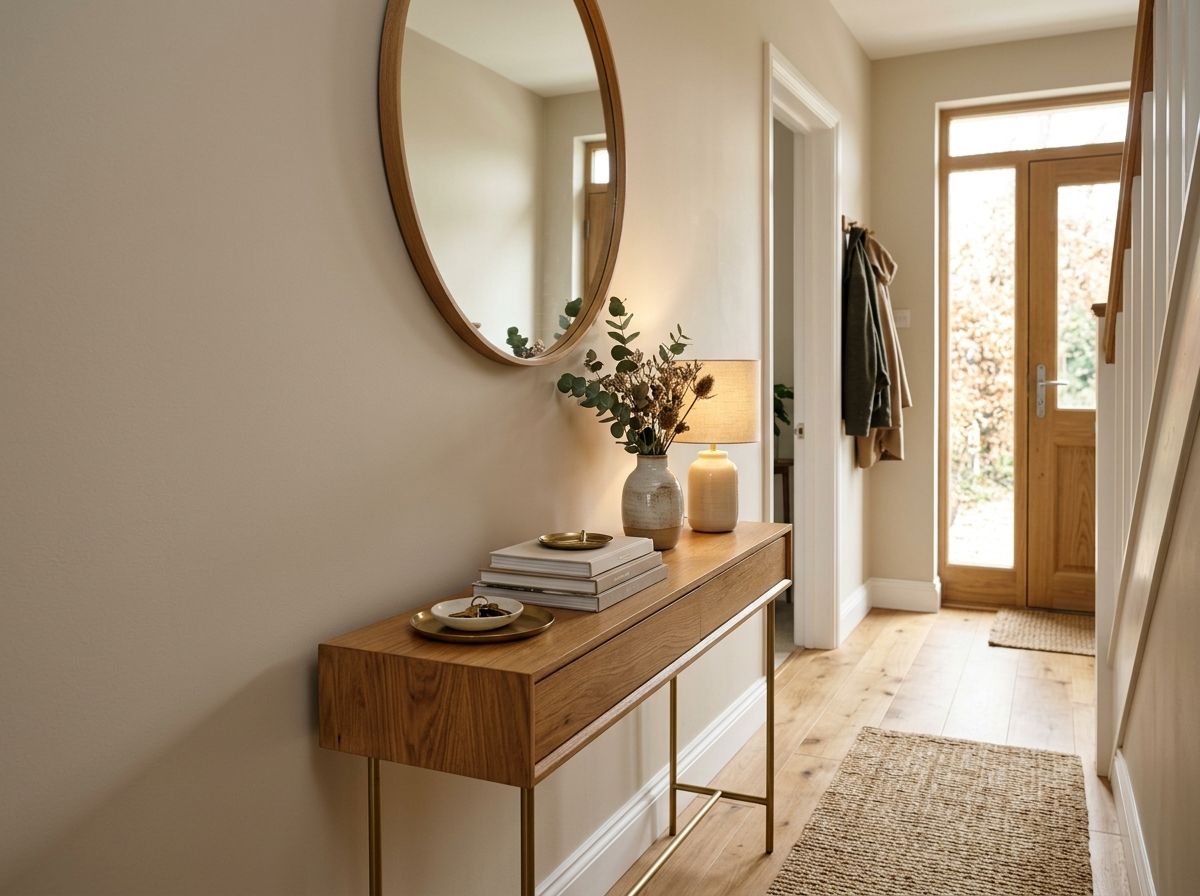
A console table is a narrow, wall-hung style table, usually between 25cm and 40cm deep, used in hallways, behind sofas or against a spare wall to hold keys, lamps, mail or decorative items. It’s one of the easiest ways to make an awkward gap in a room feel finished. If you’re trying to work out what size to buy, what it should cost, or whether you actually need one, this guide walks through it properly.
This is written for anyone furnishing a UK home for the first time, whether that’s a first flat, a growing family home, or a spare wall that’s been bothering you for months.
What Is a Console Table Actually For?
A console table earns its keep in a few specific spots. In a hallway, it’s a landing pad: keys, post, sunglasses, the odd forgotten glove. Behind a sofa that floats in the middle of a room, it fills the dead space and gives you somewhere for a lamp or a stack of books. Along a bare living or dining room wall, it works more like a display shelf for photos, plants or a mirror above.
What it’s generally not built for is heavy daily use as a desk. Some slim console tables can double up for occasional laptop work, but a proper desk needs 50 to 60cm of depth for comfortable legroom, according to several UK furniture retailers’ sizing guides. A console table rarely gives you that.
Standard Console Table Dimensions
Most console tables sold in the UK sit within a fairly consistent size range:
- Height: 75cm to 85cm, roughly worktop height
- Depth: 25cm to 40cm for hallway use; deeper (up to around 45cm) if it’s going along a living room wall with more room to spare
- Width: anywhere from 80cm up to 160cm or more, depending on the wall
Behind a sofa, the table should sit level with, or just below, the top of the sofa back, which for most UK sofas is around 70 to 80cm. Go much taller and it looks top-heavy; go much shorter and it disappears visually.
For a hallway, keep the depth under 35cm wherever possible. Anything deeper starts eating into the width you need to walk past comfortably, especially in older UK terraced houses where hallways can be under a metre wide.
The Two-Thirds Rule for Sizing a Console Table
A simple rule several furniture retailers use: your console table should be no more than two-thirds the length of the wall it’s sitting against. On a 180cm wall, that puts you at a maximum width of around 120cm. Go wider and the table starts to dominate the space rather than sit within it.
Always measure the wall, the width of any doorway swing, and the gap you’ll have left to walk past, before you order. Returns on flat-pack furniture can be awkward and sometimes cost you the delivery fee both ways, so getting the measurements right first saves a lot of hassle.
Types of Console Table
Not every console table does the same job, and the right one depends on what you’re trying to solve.
With drawers. Good for hiding the everyday clutter, keys, chargers, post, without it living on the surface. Two or three drawers is typical.
With an open shelf. A lower shelf gives you display space for baskets, books or shoes, and it’s usually cheaper than a drawer version because there’s less to build.
Mirrored or glass-topped. Reflective surfaces bounce light around a room, which is genuinely useful in a dark or narrow hallway. They show fingerprints more readily, so factor in a bit more cleaning.
Nesting console tables. Two or three tables of different sizes that slot together, giving you flexible extra surface space when you need it and a smaller footprint when you don’t.
Materials and Finishes
Solid wood, oak or pine most commonly, brings a warm, traditional look and tends to hold up well over years of use, though it costs more than manufactured alternatives. Metal-framed console tables, often paired with wood-effect panels, give a more industrial feel and are typically lighter and cheaper.
For finish, matte and oiled surfaces hide fingerprints and everyday scuffs far better than high-gloss lacquer, which is worth knowing if the table is going somewhere it’ll get touched a lot, like a hallway.
Console Table vs Sideboard vs Hall Table
These three get mixed up constantly, so here’s the actual difference. A sideboard is deeper, usually has doors rather than open shelving, and is built for proper storage, think crockery, linens or drinks. A console table is narrower and more open, with small drawers at most, and it’s designed to be seen as much as used. A hall table is really just a console table placed specifically in an entryway; the terms are largely interchangeable, though “hall table” tends to imply something a bit smaller and simpler.
If you need to store a lot of things out of sight, a sideboard is the better fit. If you want a slim, decorative surface, a console table wins.
How Much Do Console Tables Cost in the UK?
Prices vary a great deal depending on material, brand and where you shop. Boutique and independent UK retailers currently list console tables from around £259 up to £1,695, with an average price around £890 across their ranges, according to furniture comparison site MeetFelix. Larger high-street retailers such as John Lewis and Dunelm carry a broader spread, including budget flat-pack options well below that range alongside premium solid wood pieces at the top end.
As with most furniture, price doesn’t always track quality in a straight line. A well-made oak console from a smaller direct-to-consumer brand can outlast a pricier piece from a big department store. It’s worth checking reviews on wobble and drawer runners specifically, since those are the parts that fail first on cheaper builds.
Prices change often across retailers, so treat the figures above as a general guide and check current listings before you commit to a budget.
How to Style a Console Table
A console table looks best with a bit of deliberate imbalance rather than a perfectly matched pair of objects on each end. A common approach: a taller item on one side, a lamp or a tall vase, then a smaller cluster on the other, a stack of books topped with a small ornament or plant. A mirror or piece of art above ties the whole thing together and adds height without taking up floor space.
Vary the heights of what you put on it. A row of same-sized objects reads as flat and a little dull, while mixed heights give the eye somewhere to travel.
[Image suggestion: styled console table example showing mixed-height decor]
Caring for Your Console Table
Dust wood and lacquered surfaces with a dry or barely damp cloth rather than spray polish, which can build up residue over time on lacquered finishes. Wipe up spills quickly, particularly on solid wood, to avoid watermarks. For mirrored or glass-topped tables, a standard glass cleaner and a microfibre cloth will keep fingerprints under control without streaking.
If your table has an anti-tip fixing (common on taller, narrower mirrored consoles), fit it to the wall, especially if there are children or pets in the house.
FAQs
What is a console table used for?
A console table is most commonly used as an entryway surface for keys, post and a lamp, or placed behind a sofa or along a bare wall to fill space and hold decorative items. It’s a display and drop-off surface rather than a storage-heavy piece of furniture.
How deep should a console table be for a hallway?
Keep it between 25cm and 35cm deep for a typical UK hallway. This gives you a usable surface without narrowing the walkway too much, particularly important in older or terraced houses with tighter hall widths.
What height should a console table be?
Most console tables stand between 75cm and 85cm tall. Behind a sofa, aim for a height level with, or just below, the sofa’s back, usually around 70 to 80cm.
Can a console table be used as a desk?
Occasionally, for light laptop work, but it’s not ideal. A proper desk needs 50 to 60cm of depth for comfortable legroom, and most console tables fall well short of that.
What’s the difference between a console table and a sideboard?
sideboard is deeper and has closed storage, usually doors, built for hiding away crockery or linens. A console table is narrower, more open, and designed as much for display as for storage.
How wide should my console table be?
Follow the two-thirds rule: measure the wall it will sit against and choose a table no wider than roughly two-thirds of that length, so a 180cm wall suits a table up to around 120cm wide.
How much should I expect to pay for a console table in the UK?
Boutique UK retailers currently price console tables from around £259 to £1,695, averaging roughly £890, though high-street stores also stock cheaper flat-pack options at the lower end. Prices shift often, so check current listings before buying.
Do console tables need to be fixed to the wall?
It’s not a legal requirement for most console tables, but taller or narrower pieces, particularly mirrored ones, are more prone to tipping. Fitting the anti-tip bracket that comes with the table is a sensible precaution if you have children or pets.