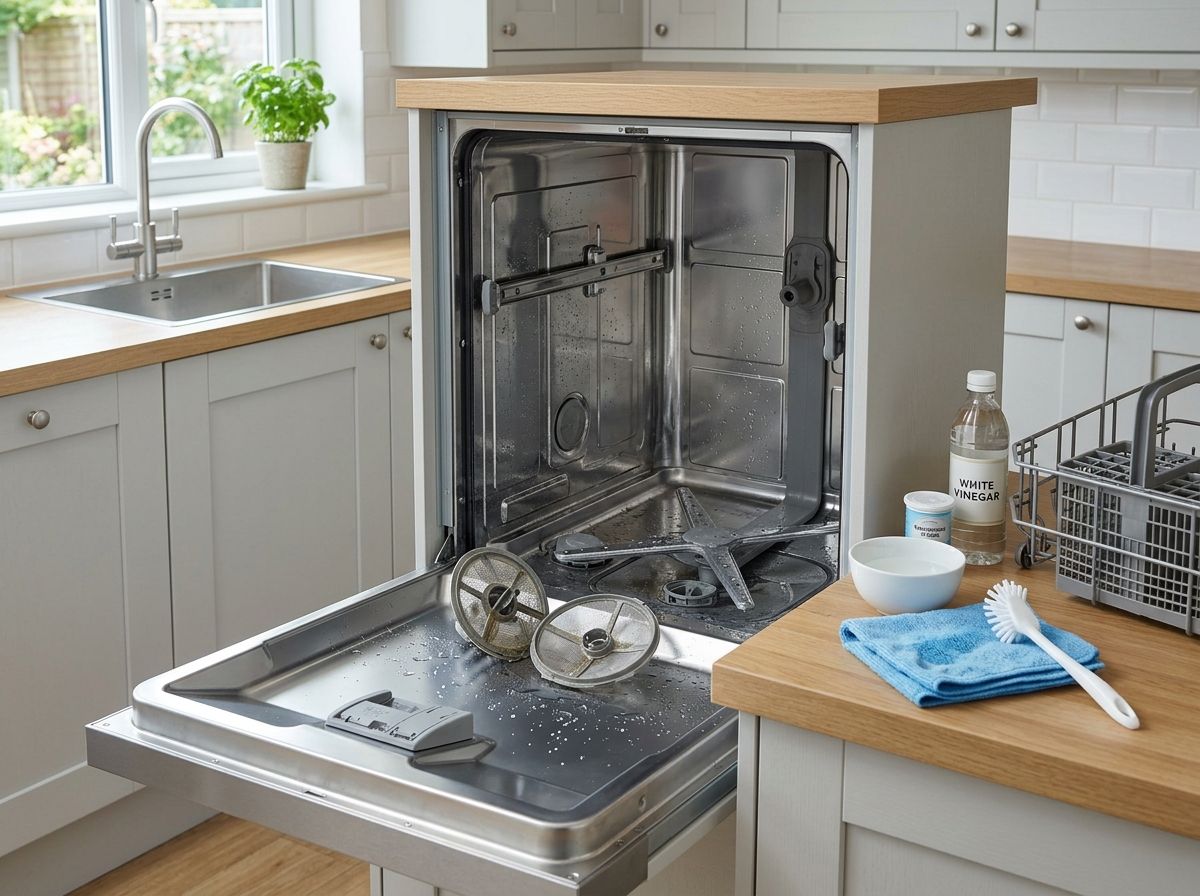
If your dishwasher smells musty or your glasses are coming out cloudy, the fix is usually a proper clean rather than a new machine. To clean a dishwasher, remove and rinse the filter, wipe out the door seal, clear the spray arm holes, then run an empty hot cycle with either a shop-bought cleaner or white vinegar. Do this once a month and you’ll avoid most of the smells, limescale and poor washing that build up over time.
This guide is written for anyone running a household dishwasher, whether it’s brand new or has been quietly ignored for the past year. Below is the full method, plus how often to do it and what to use if you’d rather skip the branded cleaners.
Why Dishwashers Need Cleaning at All
It sounds odd that a machine built to clean things needs cleaning itself, but food particles, grease and limescale collect in the filter, spray arms and seals over weeks of use. This is worse in the UK’s harder water areas, including much of the south and east of England, where mineral deposits build up faster than in soft water regions.
Left long enough, this build-up causes cloudy glassware, a musty smell every time you open the door, and dishes that come out with bits still stuck on. None of that means the machine is broken. It usually just needs a proper clean.
What You’ll Need
- Washing-up liquid and warm water
- An old toothbrush or small brush
- A toothpick or cocktail stick, for clearing spray arm holes
- White vinegar and bicarbonate of soda (optional, for a natural deep clean)
- A shop-bought dishwasher cleaner, if you’d rather skip the vinegar method (Finish and Dr Beckmann tablets are widely available in UK supermarkets, typically £6 to £9 for a multi-pack)
- A microfibre cloth
How to Clean a Dishwasher Step by Step
Step 1: Empty the Machine
Take out all plates, cutlery and racks first. This isn’t just tidiness: cleaning around loaded dishes means you miss half the grime, and any loose debris you dislodge just lands back on your washing.
Step 2: Remove and Wash the Filter
The filter sits at the bottom of the dishwasher, usually under the lower basket, and most twist out with a quarter turn. Rinse it under a warm tap, then use an old toothbrush to work off any stuck-on food, particularly around the mesh. According to several UK appliance manufacturers, this should be done weekly if you use the machine daily, since a clogged filter is one of the most common causes of dishes coming out dirty.
Step 3: Clear the Spray Arms
The spray arms are the rotating bars with small holes that shoot water around the machine. Lift them out (most simply pull upward or unclip), then check each hole for blockages. A toothpick or cocktail stick works well for pushing out trapped food or limescale. Rinse the arms under running water before clipping them back in.
Step 4: Wipe the Door Seal
Run a damp cloth around the rubber seal on the door, paying attention to the folds where mould and grime like to gather. A little washing-up liquid on the cloth helps lift ground-in dirt. This part gets skipped more than any other step, but it’s often where the musty smell is actually coming from.
Step 5: Wipe the Interior and Exterior
Wipe down the inside walls and the base of the machine with a damp, soapy cloth, then dry with a clean one. On the outside, wipe away any marks or spillages around the door and control panel, since these build up fingerprints and food splashes over time just like any other kitchen surface.
Step 6: Run a Hot Empty Cycle
With the machine empty, run it on the hottest cycle it has, usually 60°C or above. Either place a shop-bought dishwasher cleaner in the cutlery basket as directed on the packet, or set a bowl of white vinegar upright on the top rack for a natural alternative. This flushes out grease and limescale from the pipework and heating element that you can’t reach by hand.
How to Clean a Dishwasher with Vinegar and Baking Soda
If you’d rather not buy a branded cleaner, white or cleaning vinegar and bicarbonate of soda do a similar job. Cleaning vinegar is preferable to standard malt vinegar, since it has no dye that could stain plastic parts.
Place a bowl with around 250ml of white vinegar upright on the top rack of an otherwise empty machine, then run a hot cycle. Once that’s finished, sprinkle a cupful of bicarbonate of soda across the bottom of the machine and run a short, hot cycle again. This two-stage approach tackles grease with the vinegar first, then lifts stains and odours with the bicarbonate.
How Often Should You Clean a Dishwasher?
- Filter: once a week, or more often if you run the machine daily
- Spray arms and seals: once a month, alongside a full deep clean
- Full deep clean with cleaner or vinegar: every three months for average use, or monthly if you’re in a hard water area or run the dishwasher every day
If you notice smells, cloudy glasses or poor cleaning between scheduled cleans, it’s worth doing an extra cycle rather than waiting, since build-up gets harder to shift the longer it’s left.
Descaling: Why It Matters in Hard Water Areas
Limescale forms when hard water evaporates and leaves mineral deposits behind, and it’s a bigger issue across much of the south, east and Midlands of England than in Scotland, Wales or the north west, where water tends to be softer. Left unchecked, limescale can interfere with the heating element and, on newer machines, with sensors that control the wash cycle.
Using a dedicated descaler every few months, or the vinegar method above, keeps this in check. If you’re not sure how hard your water is, most UK water suppliers publish this on their website by postcode.
Common Dishwasher Smells and What They Mean
A musty smell usually points to a dirty door seal or a clogged filter trapping stagnant water. A rotten or eggy smell often means food debris has built up somewhere the spray arms don’t reach properly, commonly the drain or the underside of the lower basket. A chemical or plasticky smell straight after a cycle is usually just residual detergent and tends to fade once the door’s been open a while.
If a smell persists after a full clean including the filter, seal and a hot cycle with cleaner, it’s worth checking the drain hose for a blockage, since food waste can sometimes lodge further down the system than a standard clean reaches.
FAQs
How often should I clean my dishwasher?
Clean the filter weekly, wipe the door seal and check the spray arms monthly, and run a full deep clean with a cleaner or vinegar every three months. Increase this to monthly if you’re in a hard water area or use the machine daily.
Can I use vinegar to clean a dishwasher?
Yes, white or cleaning vinegar works well as a natural alternative to shop-bought cleaners. Place around 250ml in a bowl on the top rack and run a hot, empty cycle to flush grease and limescale from the pipework.
Why does my dishwasher smell even after cleaning?
A lingering smell after cleaning the filter and seal usually points to a blocked drain hose or debris trapped somewhere the spray arms don’t reach. Check the drain and, if the smell persists, contact a manufacturer-approved engineer.
How do I clean the dishwasher filter?
Twist and lift the filter out from the base of the machine, usually under the lower basket, then rinse it under a warm tap and scrub gently with an old toothbrush. Do this weekly if you use the dishwasher daily.
What temperature should I run to clean a dishwasher?
Run the hottest cycle available, typically 60°C or above, since lower temperatures won’t dissolve grease and limescale effectively. Most shop-bought dishwasher cleaners specify a minimum 60°C wash on the packaging.
Do I need a special dishwasher cleaner, or will washing-up liquid do?
Washing-up liquid is fine for hand-cleaning the filter, seal and interior surfaces, but it won’t flush the hidden pipework the way a dedicated cleaner or vinegar cycle does. Use both: washing-up liquid for the visible parts, a cleaner or vinegar for the hot empty cycle.
Why are my glasses coming out cloudy?
Cloudy glasses are usually caused by limescale from hard water rather than dirt, particularly in hard water regions of the UK. Running a descaling cycle and checking your rinse aid levels usually clears this up within a couple of washes.
Is mould in a dishwasher dangerous?
Mould around the door seal is unpleasant and can contribute to musty smells, but it’s a common issue in humid, enclosed appliances rather than a sign something’s seriously wrong. Regular wiping of the seal with a damp, soapy cloth prevents it building up in the first place.