“Sexiest asset” is not a formal financial or legal term. It is a phrase that shifts meaning depending on who is speaking. In investing circles, it refers to the asset class currently generating the most excitement, attention, or returns. In celebrity interviews, it means the physical feature a person considers their most attractive. And in everyday conversation, it can describe anything from a career move to a new purchase that feels particularly appealing. This article unpacks the different uses, with a focus on the financial sense that dominates search results, and explains why the phrase deserves scepticism when it appears in investment marketing.
The Financial Meaning: Hype, Not a Category
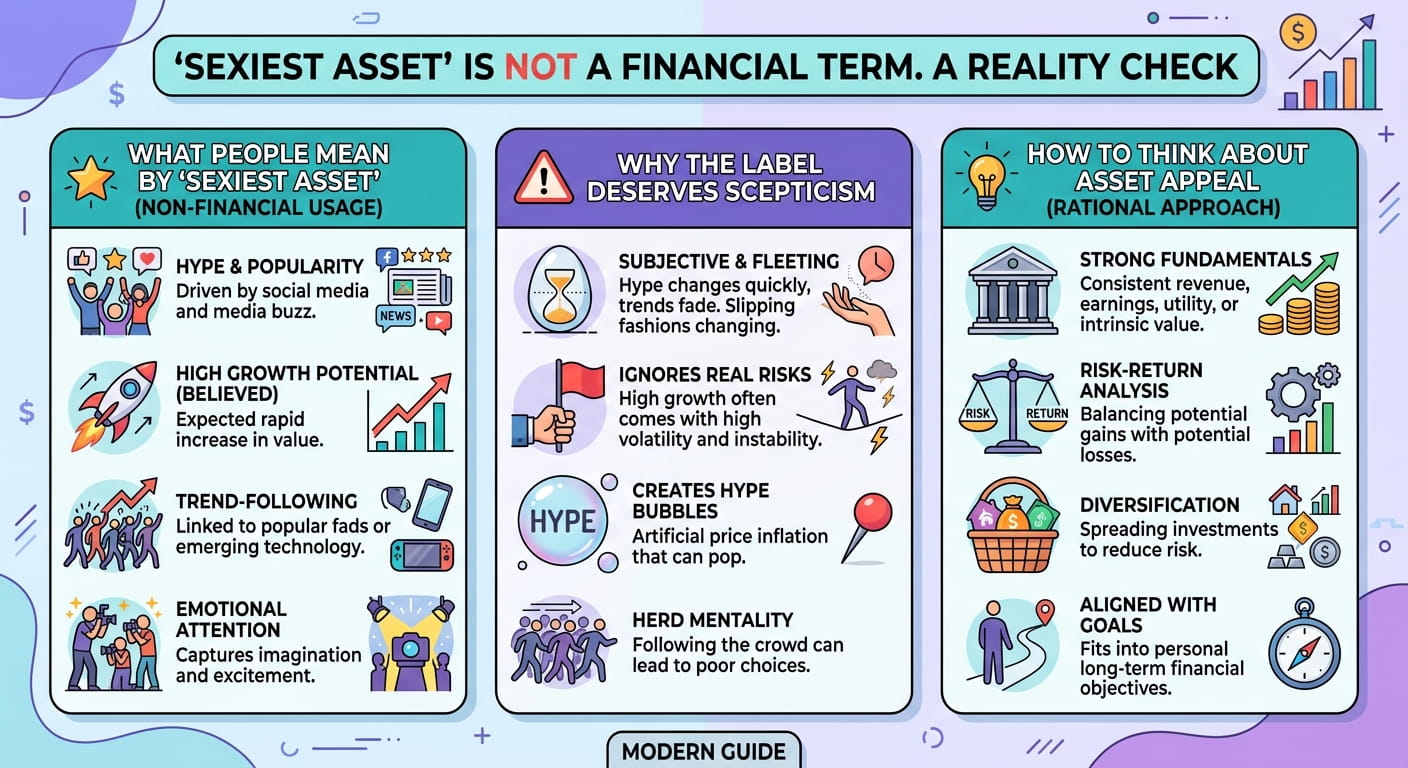
When an investor or commentator calls something the “sexiest asset”, they are not describing a technical classification. They are describing sentiment. The phrase signals that an asset class has captured collective imagination, usually because of recent strong performance, media coverage, or a compelling narrative.
A 2025 interview with Sharon Lechter, co-author of Rich Dad Poor Dad, used the phrase to frame a list of assets she considered worth diversifying into: real estate, food and agriculture, gold, defence and security, energy, and digital currency . The framing was promotional rather than analytical. Lechter’s “sexy” label was a way of making familiar asset classes feel fresh and urgent.
By early 2026, the assets attracting the most “sexy” language in financial media were precious metals and semiconductors. Gold had touched $5,500, up 98 per cent over a year, while silver had risen 60 per cent in a matter of weeks . Reports from This is Money in December 2025 noted gold up 60 per cent and silver up 121 per cent, with platinum rising 104 per cent . These are the kinds of numbers that generate excitement, and excitement is what the phrase “sexiest asset” tries to capture.
Why the Phrase Is a Warning Sign
The problem with “sexiest” as an investment label is that it describes a feeling, not a fundamental. By the time an asset is widely described as sexy, the conditions that produced its recent returns may already be shifting.
Goldman Sachs published research in February 2026 introducing a framework called HALO: Heavy Assets, Low Obsolescence. The argument was that companies with substantial physical assets and low risk of technological obsolescence, such as utilities, pipelines, and critical infrastructure, were becoming more attractive as AI accelerated the commodification of digital and human capital . This is a structural argument. It does not use the word “sexy”, and it does not rely on recent price momentum. It asks what will still matter in ten years, not what made headlines last quarter.
The contrast is instructive. “Sexiest asset” language tends to be backward-looking, celebrating what has already performed. Serious investment analysis tends to be forward-looking, asking what is likely to perform next and why.
What the Hype Cycles Have in Common
Looking at the assets labelled “sexy” in recent years, a pattern emerges. They tend to share three features: a recent surge in price, a simple story that explains the surge, and a sense that missing out would be costly.
Precious metals in early 2026 fit this pattern. The story was geopolitical uncertainty and central bank buying . Semiconductors fit it too, with the AI narrative driving demand for advanced chips . Neither story is wrong. But the “sexy” label compresses a complex situation into a simple emotional pull, which is rarely a good basis for a financial decision.
The Celebrity Meaning: Physical Features and Self-Image
Outside finance, “sexiest asset” appears almost exclusively in interviews and magazine profiles. An actor or model is asked what they consider their best feature, and the answer is framed as their “sexiest asset”.
Examples from the search results include Esha Gupta naming her waist and Chizzy naming her hips . A 2011 Victoria’s Secret event featured models giving similar answers, with Alessandra Ambrosio saying it depended on what she had worked out that day . These are lighthearted, personal responses, not claims about objective value.
The phrase in this context is a rhetorical device. It turns a question about physical appearance into something that sounds slightly more substantial, as if a body part were a portfolio holding. The effect is playful, and it should be read as such.
How to Interpret “Sexiest Asset” in the Wild
If you encounter the phrase, the first question to ask is: who is speaking, and what are they trying to achieve?
If it is an investor or financial commentator, treat the phrase as a signal of sentiment, not a recommendation. Ask what evidence supports the enthusiasm and what risks are being downplayed. The assets described as sexy in early 2026, gold and semiconductors, had already delivered extraordinary returns. The question worth asking is whether those returns are repeatable, not whether the assets are exciting .
If it is a celebrity or public figure, the phrase is part of an interview format. It is not a claim about value in any meaningful sense. It is a way of talking about self-image that sounds more polished than “my best feature”.
If it is a marketing campaign, the phrase is doing persuasive work. It is trying to make something feel desirable by association. Whether the thing is actually desirable is a separate question.
Frequently Asked Questions
What does “sexiest asset” mean in finance?
In finance, “sexiest asset” is an informal phrase for the asset class currently attracting the most attention and excitement, usually because of recent strong performance. It is a sentiment indicator, not a technical category. Assets described this way in early 2026 included gold, silver and semiconductors, following significant price rises . The phrase should not be treated as investment advice.
Is “sexiest asset” a real financial term?
No. It is not a recognised classification in finance, economics or regulation. It is a colloquial phrase used in media and marketing to describe assets that are generating hype. Formal analysis uses categories such as equities, fixed income, real assets and alternatives. The “sexy” label adds emotional colour but no analytical precision.
Why do people call gold and silver sexy assets?
Because of their recent price performance. Gold rose sharply in 2025 and early 2026, and silver rose even faster, driven by industrial demand and geopolitical uncertainty . When an asset delivers returns like that, it attracts attention, and attention generates language like “sexy”. The label describes the reaction, not the asset itself.
What is a more useful way to think about asset attractiveness?
Look at fundamentals rather than sentiment. Goldman Sachs’ HALO framework, published in February 2026, argues that heavy assets with low obsolescence, such as infrastructure and utilities, are structurally attractive in an AI-driven economy . That is a forward-looking argument based on durability, not a backward-looking celebration of recent price moves. The question worth asking is what will still matter in a decade, not what made headlines last month.