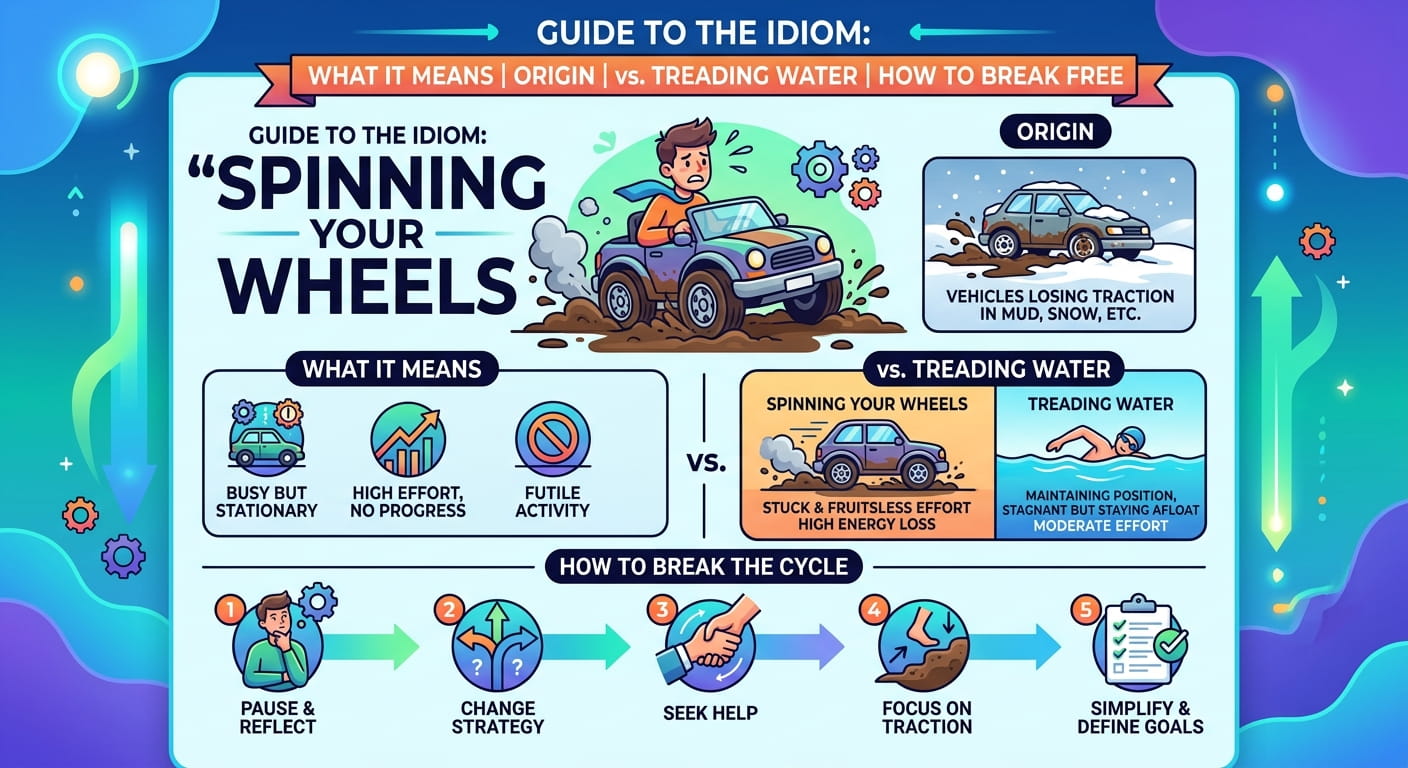
“Spinning their wheels” means putting in effort without making any real progress. It is an informal idiom, most common in American English but widely understood in the UK, that compares a person or organisation to a car stuck in mud: the wheels turn frantically, but the vehicle does not move forward . This article explains the phrase’s meaning, where it comes from, how it differs from similar expressions, and how to recognise when you or your team are doing it.
The Core Meaning
The idiom describes a specific kind of frustration. It is not laziness, and it is not a lack of activity. It is activity that produces nothing. The Merriam-Webster definition, cited in language forums, is “to make futile efforts to achieve progress” . A more recent reference puts it simply: “to make no progress despite making an effort; to get nowhere” .
The key distinction is between motion and progress. Someone spinning their wheels is busy. They may be working long hours, attending meetings, sending emails, and feeling exhausted. But the outcome is static. The effort is real; the result is not.
What It Is Not
The phrase is often confused with similar expressions that describe different situations.
Treading water means staying in the same place deliberately, to avoid sinking. There is no intent to move forward. Spinning your wheels involves an intent to progress that is being frustrated .
Being stuck in a rut suggests a long-term pattern of routine without growth. Spinning your wheels can be a shorter-term experience, a specific project or period where effort is not translating into movement.
Spinning your wheels is not the same as resting or pausing. It implies wasted exertion, not deliberate recovery.
Where the Image Comes From
The metaphor is straightforward. A car stuck in mud, snow, or sand will spin its wheels rapidly while the vehicle remains stationary. The engine is running, the driver is pressing the accelerator, and there is noise and motion, but no traction .
The phrase transfers this physical experience to mental or organisational effort. A team that keeps revising a plan without ever approving it, a writer who rewrites the same paragraph for hours without improving it, a jobseeker who sends out applications without tailoring them and hears nothing back: these are all forms of spinning wheels.
How to Recognise It in Practice
Spinning wheels is easier to diagnose from the outside than from within. When you are in the middle of it, the activity feels necessary. You are doing something. Stopping feels like giving up.
Here are signs worth watching for.
Repetition without revision. You are doing the same task again and again without changing your approach. If the third draft looks much like the first, the problem is not the drafting. It is the thinking behind it.
Activity as a substitute for decisions. Meetings are scheduled, documents are circulated, and questions are raised, but no decision is made. The process continues because stopping would require someone to choose.
Effort without feedback. You are working hard but not checking whether the work is having any effect. A writer who never shares their draft, a team that never tests its assumptions, or a business that never asks customers what they think is operating in a vacuum.
A vague sense of frustration. Spinning wheels often feels like exhaustion without satisfaction. You are tired, but you cannot point to anything you have achieved. That mismatch is a signal.
A Practical Test
Ask yourself one question at the end of a working session: what has changed? Not what have I done, but what has changed as a result. If the answer is nothing, or if the change is trivial, you may have been spinning your wheels. The question is uncomfortable, which is precisely why it is useful.
Why It Happens
Spinning wheels is rarely a sign of stupidity or laziness. It usually has a structural cause.
Unclear goals. If you do not know what success looks like, any activity feels like progress. A team without a defined objective can generate endless work without ever moving toward anything.
Fear of the wrong decision. Sometimes spinning wheels is a way of avoiding commitment. As long as you are still working on it, you have not failed yet. The activity is a shield against the risk of choosing badly.
Poor feedback loops. If you never find out whether your work is landing, you cannot correct course. You keep doing the same thing because you have no information telling you to do otherwise.
Misaligned incentives. In some workplaces, visible activity is rewarded more than outcomes. If the culture values looking busy, spinning wheels becomes a rational response.
Breaking the Cycle
The first step is recognition. The second is a deliberate change of approach.
Stop and name the problem. Say aloud or write down: “We are spinning our wheels.” Naming it creates permission to change direction.
Return to the goal. Ask what you are actually trying to achieve. If the goal is vague, make it specific. “Improve the website” becomes “reduce the checkout abandonment rate by 10 per cent.” A specific goal makes it obvious whether your activity is moving toward it.
Change one variable. If you have been doing the same thing repeatedly, do something different. Share the draft with someone who will criticise it honestly. Run a small test instead of debating the theory. Ask a customer what they actually want.
Set a deadline for decision. If the spinning is caused by avoidance, impose a time limit. “We will decide by Friday, even if we are not certain.” A imperfect decision that allows movement is often better than a perfect process that goes nowhere.
Frequently Asked Questions
What does “spinning their wheels” mean?
It means making an effort without achieving any progress. The phrase compares a person or group to a car stuck in mud, where the wheels turn but the vehicle does not move. It describes activity that feels busy but produces no result, often because of unclear goals, poor feedback, or avoidance of a decision .
Where does the phrase “spinning their wheels” come from?
It comes from the physical experience of a vehicle stuck in mud, snow, or sand. The wheels spin rapidly while the car remains stationary. The phrase transfers that image to mental or organisational effort, where activity continues but forward movement stops. It is an informal idiom, most common in American English but widely understood elsewhere .
What is the difference between “spinning wheels” and “treading water”?
Spinning wheels involves an intent to progress that is being frustrated. Treading water means staying in the same place deliberately, to avoid sinking. With treading water, the goal is to remain where you are. With spinning wheels, the goal is to move forward, but the effort is not working .
How do you stop spinning your wheels?
Start by naming the problem and returning to the goal. Ask what you are actually trying to achieve and whether your current activity is moving toward it. Change one variable in your approach, such as seeking feedback or testing an assumption. If the cause is avoidance, set a deadline for a decision, even an imperfect one, to break the cycle.