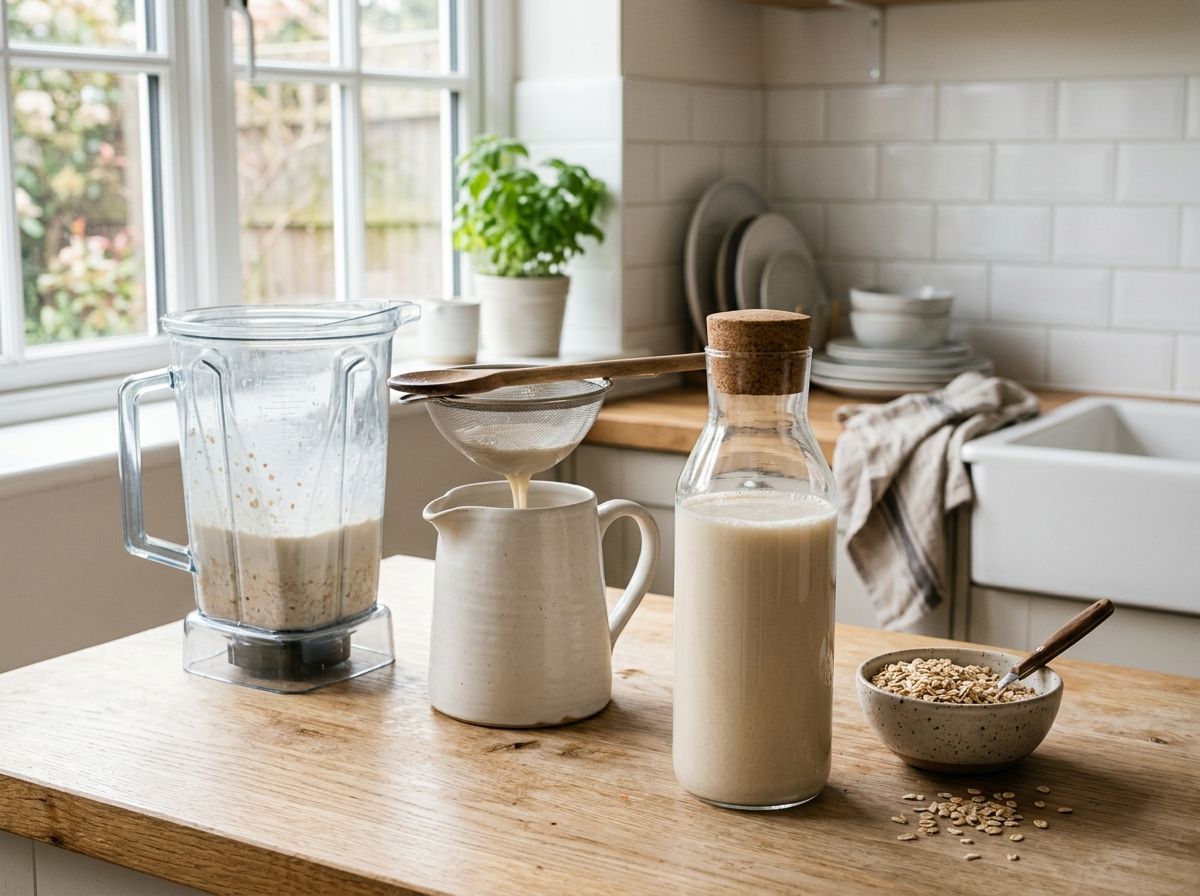
If you’ve ever winced at £2 for a litre of shop-bought oat milk, here’s the good news: making your own takes about ten minutes and costs pennies. The short version of how to make oat milk is this: blend 100g rolled oats with 750ml cold water for around 30 seconds, strain through a nut milk bag or fine sieve, then chill. Skip the soaking, keep the water cold, and don’t over-blend, and you’ll avoid the slimy texture that puts a lot of people off their first attempt.
Below, you’ll find the exact method, the common mistakes that ruin a batch, UK prices to help you weigh up homemade versus shop-bought, and a full FAQ covering everything from frothing for coffee to how long it keeps in the fridge.
What You Need to Make Oat Milk
You don’t need any special kit for this. A jug blender or a stick blender and jug will both do the job.
- Rolled oats or old-fashioned oats (not quick oats or steel-cut oats)
- Cold water, ideally filtered
- A fine mesh sieve, a nut milk bag, or a clean piece of muslin
- A blender
- A bottle or jug with a lid for storage
Any own-brand rolled oats work fine. In the UK, a 1kg bag of rolled oats typically costs between £2.25 and £2.95 at Tesco for branded options like Quaker or Scott’s Porage, and can be found for as little as £0.85 per kg on basic own-label lines, according to supermarket price comparison site Allsupers. Since a batch of oat milk uses roughly 100g of oats, you’re looking at well under 30p a litre for the raw ingredient.
How to Make Oat Milk: Step-by-Step
This is the basic ratio used by most home cooks and food writers: roughly 1 part oats to 7 to 8 parts water by volume, which works out to about 100g oats per 750ml to 1 litre of water. Adjust the water slightly if you prefer a thinner or creamier result.
- Measure your oats. Add 100g (about a cup) of rolled oats to your blender. Don’t rinse or soak them first.
- Add cold water. Pour in 750ml of cold water. Cold is important here, since warm or hot water encourages the oats to release starch and turn slimy.
- Blend briefly. Blend on high for 30 to 45 seconds, no longer. Over-blending breaks the oats down too far and thickens the liquid unpleasantly.
- Strain. Pour the mixture through a nut milk bag, muslin cloth, or fine sieve set over a large jug. Let it drip through on its own rather than pressing or squeezing the pulp, which pushes starchy residue into the milk.
- Strain again for extra smoothness (optional). A second pass through a clean sieve or cloth gives a silkier finish, particularly useful if you want it for coffee.
- Bottle and chill. Pour into a clean bottle or jar, seal, and refrigerate straight away.
Why Oat Milk Turns Slimy (and How to Avoid It)
Sliminess is the single biggest complaint about homemade oat milk, and it comes down to starch. Oats release a soluble fibre called beta-glucan when they’re exposed to heat or over-processed, and that’s what creates the gluey texture.
Three habits fix it almost every time: use cold water rather than warm, keep the blend time short, and avoid soaking the oats beforehand. If your blender runs hot during long blends, a high-speed model in particular, stick to shorter bursts rather than one continuous minute.
Flavour Variations
Plain oat milk works well in savoury cooking and porridge, but a few additions make it better suited to drinking on its own or adding to hot drinks.
- A pinch of salt sharpens the flavour and stops it tasting flat.
- One pitted date or a teaspoon of maple syrup adds gentle sweetness without any grittiness.
- A few drops of vanilla extract rounds things out nicely for use in tea or coffee.
- A tablespoon of cocoa powder plus a touch of sweetener turns it into a quick chocolate milk.
- For a golden latte style drink, blend in a small pinch of ground turmeric and black pepper.
Add whichever extras you fancy straight into the blender with the oats and water, then strain as normal.
Making Oat Milk for Coffee (Barista Style)
Shop-bought barista editions froth better than homemade oat milk mostly because they contain a small amount of added oil, which helps stabilise the foam. You can get close to that at home by adding half a teaspoon of a neutral oil, such as rapeseed oil, along with a small pinch of salt before blending.
Even with that tweak, homemade oat milk won’t froth quite as thickly as a commercial barista blend, since those products are also formulated with stabilisers you won’t have in your kitchen. It’s still perfectly good for a flat white or a splash in tea.
Storing Homemade Oat Milk
Homemade oat milk keeps for around 4 to 5 days in the fridge, stored in a sealed bottle or jar. Because it has no stabilisers or emulsifiers, the oat solids will naturally separate and settle at the bottom over time. That’s completely normal: give the bottle a gentle shake before pouring, rather than leaving it to pour unevenly.
Treat it as you would fresh dairy milk rather than a long-life carton. If it smells sour, looks lumpy beyond the usual settling, or has passed the 5-day mark, throw it out rather than risk it.
Homemade vs Shop-Bought: What’s the Difference?
Cost is the obvious win for homemade oat milk. A litre of Oatly’s original oat drink typically costs around £1.50 to £2.00 at Tesco, and own-label versions from Alpro or supermarket ranges run from roughly £1.25 upwards, according to current Tesco pricing. Homemade oat milk works out to well under half that, often closer to 20 to 30p a litre once you’ve bought your oats.
Nutrition is where shop-bought has the edge. Commercial oat drinks are usually fortified with calcium, iodine and vitamins B2, B12 and D2, which plain homemade oat milk doesn’t contain unless you add them yourself. If you’re relying on plant milk as your main calcium source, particularly for children, it’s worth keeping a fortified shop-bought carton in the fridge alongside your homemade batches, or making sure you’re getting calcium and iodine from other foods.
A Note for Coeliacs and Anyone with Gluten Sensitivity
Oats themselves don’t contain gluten, but ordinary oats are often grown, transported or processed alongside wheat, barley or rye, which can introduce cross-contamination. If you have coeliac disease or a diagnosed gluten intolerance, look for oats specifically labelled gluten-free, which are grown and handled under stricter controls, rather than standard supermarket rolled oats.
FAQs
What’s the best ratio of oats to water for oat milk?
Around 100g of rolled oats to 750ml to 1 litre of cold water gives a good everyday consistency. Use less water for a creamier, thicker milk, or more if you prefer it lighter.
Why does my homemade oat milk go slimy?
Sliminess usually comes from warm water, over-blending, or soaking the oats beforehand, all of which cause the oats to release excess starch. Stick to cold water, a 30 to 45 second blend, and skip any soaking step.
Can I use porridge oats instead of rolled oats?
Rolled oats and porridge oats are generally the same thing in UK supermarkets, so either works well. Avoid quick oats or steel-cut oats, since they behave differently in a blender and can affect the texture.
Do I need a nut milk bag to make oat milk?
No, a fine mesh sieve or a clean piece of muslin cloth strains oat milk just as effectively as a nut milk bag. A nut milk bag is convenient but not essential kit.
How long does homemade oat milk last in the fridge?
Homemade oat milk keeps for about 4 to 5 days when stored in a sealed container in the fridge. Give it a sniff and a look before using it if it’s getting close to that point.
Is homemade oat milk as healthy as shop-bought?
It’s lower in additives, but shop-bought oat milk is usually fortified with calcium, iodine and vitamins that plain homemade oat milk lacks. Neither is inherently healthier, they simply serve slightly different purposes.
Can I froth homemade oat milk for coffee?
It froths reasonably well, though not quite as thickly as shop-bought barista editions. Adding half a teaspoon of neutral oil and a pinch of salt before blending helps it froth more like a commercial version.
Is oat milk suitable for people with coeliac disease?
Only if it’s made from oats specifically labelled gluten-free, since standard oats can pick up cross-contamination from wheat during farming and processing. Check the packaging carefully if gluten is a concern.
Why do you shake oat milk before use but not straight after blending?
Because homemade oat milk has no added stabilisers, the oat solids settle at the bottom over a day or two in the fridge. A gentle shake before pouring redistributes them evenly, whereas shaking it warm straight after blending isn’t necessary.
Can I make oat milk without a blender?
Not easily. A blender is what breaks the oats down enough to release their liquid, so a food processor with a strong enough motor is really the only practical substitute.