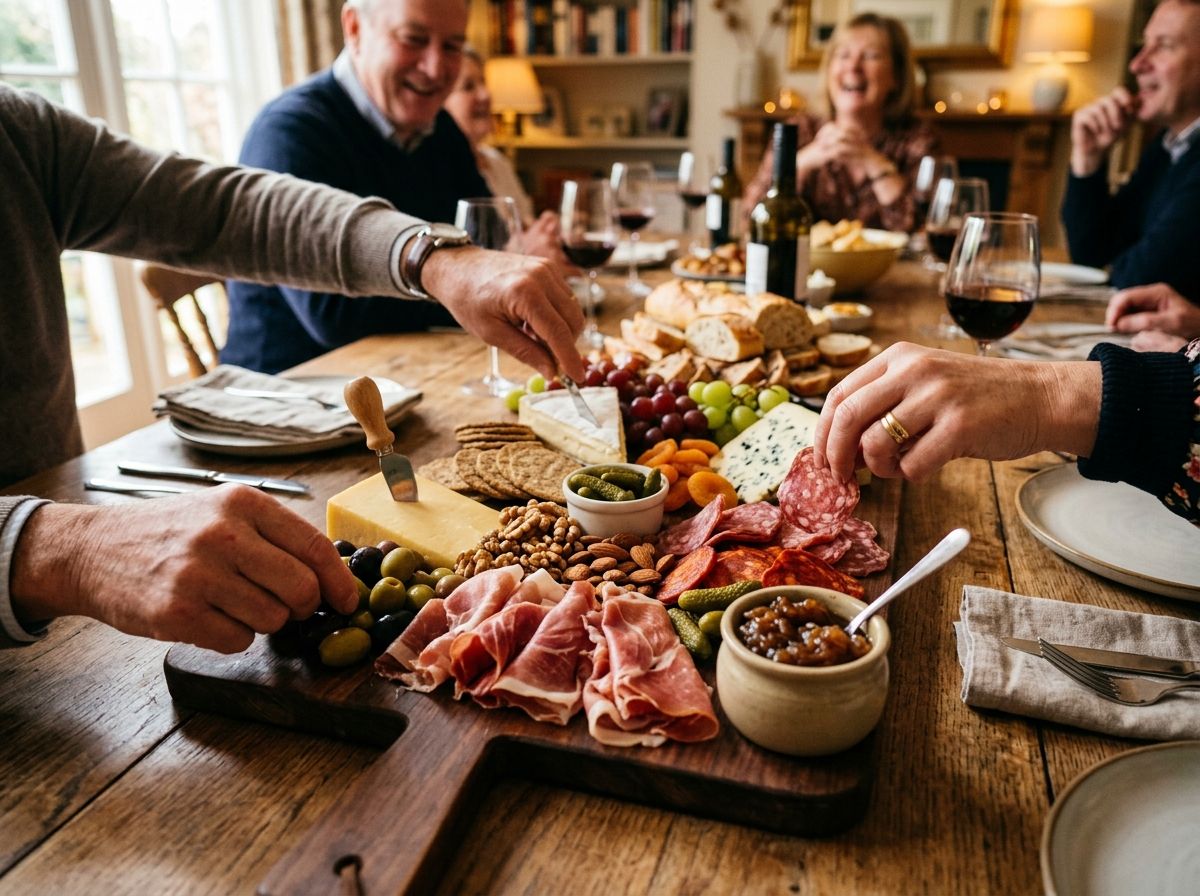
A charcuterie board is a sharing platter built around cured meats, usually paired with a few cheeses, crackers or bread, and extras like olives, nuts, fruit and chutney. The word comes from the French term for cold cured meats, though most modern boards also include cheese and other bits, which is why some people call the same thing a grazing board or a cheese and meat platter. You don’t need a recipe, just a board, a handful of ingredients from the deli counter, and about 20 minutes to arrange it. The rest of this guide walks through exactly what to buy, how much per person, and how to put it together so it looks like it took far longer than it did.
What a charcuterie board actually is
At its simplest, a charcuterie board is a way of serving food without plates, cutlery or a sit-down meal. Guests pick at it with their fingers or small forks, which makes it ideal for parties, picnics and pre-dinner drinks. There’s no fixed recipe, just a loose structure: something cured, something creamy or sharp, something crunchy, and something sweet to cut through the richness.
Charcuterie board, cheese board or grazing board: what’s the difference?
These terms overlap so much in everyday use that the confusion is fair. A cheese board focuses purely on cheese, with crackers and maybe a chutney, and little or no meat. A charcuterie board centres on cured meats, with cheese playing a supporting role. A grazing board (sometimes called a grazing table when it’s large) is the broadest term, covering everything from meat and cheese to dips, vegetables and even sweet treats, often spread across a whole table rather than one board. In UK supermarkets, you’ll see all three labels used loosely for what is essentially the same idea, so don’t worry too much about picking the “correct” name.
What goes on a charcuterie board
Meats
Aim for two to four types with different textures: something thin and delicate like Parma ham or prosciutto, something with more bite like salami Milano or chorizo, and something coarser like a pâté or terrine if you want variety. Waitrose, M&S and Aldi all stock ready-sliced continental meat selections aimed squarely at boards like this, which saves you slicing anything yourself.
Cheeses
Three cheeses is a sensible upper limit for most gatherings: one hard (mature Cheddar, Manchego, Parmigiano Reggiano), one soft (Brie, Camembert), and one with more punch (a blue cheese or a goat’s cheese). Leave hard cheese out of the fridge for 20 to 30 minutes before serving so it isn’t rock hard and tasteless.
Accompaniments
This is where a board goes from good to memorable. Think chutney or fig jam, honeycomb, cornichons, olives, dried apricots, fresh grapes, and toasted nuts. A drizzle of honey over blue cheese is a genuinely good combination if you haven’t tried it.
Bread and crackers
A mix of textures works best: a crusty baguette sliced thin, oatcakes, and a couple of flavoured crackers. Toasting thin baguette slices with a little olive oil for eight to ten minutes at 180°C gives you crisp crostini that hold up better than plain bread once meat and cheese sit on top.
How much to buy per person
This is the question most guides skip over, and it’s where a lot of boards go wrong by either running out of food or drowning in leftovers. As a rough guide, allow around 75g each of meat and cheese per person if the board is a starter or a pre-dinner nibble alongside a main meal, rising to about 125g each per person if the charcuterie board is the entire meal. For accompaniments like olives, nuts and dried fruit, 30 to 40g per person is usually plenty since guests tend to take small amounts of several things rather than a lot of one. These figures are a starting point rather than a rule, since appetite varies a lot by occasion, so it’s sensible to buy slightly more if you’re unsure, since most of these ingredients keep well in the fridge if leftovers do occur.
How to build a charcuterie board step by step
- Choose your board. A wooden chopping board, a large slate, or even a clean baking tray all work. Bigger is usually better since a crowded board looks more generous than a sparse one.
- Add bowls first. Place any small bowls for olives, honey or dips on the board before anything else, so you know how much space is left.
- Fold or fan the meat. Folding thin slices into ribbons or fans takes seconds and looks far more considered than laying them flat.
- Position the cheese. Space the cheeses apart from each other so guests can tell them apart, and add a small cheese knife to each one if you haven’t pre-cut it.
- Fill the gaps. Work outward from the centre, tucking crackers, grapes, nuts and dried fruit into any remaining space. Leave no obvious empty patches.
- Add a final garnish. A few sprigs of rosemary or thyme scattered across the board takes ten seconds and makes the whole thing look finished.
Buying a ready-made charcuterie board in the UK
If you’d rather skip the assembly, most major UK supermarkets sell ready-made charcuterie or grazing platters. M&S stocks several, including a Continental Charcuterie Grazing Platter with prosciutto, salami Milano and chorizo, alongside a larger Charcuterie & Antipasti Grazing Platter that has previously been priced at around £50 for bigger gatherings, according to M&S’s own product listings. Waitrose and Aldi’s Specially Selected range both carry smaller continental meat and cheese platters too, typically in the £4 to £10 range for a two to four person sharing pack. Prices and exact ranges shift with the seasons, especially around Christmas, so it’s worth checking current listings on each retailer’s site rather than relying on last year’s figures.
How long can a charcuterie board sit out
Cured meats and cheese are more forgiving than fresh cooked food, but they’re not immune to spoiling. As a general food safety guide, don’t leave meat and cheese out at room temperature for more than around two hours, or one hour if the room is particularly warm, such as a garden party in summer. If your gathering runs longer than that, it’s worth refreshing the board with a fresh batch rather than leaving the same meat and cheese out all afternoon.
Common mistakes to avoid
Overcrowding the board with too many similar items is one of the most common mistakes, since three types of salami don’t offer the variety that one salami, one pâté and one prosciutto would. Skipping the small bowls is another, since loose olives and nuts scattered directly on the board look messier and are harder to serve. Serving cheese straight from the fridge is a smaller but real issue, since cold cheese has far less flavour than cheese served closer to room temperature.
FAQs
What is a charcuterie board exactly?
A charcuterie board is a sharing platter of cured meats, usually served alongside cheese, crackers or bread, and extras like olives, fruit and chutney. It’s designed for picking at with fingers rather than eating as a formal course.
What’s the difference between charcuterie and antipasti?
Charcuterie specifically refers to cured meats, while antipasti is the broader Italian term for a starter course that can include meat, cheese, marinated vegetables and seafood. In practice, UK supermarkets often use the two terms almost interchangeably on grazing platters.
How much meat and cheese do I need per person?
Around 75g each of meat and cheese per person works well as a starter or nibble, rising to about 125g each if the board is the main meal. Add roughly 30 to 40g of olives, nuts or dried fruit per person on top of that.
What cheeses go best on a charcuterie board?
A mix of textures works best: one hard cheese like mature Cheddar or Manchego, one soft cheese like Brie or Camembert, and one stronger option such as a blue cheese. Three cheeses is usually enough variety without overwhelming guests.
Can you make a charcuterie board ahead of time?
Yes, though it’s best assembled no more than two to three hours before serving so nothing dries out or discolours. If you need to prepare further ahead, slice everything and store it covered in the fridge, then arrange the board just before guests arrive.
Is a charcuterie board healthy?
It can be, depending on what’s on it. Cured meats are high in salt, so balancing the board with fresh fruit, vegetables and smaller portions of meat and cheese makes it a more moderate choice than one loaded entirely with cured meat and crackers.
What board or tray should I use?
Wooden chopping boards, slate platters and large trays all work well, and the exact material matters far less than having enough surface area. A board that’s too small forces overcrowding, which makes assembly harder and the result look cramped.
How long does a charcuterie board last once made?
It’s safest eaten within a couple of hours of being put together and left at room temperature. Any leftover meat or cheese that hasn’t been sitting out can usually be wrapped and refrigerated for a few more days, though check individual product dates.