Burns Night 2026 fell on Sunday 25 January 2026, marking the 267th anniversary of Robert Burns’s birth in Alloway, Ayrshire, in 1759. That date has now passed, so if you’re planning ahead, the next one lands on Monday 25 January 2027. Whichever year you’re reading this, Burns Night is Scotland’s annual tribute to its national poet, built around a Burns supper of haggis, whisky, poetry and song. This guide covers what happened around Burns Night 2026, the traditions behind it, and everything you need to host or attend a supper of your own.
When Was Burns Night 2026?
Burns Night 2026 was held on Sunday 25 January, the actual anniversary of Robert Burns’s birth. Because that date fell on a Sunday, many community and society suppers were moved to the surrounding Friday or Saturday, 23 or 24 January, to make it easier for guests to attend, a pattern that’s common whenever the 25th lands on a weekday people can’t easily get out on.
Robert Burns was born on 25 January 1759 in Alloway, Ayrshire, and died in Dumfries on 21 July 1796 at the age of 37, according to Office Holidays. Since Burns Night always falls on 25 January regardless of the day of the week, the next one after 2026 falls on Monday 25 January 2027.
What Is Burns Night and Why Do We Celebrate It?
Burns Night honours Robert Burns, widely regarded as Scotland’s national poet and the writer behind works including “Auld Lang Syne”, “A Red, Red Rose” and “Tam o’ Shanter”. In 2009, a public poll run by Scottish broadcasters voted him the Greatest Ever Scot.
The tradition began not long after his death, with the first recorded Burns Supper held by his friends in the early 1800s to mark the anniversary of his passing. Over time, the date shifted to his birthday instead, and the format grew into the structured Burns supper still used today.
Burns wrote in both English and the Scots language, and his work is credited with helping preserve Scots as a literary language during a period when it was falling out of formal use. That’s part of why Burns Night carries weight well beyond a simple birthday celebration, functioning as a night of Scottish cultural pride as much as a tribute to one writer.
Is Burns Night a Bank Holiday in Scotland?
No, Burns Night is not a bank holiday anywhere in the UK, including Scotland. Banks, schools and most workplaces operate as usual on 25 January, and any celebrating happens in the evening or over the closest weekend.
It’s sometimes described as Scotland’s unofficial second national day, after St Andrew’s Day on 30 November, but neither carries the legal status of an official bank holiday. If you’re planning to take time off work for a Burns supper, you’ll need to book it as ordinary annual leave.
The Traditional Burns Supper: Order of Service
A formal Burns supper follows a fairly fixed running order, though home gatherings often simplify it.
- Piping in the guests, welcomed with bagpipe or traditional music as they arrive
- The Selkirk Grace is recited before the meal begins. Despite its association with Burns, he didn’t write it; it’s an older Scottish grace he simply recited at a dinner hosted by the Earl of Selkirk in 1794
- A starter course, typically a soup such as Scotch broth, cock-a-leekie or Cullen skink
- Piping in the haggis, carried to the table on a platter while guests stand
- The Address to a Haggis is read over the dish before it’s ceremonially cut open with a knife. Burns wrote the poem in 1786, and its famous opening runs: “Fair fa’ your honest, sonsie face, Great chieftain o’ the pudding-race!”
- The main course is served, haggis with neeps and tatties, followed by dessert, often cranachan
- The Immortal Memory, a speech reflecting on Burns’s life and work, usually ending in a toast
- The Toast to the Lassies, a light-hearted tribute to the women present, followed by a Reply, a more recent addition that lets the women respond in kind
- Further poetry, songs or Scottish dancing, closing with everyone standing, crossing arms and singing Auld Lang Syne
What to Eat and Drink at Burns Night
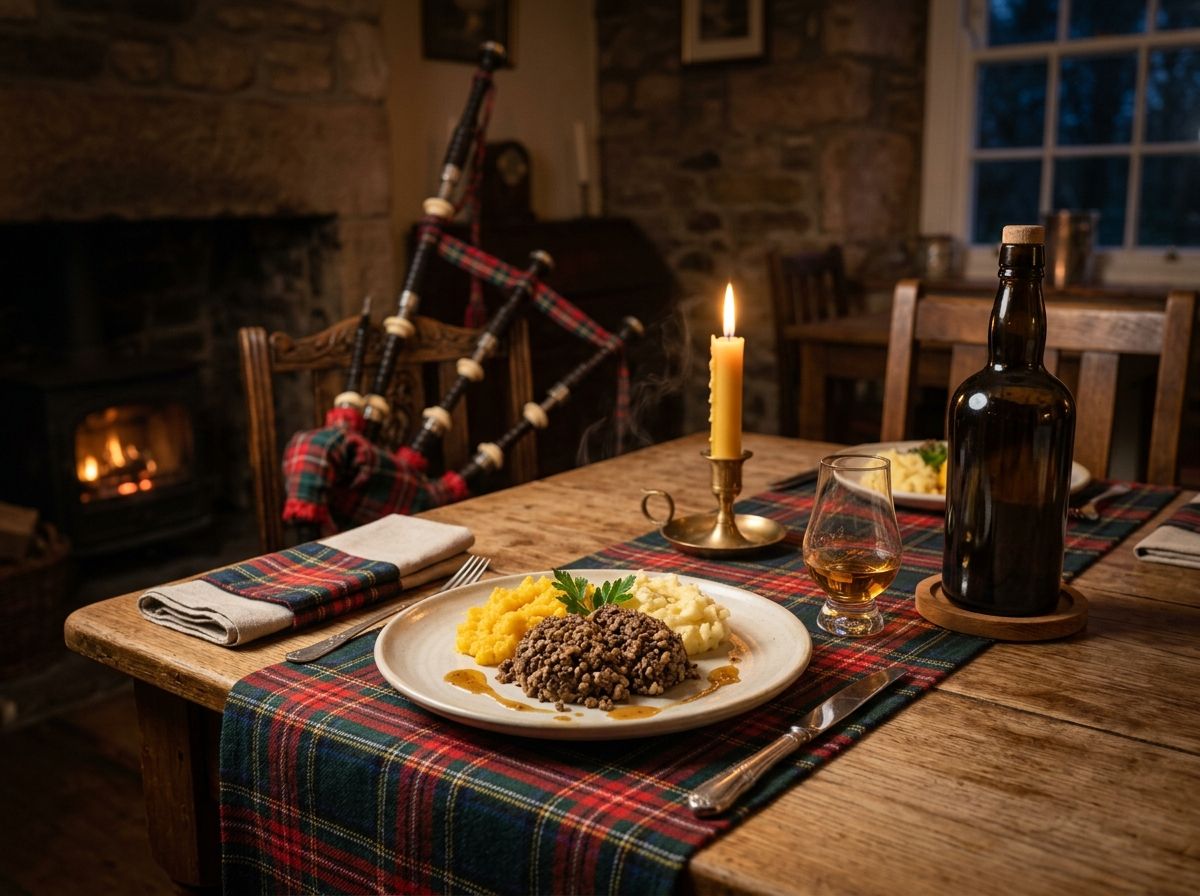
Haggis sits at the centre of every Burns supper. It’s a savoury pudding of oats, onion, spices and offal (usually lamb), traditionally served with neeps (mashed swede or turnip) and tatties (mashed potato), sometimes finished with a whisky cream sauce.
Prices for a shop-bought haggis are modest. A standard 400g to 454g pack from brands like Macsween or Simon Howie runs from around £2 to £5 in UK supermarkets, according to price comparison data from Trolley.co.uk, while Macsween’s own vegetarian version, made from oats, pulses and vegetables, costs a similar amount and has been Vegetarian Society approved since 1984.
To drink, Scotch whisky is the obvious choice, poured for toasts throughout the evening. Hosts commonly budget around one bottle for every six to eight guests, leaving room for anyone who’d rather toast with something else. Non-alcoholic options work perfectly well too; the toasting is the point, not the drink itself.
How to Host Your Own Burns Night
You don’t need a hall full of bagpipers to mark Burns Night properly.
- Decide how formal you want it. A living-room supper for four friends can skip the speeches entirely and still feel authentic with just the grace, the haggis and a toast
- Order your haggis in advance, since demand spikes hard in the days before 25 January and popular brands can sell out
- Assign roles ahead of time. Ask one guest to say the Selkirk Grace, another to read the Address to a Haggis (ideally with a real knife for the theatrical cut), and someone confident to deliver a short Immortal Memory
- Keep whisky glasses topped up for toasts, but don’t force anyone who’d rather not drink it
- Finish with Auld Lang Syne, sung in a circle with crossed and joined hands, even if nobody remembers all the words past the first verse
What to Wear to Burns Night
There’s no strict dress code, though kilts and tartan are common at formal suppers and community events. Highland dress, black tie or simply smart clothing are all acceptable depending on how formal the occasion is.
For a home gathering among friends, casual dress is perfectly fine. Save the full Highland outfit for a ticketed event or a society dinner where it’s expected.
FAQS
When was Burns Night 2026?
Burns Night 2026 fell on Sunday 25 January 2026, the 267th anniversary of Robert Burns’s birth. Many community suppers were held on the surrounding Friday or Saturday instead, since the actual date landed on a weekend.
When is the next Burns Night?
The next Burns Night falls on Monday 25 January 2027. The date is fixed to Robert Burns’s birthday and doesn’t move, regardless of which day of the week it lands on.
Is Burns Night a public holiday?
No, Burns Night isn’t a bank or public holiday anywhere in the UK. Schools, banks and most workplaces stay open as normal, with celebrations taking place in the evening.
What do you eat on Burns Night?
The centrepiece is haggis, served with neeps (mashed swede or turnip) and tatties (mashed potato), often preceded by a soup starter like cock-a-leekie or Cullen skink. Dessert is commonly cranachan, a mix of whipped cream, whisky, honey and toasted oats with raspberries.
What is the Address to a Haggis?
It’s a poem Robert Burns wrote in 1786 in praise of haggis, traditionally recited over the dish before it’s ceremonially cut open at the start of the meal. It’s one of the fixed elements of a formal Burns supper, alongside the Selkirk Grace and Auld Lang Syne.
Do you need to be Scottish to celebrate Burns Night?
No, Burns Night is celebrated well beyond Scotland, including across the rest of the UK, the US, Canada and Australia, wherever there are Scottish societies or simply people keen to mark the occasion. Anyone can host or attend a supper regardless of heritage.
What is the Selkirk Grace?
It’s a short grace recited before the meal at a Burns supper, thanking those present for having food to eat. Despite the association with Burns’s name, he didn’t write it; it’s an older Scottish grace that predates him.