Testing a smoke detector takes about 10 seconds: press and hold the test button on the front of the unit until the alarm sounds, then let go. If it sounds a loud, steady tone for a few seconds, it’s working. If nothing happens, or the sound is weak, you need to check the battery or replace the unit before you rely on it again.
London Fire Brigade recommends testing every smoke alarm in your home once a week, and it’s one of the simplest habits that genuinely saves lives. This guide covers how to test smoke detectors properly, how to test a smoke alarm that’s interlinked with others, how to check the battery specifically, and what UK law says landlords must do about it.
How to Test Smoke Detectors: Step by Step
1. Tell everyone in the house first
A full-volume alarm test can be startling, especially for children, pets, or anyone asleep. A quick heads-up avoids unnecessary panic and stops someone assuming there’s a real fire.
2. Find the test button
Every domestic smoke detector has a single button on the front or side, usually marked “test” or shown with a bell icon. On most models, it’s the same button you’d press to hush a false alarm.
3. Press and hold for a few seconds
Hold the button down until the alarm sounds, then release it. A working alarm gives a loud, continuous tone that lasts around 10 to 20 seconds once you let go, according to guidance from several London councils including Enfield and Southwark.
4. Check every alarm in the house, not just one
If your alarms are interlinked (common in newer builds and required in Scotland and Wales), testing one should trigger all the others in the property at the same time. Walk through the house to confirm each unit actually sounds, since a faulty link can mean one alarm stays silent while the rest fire.
5. Reach it safely
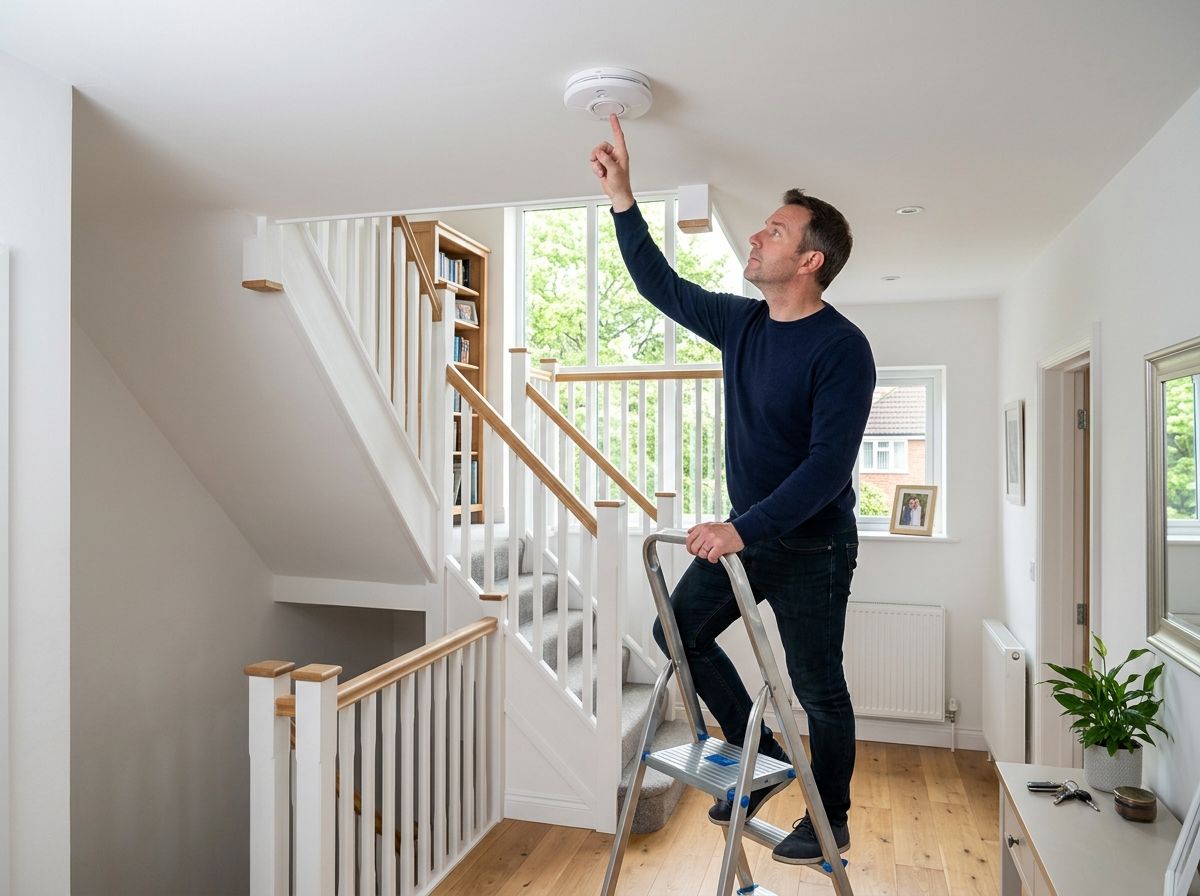
Most smoke detectors are ceiling-mounted, so you’ll need a secure step stool to reach the test button comfortably. Never stretch or balance on furniture to reach one, and if a ceiling alarm is genuinely awkward to reach, some models come with a test pole or remote test function you can buy separately for around £10 to £15.
How to Test a Smoke Alarm With Real Smoke
The test button confirms the electronics, horn, and battery are working, but it doesn’t prove the sensor itself can actually detect smoke. For a more thorough check, you can hold a just-extinguished match or a purpose-made smoke test aerosol a short distance from the detector and see if it triggers the alarm.
This isn’t something you need to do weekly. Once or twice a year is plenty, and it’s worth doing straight after cleaning the unit, since a genuine smoke test also confirms the sensor chamber hasn’t been clogged by the cleaning process itself.
How to Test Smoke Detector Battery Specifically
If the test button doesn’t produce a sound, or the tone is weak and fading, the battery is the most likely cause. Here’s how to isolate that:
- Listen for chirping first. A single, intermittent chirp every 30 to 60 seconds (not a full alarm) is the standard low-battery warning on almost every model sold in the UK.
- Replace with the exact battery type specified, usually a 9V PP3 or two AA batteries depending on the model. Using the wrong type or a weaker rechargeable battery can cause the alarm to under-perform.
- Test again immediately after replacing the battery. If the alarm still doesn’t sound properly, the fault is with the unit itself, not the power source.
- Never remove a battery to silence an alarm and leave it out. This is one of the most common reasons smoke alarms fail to work when they’re actually needed, according to fire safety guidance repeated by councils across the UK.
- For sealed 10-year alarms, there’s no separate battery to change. If the test button fails on one of these, the whole unit needs replacing.
How Often Should You Test a Smoke Detector?
Test weekly, using the button. This is the consistent advice from London Fire Brigade and multiple London borough councils, including Camden, Enfield, and Southwark, all of which tell residents to test alarms every week as standard practice.
Combine that with a monthly clean, running a vacuum nozzle gently over the unit to remove dust and cobwebs that can interfere with the sensor. A full smoke test with a real source is only needed once or twice a year, and the entire unit should be replaced every 10 years regardless of how well it’s performing, since the sensor inside degrades even if the alarm still sounds during a test.
What UK Law Says About Smoke Alarms in Rented Homes
If you’re a tenant, your landlord has clear legal duties here, and it’s worth knowing them even if you never need to enforce them.
Under the Smoke and Carbon Monoxide Alarm (England) Regulations 2015, as amended in 2022, private and social landlords in England must provide at least one smoke alarm on every storey of the property used as living accommodation, and check it’s in working order at the start of every new tenancy. Wales has gone further: since December 2023, landlords there must fit mains-powered, interlinked smoke alarms on every storey. Scotland’s rules, introduced across all homes regardless of tenure, are the strictest in the UK and also require interlinked alarms throughout.
If a landlord fails to comply in England, the local authority can serve a remedial notice giving 28 days to fix it, and can carry out the work themselves and bill the landlord if it’s ignored, alongside a civil penalty of up to £5,000. As a tenant, you’re still expected to test the alarms weekly yourself in between the landlord’s checks, since a working alarm on paper is no use if nobody’s checking it’s still working in practice.
Common Mistakes to Avoid
- Testing only one alarm and assuming the rest of an interlinked system works too
- Painting over a smoke detector during redecorating, which can block the sensor completely
- Fitting an alarm in the kitchen or bathroom, where steam and cooking fumes cause frequent false alarms and encourage people to disable them
- Ignoring a chirping alarm for weeks because it’s not the full siren
- Forgetting to test after any DIY work, since dust from drilling or sanding is a common cause of a detector failing silently
FAQS
How do you test a smoke detector?
Press and hold the test button on the front of the unit for a few seconds until the alarm sounds, then release it. A working detector gives a loud, steady tone for around 10 to 20 seconds, and you should do this for every alarm in the house, not just one.
How often should you test a smoke alarm?
Test every smoke alarm weekly using the test button, which is the standard advice from London Fire Brigade and councils across the UK. Combine this with a monthly clean and a full replacement of the unit every 10 years.
Why is my smoke alarm chirping instead of sounding a full alarm?
A single chirp every 30 to 60 seconds is the standard low-battery warning, not a fault with the alarm itself. Replace the battery with the correct type straight away and test the unit again to confirm it’s working properly.
Can I test a smoke alarm with real smoke?
Yes, holding a just-extinguished match or a smoke test aerosol near the sensor checks that it can genuinely detect smoke, not just that the electronics and horn work. This is worth doing once or twice a year rather than every week.
How do you test an interlinked smoke alarm system?
Press the test button on any one alarm and check that every other linked alarm in the property also sounds. If one stays silent while the rest trigger, that unit or its interconnection has a fault and needs checking separately.
Do landlords have to test smoke alarms in the UK?
Yes, landlords in England must ensure smoke alarms are working at the start of every new tenancy under the Smoke and Carbon Monoxide Alarm Regulations, and failure to comply can lead to a civil penalty of up to £5,000. Tenants are still expected to test the alarms weekly themselves between landlord checks.
How long do smoke detectors last before they need replacing?
Most smoke detectors need replacing after 10 years, regardless of whether they still pass a test, since the internal sensor degrades over time. The manufacture date is usually printed inside the unit or on the back of the casing.
What’s the difference between testing the alarm and testing the battery?
Pressing the test button checks the horn, circuitry, and battery all at once, so a successful test usually confirms the battery is fine too. A separate, dedicated battery check is only needed if the test produces a weak sound or the unit is chirping intermittently between full tests.
Should smoke alarms be fitted in the kitchen or bathroom?
No, smoke alarms shouldn’t go in kitchens or bathrooms, since steam and cooking fumes trigger frequent false alarms. Fit a heat alarm in the kitchen instead, and keep smoke alarms in hallways, landings, and living areas.