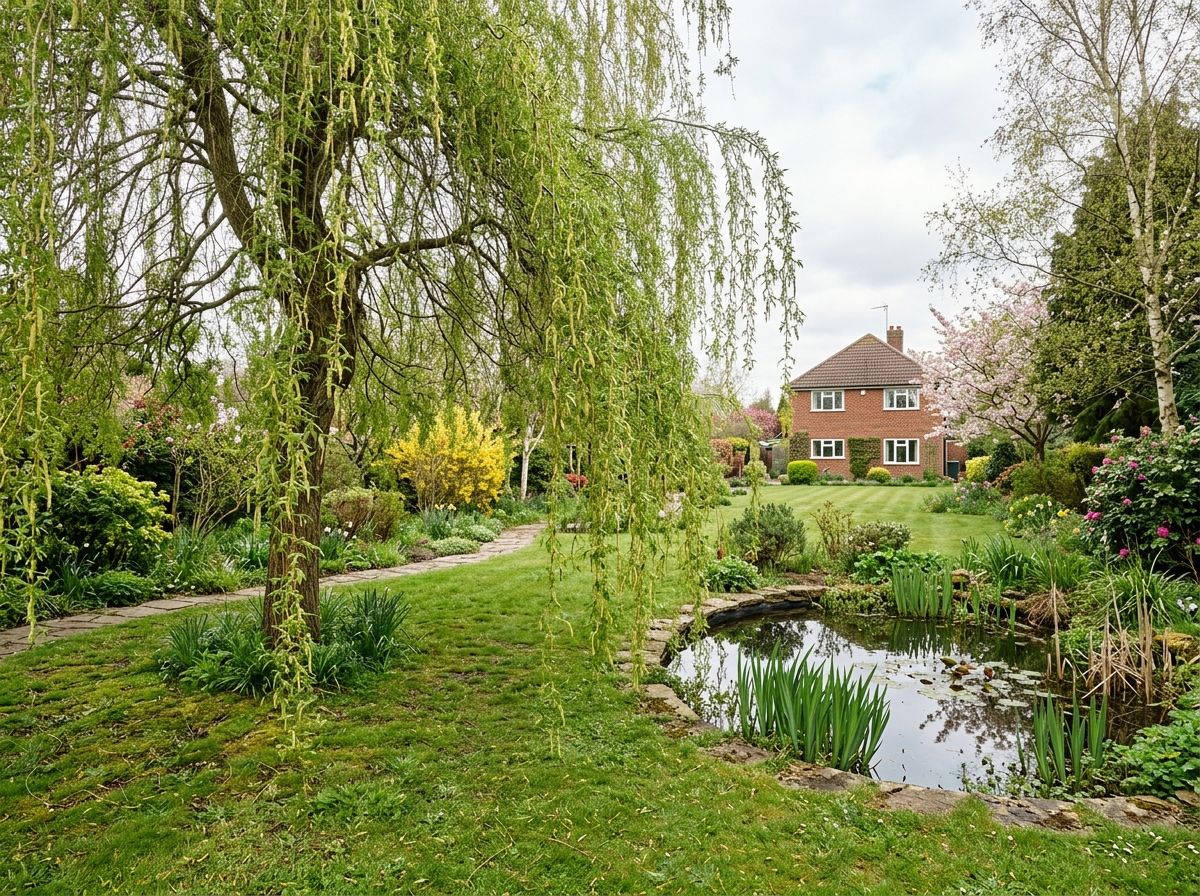
Thinking about planting a willow tree, or trying to work out if the one in your garden is a problem? A willow tree (genus Salix) is a fast-growing, moisture-loving tree with more than 400 species, ranging from towering weeping willows to compact patio varieties like ‘Kilmarnock’. In the UK, willows are prized for early spring catkins, quick screening and their graceful shape, but they also have the most demanding root systems of any common garden tree, so where you put one matters as much as which one you pick.
This guide covers the whole picture: choosing a variety, planting it correctly, keeping it healthy, and the root and legal questions that catch most UK homeowners out.
What Is a Willow Tree?
A willow tree belongs to the genus Salix, according to the Royal Horticultural Society (RHS), which lists around 350 to 400 species and cultivars worldwide. They’re deciduous, meaning they lose their leaves each autumn, and most are native to damp ground near rivers, ponds and wetlands.
Willows are usually among the first trees to leaf up in early spring, with soft green or silvery foliage and fluffy catkins that are an important early food source for bees. If you want to see the full range in one place, the UK National Willow Collection at Rothamsted Research in Harpenden, Hertfordshire, holds specimens from ornamental trees to basket-weaving cultivars.
Types of Willow Tree for UK Gardens
Not every willow tree grows into a 50-foot giant. Here are the varieties UK gardeners ask about most.
- Weeping willow (Salix babylonica and Salix x sepulcralis ‘Chrysocoma’): the classic cascading tree, reaching 12 to 15 metres. Best suited to large gardens near water.
- Kilmarnock willow (Salix caprea ‘Pendula’): a dwarf, weeping tree that tops out around 2 metres, perfect for small gardens or large pots.
- Corkscrew willow (Salix matsudana ‘Tortuosa’): grown for its twisted branches, which stand out in winter once the leaves drop.
- Goat willow / pussy willow (Salix caprea): a native UK species valued for its soft grey catkins in late winter.
- Coloured-stem willows: grown as shrubs and cut back hard each spring for bright red, orange or yellow winter stems.
How to Plant a Willow Tree
Willows are usually sold as bare-root plants (typically November to March) or in containers (available all year), according to the RHS growing guide.
- Choose the right spot. Full sun, deep, moist, fertile soil. Avoid shallow chalk. Keep well away from buildings, drains and driveways (see the root safety section below).
- Dig a hole twice as wide as the rootball and to the same depth, so the tree sits at its original planting depth.
- Loosen the surrounding soil and mix in well-rotted compost or manure if your soil is poor.
- Backfill and firm gently, then stake young trees to keep them stable while roots establish.
- Water thoroughly straight after planting, then regularly through the first two or three summers, especially in dry spells.
- Mulch in fine autumn or winter, keeping it a few centimetres clear of the trunk to hold moisture and suppress weeds.
Willow Tree Care Through the Year
Once established, most willows are low-maintenance. A few habits keep them healthy.
Watering matters most in the first two to three years. Check the soil at around 15cm (6in) deep; if it’s dry, water deeply rather than little and often. Mature willows in reasonably moist ground rarely need extra watering except during prolonged drought.
Pruning depends on the type. Many mature standard willows fall into RHS Pruning Group 1 and need very little cutting back, just removing dead, damaged or crossing branches in late autumn or winter. Coloured-stem shrub willows are the exception: cut them back hard (almost to the base) each spring to encourage vivid new growth. Large, mature willows are best pruned by a qualified tree surgeon, since older branches can snap unexpectedly.
Willow trees aren’t fussy about fertiliser and generally need little or none in reasonable soil.
Willow Tree Roots and Subsidence: What UK Homeowners Need to Know
This is the question that brings most people to this page, and it’s worth taking seriously. Willow trees have a reputation as one of the worst species for subsidence risk on clay soils, largely because they draw huge amounts of water from the ground. A mature specimen can pull anywhere from 50 to 100 gallons of water a day from the surrounding soil.
The problem isn’t usually the roots physically cracking a foundation. It’s that thirsty roots dry out clay soil, which shrinks, and the ground beneath the foundation moves unevenly. This is more common in southern and eastern England, where clay subsoils are widespread.
Recommended safe planting distances vary by source, soil type and tree size, but figures commonly cited by UK insurers and arborists range from around 18 metres for a young or well-managed willow up to 40 metres for a large, mature specimen on shrinkable clay. As a rule of thumb, don’t plant a willow anywhere near a house, boundary wall, drain or driveway if your soil is clay-based.
If you already have a willow tree near your property:
- Don’t remove it suddenly if it’s mature and long-established. This can cause “heave”, where dried-out soil swells back up and causes a different kind of damage.
- Ask your insurer whether your policy covers subsidence and whether you need to declare the tree.
- Get a qualified arborist to assess crown reduction or pollarding, which reduces the tree’s water demand without removing it outright.
- Watch for diagonal cracking, sticking doors or windows, and get a structural survey if you’re concerned.
Do You Need Permission to Prune or Remove a Willow Tree?
Sometimes, yes. Under UK planning law, a tree protected by a Tree Preservation Order (TPO) or growing within a conservation area generally cannot be pruned, topped, lopped or felled without written consent from the local planning authority, according to GOV.UK. Cutting roots on a protected tree counts too.
Willow trees themselves aren’t automatically protected just because of the species, and many local authorities allow removal of self-seeded or fast-growing species like willow, sycamore and poplar without permission if no TPO applies. But you should always check with your local council first, since rules and exemptions vary between authorities. You can apply for consent to work on a protected tree directly via the GOV.UK “works to trees” application.
How Much Does a Willow Tree Cost in the UK?
Prices vary by size, variety and supplier, and change fairly often, so treat these as a guide rather than a guarantee.
- Kilmarnock willow (dwarf, potted): around £30 to £35
- Golden weeping willow (bare root, 1.2 to 1.5m): around £35 to £45
- Standard weeping willow (larger container-grown specimen): from around £50 up to several hundred pounds for a semi-mature tree
- Large, pre-grown specimen trees: can run into four figures at specialist tree nurseries
Prices change often, so check current listings on sites such as Crocus, Notcutts or a specialist tree nursery before you buy.
Common Problems and Diseases
Willows are generally tough, but a few issues crop up regularly in UK gardens. Watch for willow anthracnose and willow scab, both fungal diseases that cause leaf spotting and dieback in wet springs. Brittle branches can snap in strong wind, particularly on mature weeping varieties, so keep an eye on dead wood after storms. Leaf shedding in a dry June is common and usually not fatal; keep the soil moist and the tree should recover.
FAQs
What is a willow tree?
A willow tree is any tree or shrub in the genus Salix, a group of around 350 to 400 species found mostly in cool, temperate parts of the Northern Hemisphere. They’re deciduous, fast-growing, and prefer moist soil, which is why they’re so common along UK riverbanks and pond edges.
How fast do willow trees grow?
Very fast by tree standards. A weeping willow can put on 2 to 4 feet of growth a year once established, according to UK and US nursery data, reaching a substantial size within a decade. This speed is part of the appeal for quick screening, but it also means they outgrow small gardens fast.
How big do willow trees get in the UK?
It depends entirely on the variety. A standard weeping willow can reach 12 to 15 metres, while a dwarf Kilmarnock willow stays around 2 metres. Always check the mature height and spread before buying, since willows are rarely suited to small plots.
Are willow tree roots dangerous to house foundations?
They can be, particularly on shrinkable clay soils common across southern and eastern England. Willow roots draw large amounts of water from the ground, which can dry out clay and lead to subsidence. The risk is lower on sandy or well-drained soils.
How far should a willow tree be planted from a house?
Most UK sources recommend a minimum of 18 to 40 metres on clay soil, depending on the tree’s eventual size and the soil type. On non-clay soil the safe distance is usually much shorter, but it’s worth getting site-specific advice from an arborist if you’re unsure.
When is the best time to plant a willow tree?
Bare-root willows are best planted between November and March while dormant. Container-grown willows can go in the ground at any time of year, though autumn and winter still give the roots the easiest start before summer heat arrives.
Do I need permission to cut down a willow tree?
Only if it’s protected by a Tree Preservation Order or sits within a conservation area. In that case you’ll need written consent from your local planning authority before pruning or felling. Unprotected willows on private land can usually be worked on freely, but always check with your council first.
How much does a willow tree cost in the UK?
Small dwarf varieties like Kilmarnock willow start at around £30, while a larger weeping willow typically costs £40 to £100 depending on size and supplier. Semi-mature or specimen trees from specialist nurseries can cost several hundred pounds or more.
Are willow trees toxic to pets?
No, willow trees are not considered toxic to pets or humans, though eating any part of the plant in quantity may cause mild stomach upset, according to gardening advice from the RHS and Garden Design. As with most garden plants, it’s sensible to discourage pets from chewing on leaves or bark regardless.
Can I grow a willow tree in a pot?
Yes, if you choose a compact variety like Kilmarnock willow, which copes well in a large container. Standard weeping willows need far too much root space and water for pot culture and should always go straight into the ground.